
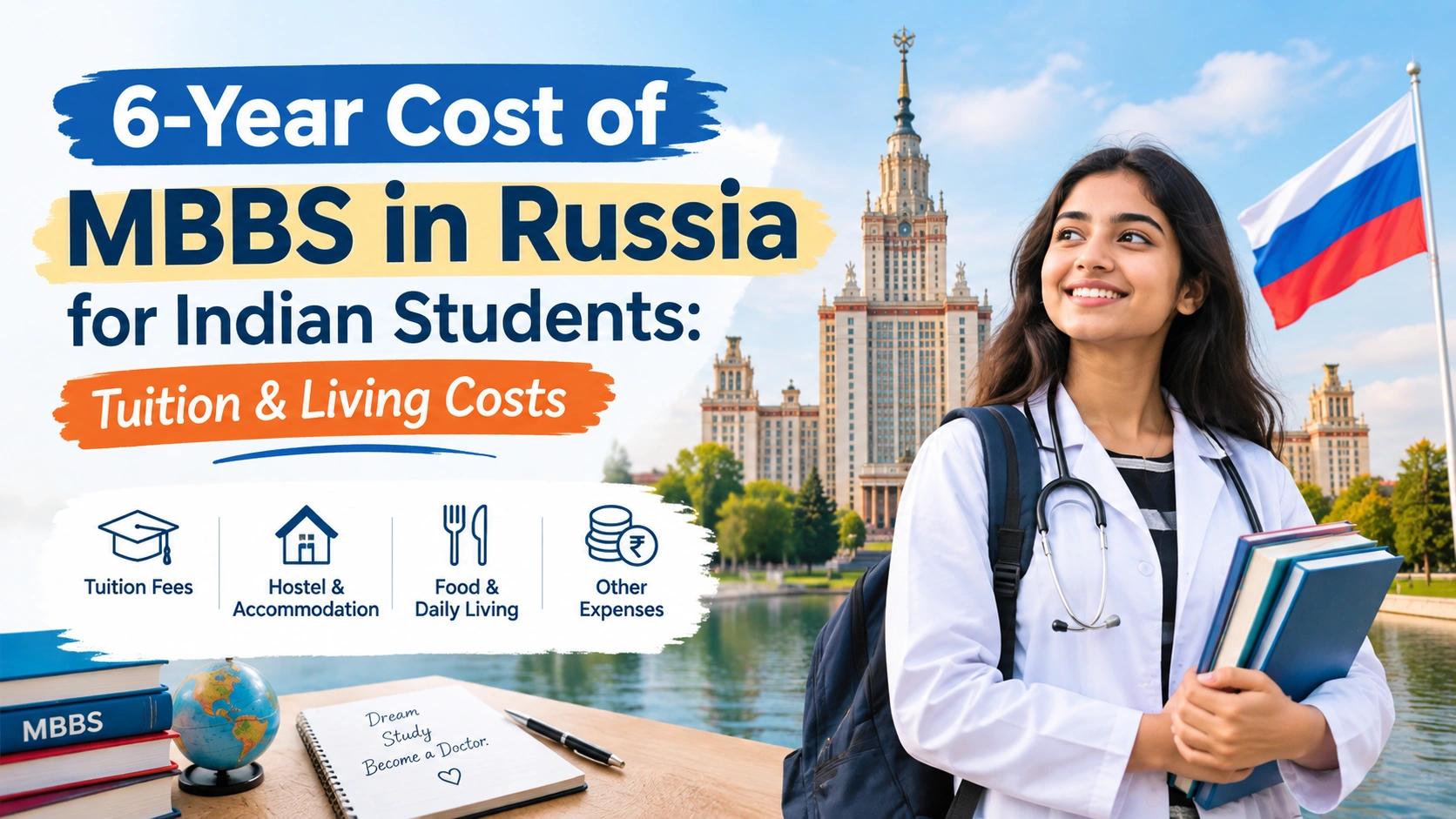
Planning to study medicine abroad is exciting until the family starts doing the actual maths. Tuition. Hostel. Food. Flights. Visa. Insurance. Then someone mentions currency exchange rates, and suddenly the original budget doesn't look so simple. For Indian students considering MBBS in Russia, the biggest advantage is that Russia offers medical programmes across a wide range of universities and cities, so the total six-year expense can vary quite a lot. A practical estimate for the complete six-year budget can sit around ₹20 lakh to ₹45 lakh, while premium universities in expensive cities can push the figure higher. The number you should focus on isn't just the tuition fee advertised for Year 1. You need to calculate what you'll actually spend across six years. That's where this guide helps.
What Is the Total Cost of MBBS in Russia for 6 Years?
A six-year medical programme is the standard duration for many Russian medical schools. The World Directory of Medical Schools lists several Russian programmes with a six-year curriculum, including programmes taught in Russian and English. For an Indian student, a sensible planning figure is ₹3 lakh–₹7.5 lakh per year for tuition, depending on the university, plus hostel, food, insurance, travel and personal expenses. At the lower-cost end, a student may complete the entire six-year course within roughly ₹20–25 lakh if tuition and living expenses remain moderate. At a university with higher tuition and a more expensive city, the same degree may cost ₹35–45 lakh or more. So, don't let a website quoting “₹15 lakh total” or “₹50 lakh total” decide your budget immediately. Check what has actually been included.
|
Expense |
Approx. Annual Cost |
Approx. 6-Year Cost |
|
Tuition fee |
₹2.3–₹7.5 lakh |
₹14–₹45 lakh |
|
Hostel |
₹30,000–₹1.2 lakh |
₹1.8–₹7.2 lakh |
|
Food |
₹8,000–₹20,000/month |
₹5.8–₹14.4 lakh |
|
Medical insurance |
₹10,000–₹30,000/year |
₹60,000–₹1.8 lakh |
|
Visa & registration |
₹10,000–₹30,000/year* |
₹60,000–₹1.8 lakh* |
|
Personal/transport expenses |
₹3,000–₹10,000/month |
₹2.2–₹7.2 lakh |
|
Flights & travel |
Variable |
₹1–₹3 lakh+ |
|
Possible overall budget |
— |
₹20–₹45 lakh+ |
|
*Costs vary by university, city, exchange rate and individual circumstances. These are planning ranges, not fixed university charges. |
How Much Is the Tuition Fee for MBBS in Russia?
Tuition is usually the largest part of the budget, but there's no single Russian MBBS fee. Public medical universities can be relatively affordable, while well-known universities in Moscow or other major cities can charge substantially more. For example, Rostov State Medical University lists a 2026–27 first-year fee of 257,900 Russian rubles for General Medicine and 373,900 rubles for its English-medium General Medicine programme. At the other end of the range, Sechenov University lists 1.3 million rubles for General Medicine for 2026/27, showing just how wide the fee gap can be between Russian universities. These examples are useful because they show why quoting one “average” figure can be misleading. The course language, university reputation, city and programme structure all affect the bill. Fees can also change from one academic year to the next, so students shouldn't assume that the Year 1 fee will remain exactly the same until graduation.
A Practical Tuition Budget
For initial planning, many Indian families can use ₹3–₹5 lakh per year as a working tuition range for moderately priced universities, while keeping a higher buffer for universities charging ₹5–₹8 lakh or more annually. Some published 2026 estimates place Russian medical tuition between approximately ₹2.3 lakh and ₹7.5 lakh per year, although actual university charges differ. A six-year calculation at ₹4 lakh per year gives ₹24 lakh. At ₹5 lakh, it becomes ₹30 lakh. That's before you add accommodation and daily expenses. Small difference annually. Big difference after six years.
University-Wise Cost Can Look Very Different
Which university you choose may have more impact on your final budget than students initially expect. Current published comparisons show examples ranging from roughly ₹17–20 lakh for lower-cost options to ₹33–40 lakh for more expensive universities when tuition and accommodation are considered, although these figures are estimates and can change.
|
University/Example |
Approx. Tuition Position |
Approx. 6-Year Budget* |
|
Syktyvkar State University |
Lower range |
₹17–20 lakh |
|
Ulyanovsk State University |
Moderate |
₹22–26 lakh |
|
Kursk State Medical University |
Moderate |
₹23–28 lakh |
|
Stavropol State Medical University |
Moderate-high |
₹26–30 lakh |
|
North-Western State Medical University |
Higher |
₹33–40 lakh |
|
*Indicative published estimates; verify current university fees before admission. These figures shouldn't be treated as guaranteed six-year prices. |
||
|
The interesting part? A university with a slightly higher tuition fee isn't automatically a bad financial decision. A cheaper city can offset some of the difference through lower accommodation and food expenses. The reverse is also true. Saving ₹1 lakh in tuition doesn't help much if the student spends considerably more every month on private accommodation and city travel. |
Hostel and Accommodation Costs
Accommodation is often underestimated because students focus so heavily on tuition. University hostels are generally the first option worth checking. Depending on the university and city, hostel charges can range from around ₹30,000 to ₹1.2 lakh per year, although individual universities may charge outside this range. Some universities have inexpensive student dormitories, while accommodation in major cities can be much more expensive. Private apartments are another option, but they can significantly increase the monthly budget, especially if the student lives alone. Sharing a flat with two or three students can bring the cost down. That's a very common practical choice.
Is a University Hostel Better Than a Private Flat?
For the first year, usually yes from a budgeting perspective. A hostel gives students a clearer idea of the city, transport system and everyday expenses before they commit to private housing. It also reduces the number of bills the family needs to worry about. Later, students may prefer shared apartments for privacy or convenience. Either way, ask the university for the latest hostel fee rather than relying on an agent's old quotation.
Food and Monthly Living Expenses in Russia
Food is where individual spending habits start showing. A student who cooks regularly can spend much less than someone eating outside several times a week. Indian students may also spend extra on spices, familiar groceries and occasional Indian restaurant meals. A reasonable starting budget for food and daily living can be around ₹8,000–₹20,000 per month, depending heavily on the city and lifestyle. Some published 2026 estimates place the overall student living expense in a similar broad range, with major-city costs naturally tending to be higher. If you cook in the hostel or shared apartment, buy groceries in bulk and use student transport, the monthly budget can remain manageable. If you order food frequently, use taxis regularly and travel around Russia during holidays, it won't. Simple.
City Makes a Difference to Your Six-Year Budget
Moscow and other large metropolitan areas generally require a larger living budget than smaller student cities. Rent, transport, eating out and entertainment can all add up. A student studying in a smaller city may spend less even if the tuition fee isn't dramatically different. This is one reason the cost of MBBS in Russia for Indian students shouldn't be compared using tuition alone. Imagine two universities. University A costs ₹50,000 more per year in tuition but is located in a cheaper city. University B looks cheaper initially but requires expensive private accommodation. After six years, University A could actually work out cheaper.
Other Costs Indian Students Need to Budget For
Tuition and hostel aren't the whole story. Several smaller expenses appear throughout the six years, and individually they don't look frightening. Together, they matter.
- Medical insurance: roughly ₹10,000–₹30,000 per year, depending on policy and university requirements.
- Visa and registration expenses: budget for recurring charges and changes in fees.
- Air tickets: usually higher around Indian holiday periods, so don't assume every return ticket will cost the same.
- Local transport: metro, buses, taxis or student travel passes.
- SIM/mobile data: a small monthly expense, but unavoidable.
- Study materials: textbooks, stationery, lab-related requirements and printing.
- Winter clothing: particularly relevant for students moving from warmer parts of India.
- Emergency expenses: medicines, unexpected travel and urgent purchases.
Honestly, the winter clothing point gets ignored a lot. Russia isn't just “cold.” Some cities can be extremely cold during winter, and a student arriving with a couple of light jackets from India may quickly discover that the budget needs another line.
Does the Six-Year Course Include Internship?
This needs careful checking before admission because course structure and clinical training arrangements vary between universities and programmes. Many Russian medical programmes are six years in duration, as shown in WDOMS listings, but the exact clinical training and graduation requirements should be confirmed with the university. For an Indian student, the bigger question isn't simply “Is the course six years?” It's whether the programme and the student's overall training meet the requirements applicable to foreign medical graduates in India. NMC regulations should be checked before paying an admission fee.
NEET Requirement for Indian Students
Indian students planning to pursue medicine abroad should qualify in NEET-UG according to the eligibility requirements applicable to foreign medical education. The official NEET portal is the right place to check the current examination information, dates and notices rather than relying on old admission articles. NEET is not something to treat as an optional detail just because the university is outside India. If your long-term plan is to return to India and practise medicine, your foreign medical education needs to be considered alongside Indian regulatory requirements from the beginning.
Eligibility for MBBS in Russia
Most universities generally require completion of secondary education with the required science subjects. Indian applicants commonly need Physics, Chemistry and Biology/Biotechnology along with English at the qualifying level prescribed for medical admission, plus the applicable NEET requirement. However, admission rules can differ by university. Some Russian institutions may also conduct entrance examinations. For example, Rostov State Medical University states that its 2026 admission process for foreign applicants includes subject examinations depending on the programme and language of instruction. Before choosing a university, check the official admission page for the exact academic requirements, document format, language requirements and entrance-test rules.
Is English-Medium MBBS Available in Russia?
Yes, but don't assume every university offers the entire medical programme in English. WDOMS listings show Russian universities with different language combinations, including Russian, English and other languages. Some universities have English-medium tracks, while others may use Russian more heavily, especially during clinical training. That distinction matters. A student may manage classroom theory in English but still need Russian to communicate effectively with patients and hospital staff. Some universities also provide Russian-language preparatory courses for international students. Sechenov University, for instance, offers preparatory training aimed at international applicants and specifically includes Russian language preparation.
Recognition: What Should Indian Students Check?
This is probably the section parents should read twice. Don't select a medical university just because an advertisement says “WHO approved” or “NMC approved.” Check the current status yourself. WDOMS can be used to verify whether a medical school is listed, but WDOMS itself clearly states that listing does not automatically mean recognition, accreditation or endorsement. For an Indian student, NMC requirements are particularly important because the ultimate goal may be medical registration and practice in India. The NMC maintains regulations covering foreign medical graduates, including the Foreign Medical Graduate Licentiate Regulations. So before paying a large advance, check the university, programme, course duration, medium of instruction, clinical training and other requirements against the latest NMC rules.
FMGE and NExT: Why This Matters Before Admission
The licensing system for foreign medical graduates is an area students should follow closely because Indian regulations can change. NMC currently publishes regulations and FAQs relating to foreign medical graduates and licensing requirements. Don't choose a Russian university based only on someone else's FMGE result or an old “pass percentage” chart. Your eligibility to practise in India depends on meeting the applicable regulatory requirements, not on a university brochure promising an easy return to India. This is also why checking NMC information before admission is far better than discovering regulatory issues in the final year.
Admission Process for MBBS in Russia
The application process generally begins with shortlisting universities, checking eligibility and preparing academic documents. After that, students submit an application to the university or through the permitted admission channel, receive an admission or invitation document where applicable, complete visa formalities and travel to Russia for enrolment.
- Shortlist universities based on current NMC requirements and university status.
- Check tuition, hostel fees and course language.
- Prepare passport, academic certificates, photographs and other required documents.
- Submit the application.
- Complete any university entrance examination if applicable.
- Receive the admission confirmation/invitation according to the university's process.
- Apply for the appropriate Russian student visa.
- Travel and complete university registration.
- Pay the required fees according to the university contract.
- Begin the medical programme and maintain documentation throughout the course.
Admission calendars vary, but international applications often begin several months before the academic session. Don't wait until the last minute. Visa processing and document preparation can take time, and university deadlines aren't identical.
A Sample Six-Year Budget
Let's take a middle-of-the-road example rather than using the cheapest possible university. Suppose tuition averages ₹4.25 lakh per year, hostel costs ₹60,000 per year, and food plus everyday expenses average ₹12,000 per month. Tuition over six years: ₹25.5 lakh. Hostel: ₹3.6 lakh. Food and daily living: ₹8.64 lakh. Add approximately ₹1.5–₹2.5 lakh for insurance, visa, travel and miscellaneous expenses, and the overall figure comes to roughly ₹39–₹40 lakh. Now compare that with a university where tuition averages ₹3 lakh per year and the student lives in a lower-cost city. The six-year total can drop substantially. This is why one family's Russian budget may be ₹24 lakh while another's is ₹40 lakh. Both can be realistic.
How to Reduce the Overall Cost
There are several sensible ways to keep the six-year expense under control without compromising on the basics.
- Prefer university hostel accommodation where practical.
- Compare the complete six-year cost, not only first-year tuition.
- Choose a city where everyday expenses fit the family budget.
- Cook regularly instead of relying heavily on restaurants.
- Use student/public transport.
- Share accommodation if university rules permit it.
- Keep a separate emergency fund.
- Compare currency conversion charges before transferring fees.
- Ask for the complete fee schedule in writing.
- Confirm whether tuition increases annually.
A lower fee isn't always the best deal, but an unexplained fee is definitely a warning sign. Ask questions before signing.
Hidden Costs That Can Change Your Budget
One of the biggest mistakes families make is preparing a budget that contains only tuition and hostel. What about annual fee increases? What about the flight home? What if the student needs to change accommodation? What if the university requires additional insurance or registration payments? What if currency exchange rates move sharply? These aren't reasons to avoid MBBS in Russia. They're reasons to keep a financial buffer. I'd suggest keeping at least 10–15% above your estimated total budget where possible. If your calculation says ₹30 lakh, planning around ₹33–35 lakh gives the family breathing room. It doesn't mean you'll spend all of it. That's the point.
Pros and Cons of Studying MBBS in Russia
Russia can make sense for students who want an international medical education and are prepared for the practical realities of studying abroad. There are established medical universities, six-year medical programmes, English-medium options at selected institutions and a wide range of tuition levels. WDOMS records also show many Russian medical schools with long operating histories and programmes admitting international students. But there are downsides. Winter can be difficult for students unfamiliar with extreme cold. Russian language skills can become important during clinical interactions. Currency fluctuations can change the effective cost for Indian families. And the student must stay aware of Indian medical licensing requirements throughout the course.
Advantages
- Wide choice of medical universities and cities.
- Six-year programmes are common.
- English-medium options exist at selected universities.
- Tuition can be lower than many private medical options in India.
- University hostel accommodation can keep costs manageable.
- International student communities are present at many institutions.
Challenges
- Total expenses vary significantly between universities.
- Russian language can matter during clinical exposure.
- Climate can be a major adjustment.
- Currency exchange rates can affect annual payments.
- NMC requirements must be checked carefully.
- Travel between India and Russia adds to the overall budget.
Who Should Consider MBBS in Russia?
A student who has a realistic budget, understands that medicine is a long commitment and is willing to adapt to a new language and climate may find Russia worth considering. It isn't a shortcut. Six years is still six years, and the academic workload doesn't disappear because the university is overseas. Families should also be comfortable checking documents themselves instead of depending entirely on promises made during counselling. If the student's main priority is the lowest possible cost, compare several countries and Indian options first. If the priority is a recognised foreign medical education with a broad university choice, MBBS in Russia deserves a place on the shortlist.
Frequently Asked Questions
1. What is the total cost of MBBS in Russia for Indian students?
A practical six-year estimate can range from around ₹20 lakh to ₹45 lakh or more, depending on tuition, university, city, hostel, food, travel and personal expenses. Lower-cost universities may fall below the middle of this range, while expensive universities and cities can push the budget higher.
2. Is MBBS in Russia six years old?
Many Russian medical programmes leading to the medical qualification commonly take six years. WDOMS listings for Russian medical schools show six-year General Medicine programmes, although students should verify the exact programme structure of their chosen university.
3. Is NEET required for Indian students studying medicine in Russia?
Indian students should meet the applicable NEET requirement for studying medicine abroad. Always check the latest NTA and NMC rules for the admission year rather than relying on old consultancy information.
4. Can I study medicine in English in Russia?
Yes, selected Russian universities offer English-medium medical programmes. However, language arrangements differ between universities, and Russian can become useful or necessary during clinical interactions. Check the exact programme language before admission.
5. Is Russia cheaper than studying MBBS at a private medical college in India?
It can be, but there isn't one universal answer. Russian tuition and living expenses vary widely, while private Indian medical college fees also differ by state and institution. Compare the complete six-year cost rather than comparing tuition alone.
6. How can I verify whether a Russian medical university is suitable for an Indian student?
Start with the university's official website, check its programme details, use WDOMS to verify the school's listing, and review the latest NMC regulations applicable to foreign medical graduates. WDOMS itself warns that being listed does not by itself constitute recognition or endorsement.
Final Cost Checklist Before You Pay
Before making the first payment for MBBS in Russia, put these numbers on one sheet: six-year tuition, annual hostel, monthly food, insurance, visa and registration charges, flight budget, local transport, study materials and an emergency reserve. Then check the university's current fee notice. Not an old PDF. Not a random counselling poster. The current one. Also verify the medical school's status through reliable sources such as WDOMS and review the latest NMC requirements that could affect your return to India.
Conclusion
The six-year cost of MBBS in Russia for Indian students isn't one fixed number. A realistic budget can begin around ₹20–25 lakh for a lower-cost route and rise toward ₹35–45 lakh or more for universities with higher tuition and living expenses. The smartest approach is to calculate the full cost before choosing the university, not after admission. Tuition matters, but so do hostel charges, food, insurance, flights, currency movement and unexpected expenses. Most importantly, don't separate the financial decision from the academic and regulatory one. A university that looks cheap on paper isn't necessarily the right choice if its programme doesn't fit your long-term plans. For current university options, admission guidance and Russia-specific information, students can also review. MBBS In Russia and cross-check every important academic and regulatory detail against official university and NMC sources.