
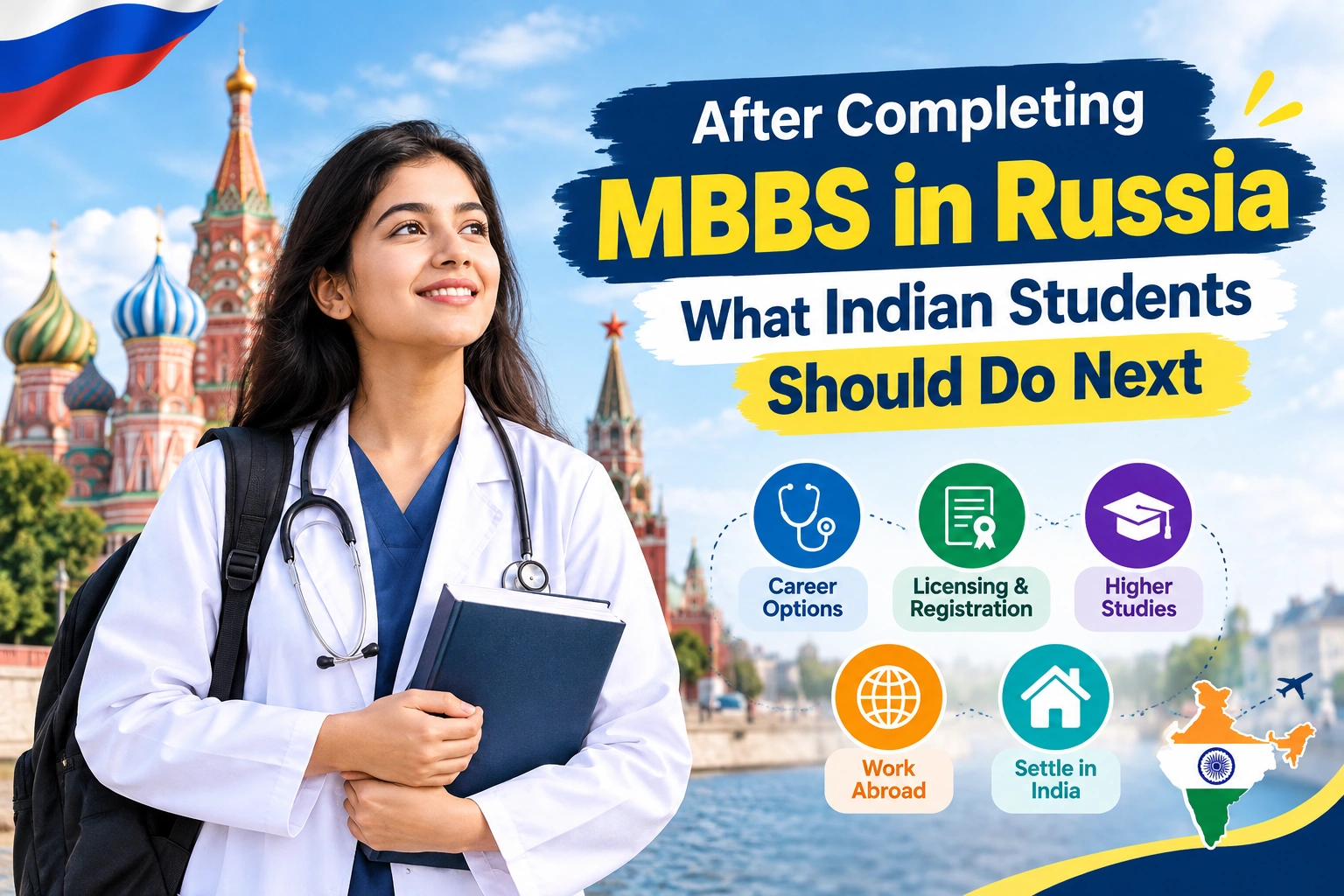
Finishing your medical degree in Russia feels like the end of a long journey. Six years of lectures, hospital postings, exams, Russian winters, homesickness, and clinical training — and suddenly you're holding your medical degree. But for an Indian student, that's actually where another important phase begins. If you completed MBBS in Russia, you can't simply return to India and start practising as a doctor. There are regulatory steps, licensing requirements, internship rules, and qualifying examinations to deal with first. The exact route can also depend on when you joined your course and which regulations apply to your graduation year. So, don't make plans based on an old YouTube video or a friend's experience from five years ago.
What Should You Do Immediately After MBBS in Russia?
The first thing is surprisingly simple: collect and verify your documents. Keep your final medical diploma, academic transcripts, internship or clinical-training records, passport, university documents, registration documents from Russia if applicable, and other supporting certificates safely organised. Your university should also provide the documents required for verification and future registration processes. Don't wait until you're back in India to discover that one certificate has a spelling mismatch or that you need another document from your university. It can become a headache.
For Indian graduates, the National Medical Commission (NMC) rules are the main reference point for understanding the pathway back into medical practice. NMC currently lists the Foreign Medical Graduate Licentiate Regulations 2021 and related FAQs among its regulations, so graduates should check the latest official requirements rather than relying only on consultancy material.
Is NEET Still Relevant After Completing MBBS in Russia?
Yes, but there's a difference between admission eligibility and post-graduation licensing. NEET is relevant to Indian students seeking admission to an undergraduate medical course abroad, while the process after graduation involves separate regulatory requirements.
Before studying abroad, Indian students are required to satisfy the applicable eligibility conditions, including NEET requirements for foreign medical education. The official NEET portal should be checked for the rules applicable to the relevant admission year. After completing the degree, your focus shifts toward medical registration and the examination pathway applicable to foreign medical graduates. This distinction matters. A student sometimes thinks, "I already cleared NEET, so I'm done with Indian exams." Not necessarily. NEET gets you into the medical education pathway; it doesn't automatically give you a licence to practise medicine in India.
FMGE or NExT: What Exam Will You Need?
This is probably the biggest question for Indian students after MBBS in Russia. Historically, foreign medical graduates have had to qualify through the Foreign Medical Graduate Examination (FMGE) route before obtaining registration in India. However, the regulatory framework is moving toward the National Exit Test (NExT), and the applicable examination pathway depends on when NExT becomes operational and the rules applicable to your batch. The NMC's FMGL framework states that foreign medical graduates are required to clear the National Exit Test or another examination mandated by NMC once the relevant system becomes operational. NMC also currently lists the National Exit Test Regulations, 2023, while its website records a 2023 public notice deferring the examination. So don't assume that FMGE and NExT will work exactly the same way for every graduating batch. The practical approach? Check the latest NMC notification close to your graduation and registration stage. That's the version that matters.
Do You Need an Internship in India After MBBS in Russia?
In many cases, yes, an Indian foreign medical graduate may need to complete the required supervised internship in India before obtaining permanent registration, subject to the regulations applicable to that graduate. NMC's published material states that foreign medical graduates who are required to undertake an internship in India must complete it in medical colleges or institutions approved for compulsory rotating medical internship, with allocation handled through the relevant State Medical Council. The FMGL framework also sets requirements around the foreign medical course and internship, including a minimum internship component in the foreign institution. So the timeline can become longer than simply "six years in Russia and immediately start working in India." Plan for the additional registration and internship stage if it applies to you.
Check Your Russian Medical University's Recognition and Records
Before you leave Russia, check your university's current status and keep evidence of the programme you completed. The World Directory of Medical Schools (WDOMS) provides information on medical schools around the world and is one useful source for checking a school's listing. WDOMS describes its directory as a comprehensive source of information on medical schools and their programmes. Don't confuse WDOMS listing with an automatic Indian medical licence. They're not the same thing. Indian registration depends on the requirements of the Indian regulator, while WDOMS is a global directory containing information about medical schools. This is also why students should keep their university records, course details, internship information, and graduation documents intact. A missing paper can cause more trouble than a difficult exam.
How Long Does the Whole Process Take?
There isn't one fixed timeline for every Russian medical graduate. The degree itself is commonly around six years for programmes listed in WDOMS; for example, current Russian medical-school records show six-year Medicine programmes. After that, you may have examination preparation, examination dates, document verification, registration procedures, and potentially an Indian internship.
A realistic planning mindset is better than assuming you'll finish everything within a few months. If you graduate in June, for example, your next major milestone may not happen immediately. Exam schedules and registration procedures can affect the overall timeline. Honestly, this is the part students often underestimate.
What About the Cost After Graduation?
Your major university expenses may be over, but keep some money aside for the transition period. Depending on your situation, you may have expenses related to document attestation, travel, exam preparation, examination fees, accommodation, internship-period living costs, registration, and repeated travel between your home city and training location.
The exact amount can vary significantly. A graduate living with family during preparation will have a completely different budget from someone renting accommodation near a coaching centre or internship hospital. A practical emergency fund of several months' living expenses is sensible. Don't calculate your post-MBBS budget as if the day you receive your degree is the day your salary starts.
Can You Do PG After MBBS in Russia?
Yes, there are several possible directions after graduation, but the eligibility rules depend on the country where you want to pursue postgraduate medical education. Some Indian graduates return to India and focus first on completing the required licensing pathway before pursuing postgraduate training. Others explore residency or postgraduate opportunities in countries such as Russia, the UK, the US, Germany, Australia, or other destinations, depending on their qualifications, language ability, licensing requirements, and exam eligibility. If your long-term plan is India, don't choose a foreign PG route simply because the university advertises an attractive programme. First check whether that qualification can actually be used for the professional pathway you want.
What If You Want to Work in Russia?
Working in Russia after graduation is a separate matter from simply holding a medical degree from a Russian university. You may need local professional registration, language competence, immigration permissions, and compliance with Russian medical regulations. Russian-language ability can become especially important in clinical practice because communication with patients, nurses, and hospital staff is part of everyday medical work. Studying medicine in English doesn't necessarily mean you can practise clinically without knowing Russian. That's something worth taking seriously before choosing this route.
Advantages and Challenges After MBBS in Russia
One clear advantage is that graduates already have exposure to a different healthcare system and international clinical environment. Students who developed strong clinical skills, adapted to hospital work, and learned some Russian may have useful experience when planning their next step. The challenge is the licensing process. A medical degree alone doesn't automatically translate into permission to practise in another country. Examination preparation can take months, and the transition period can be financially and mentally demanding. There can also be uncertainty around changing regulations, particularly for students whose graduation falls during a transition between licensing systems. The safest approach is boring but effective: follow the regulator's current rules, keep every document, and don't rush into a job or PG programme without checking eligibility.
A Simple Roadmap After MBBS in Russia
- Complete your Russian medical degree and required internship/clinical training.
- Collect your diploma, transcripts, internship records and other university documents.
- Confirm your medical school's current status and programme information through reliable sources such as WDOMS.
- Check the latest NMC rules applicable to your graduation batch.
- Prepare for the examination pathway applicable to you, whether FMGE or the NExT framework once operational.
- Complete the required Indian internship if applicable.
- Apply for the relevant medical registration.
- Then decide between clinical practice, PG/residency, research, or another healthcare career route.
Simple list. Long process.
FAQs
Can I practise in India immediately after MBBS in Russia?
No, completing a foreign medical degree by itself doesn't automatically provide a licence to practise in India. Foreign medical graduates must meet the applicable NMC requirements, including the relevant examination and registration requirements.
Is FMGE still applicable to Russian medical graduates?
The applicable examination pathway depends on the regulatory framework and the graduate's circumstances. NMC's current regulations and notices should be checked for the latest position because the system is moving toward NExT.
Do Russian medical graduates need an internship in India?
Some foreign medical graduates are required to complete supervised internship training in India before registration, subject to the applicable rules. NMC has published specific provisions concerning FMG internships.
Can I do PG in India after MBBS in Russia?
Potentially, but you first need to satisfy the applicable foreign medical graduate registration and entrance requirements. The exact pathway should be checked against the rules in force for your graduation year.
Should I keep my Russian university documents after graduation?
Absolutely. Keep your diploma, transcripts, internship records, registration documents and other academic records safely. You may need them during verification, examination, registration, or future applications.
Is MBBS in Russia useful if I want to return to India?
It can be a route to a medical qualification, but the post-graduation licensing pathway in India is a major part of the decision. Students considering MBBS in Russia should understand both the education period and what happens after graduation before committing to a university.
Conclusion
Getting your medical degree from Russia is a big milestone, but it isn't the final step for an Indian student who wants to practise medicine in India. Your next priorities should be documentation, regulatory compliance, the applicable licensing examination, internship requirements, and registration. Don't treat the post-MBBS stage as an afterthought. Start preparing before graduation if possible. Keep checking the NMC website for current regulations, use WDOMS to verify medical-school information, and follow official examination updates rather than relying on forwarded messages or outdated advice. The degree gets you to the next door. You still have to open it.