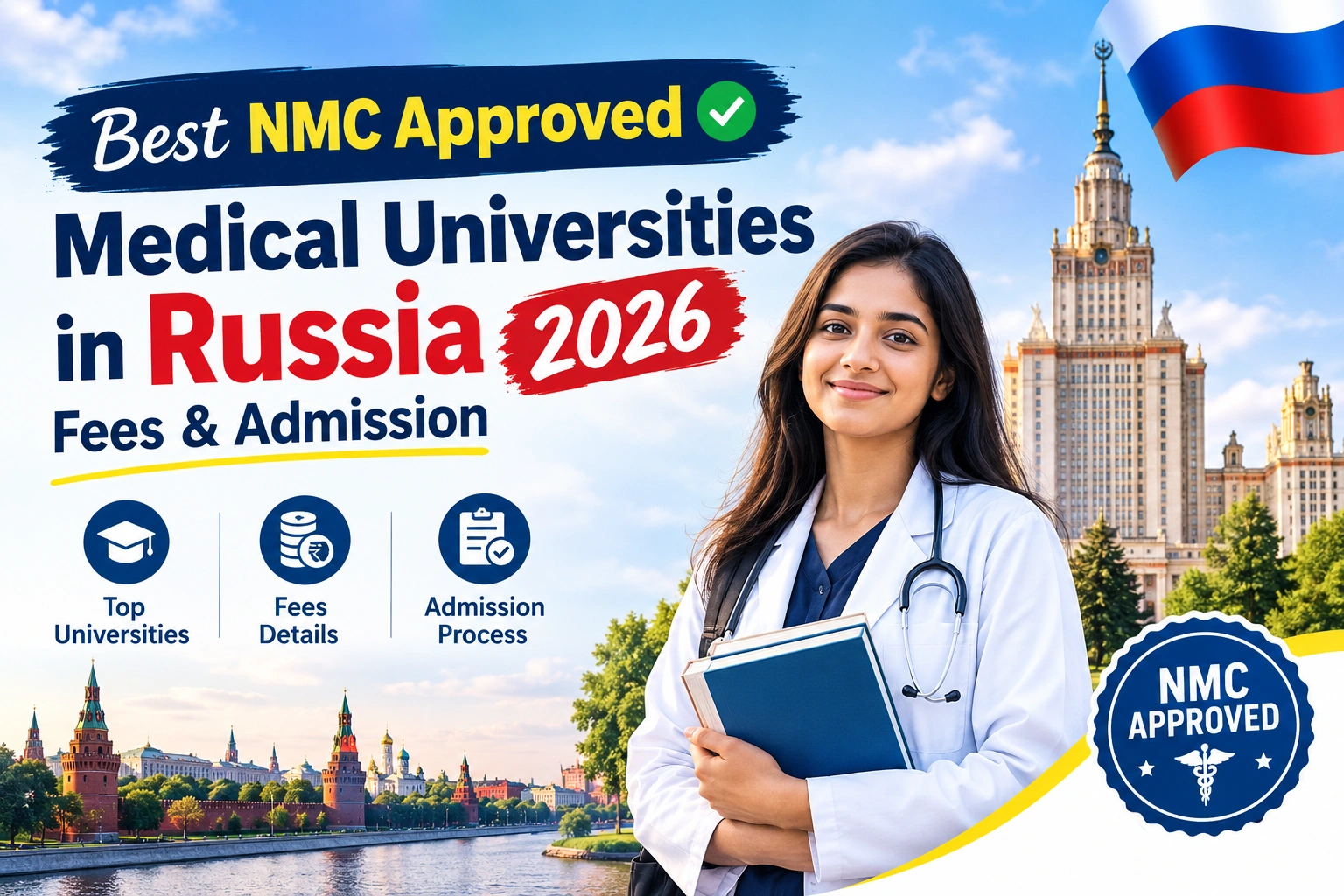
Choosing a medical university abroad is not just about finding the lowest fee. For Indian students, the bigger question is whether the course, university, clinical training and qualification fit the requirements for returning to India later. That’s where MBBS in Russia needs a little more research than simply comparing admission brochures. Russia has several established medical schools, including universities in Moscow, Kazan, Kursk, Saint Petersburg and other cities, but the rules applicable to Indian foreign medical graduates must be checked carefully before paying any admission amount. The National Medical Commission (NMC) currently publishes the Foreign Medical Graduate Licentiate Regulations and related FAQs, so students should use the latest official requirements rather than relying only on an agent or old university list.
What Does “NMC Approved” Mean for a Russian Medical University?
There’s a small confusion around this phrase. You’ll often see universities advertised online as “NMC approved,” but students should not treat that wording as a permanent certificate covering every future batch or course. NMC regulations set requirements for foreign medical graduates, and the actual programme a student joins needs to satisfy the applicable rules. The NMC website lists the Foreign Medical Graduate Licentiate Regulations 2021 along with updates and FAQs, including a June 2026 FAQ.
A safer approach is to check the university's current programme, duration, medium of instruction, clinical training and other requirements against the latest NMC rules before admission. Also check the institution in the World Directory of Medical Schools (WDOMS). WDOMS provides information about medical schools, including operational status, programmes and other institutional details; it is maintained through a collaboration involving WFME and FAIMER. For students researching MBBS in Russia, this verification step can save a lot of trouble later.
Medical Universities in Russia Indian Students Commonly Consider
Russia has a long history of medical education, and several universities have established medical programmes for international students. Rather than calling one university “the best” for everyone, it makes more sense to compare the factors that actually affect your six-year study experience.
Sechenov University, Moscow
Sechenov University is one of the oldest medical institutions in Russia. WDOMS lists it as a currently operational public medical school, with medical instruction dating back to 1758. Its listed medical programme has a six-year duration and includes Russian and English as languages of instruction. For 2026/27, Sechenov officially lists General Medicine as a six-year, full-time English-taught programme for international applicants. Its 2026 admission information also gives specific application timelines for international students and preparatory programmes. Fees are on the higher side compared with many regional Russian universities. Recent published estimates put annual tuition around ₹8 lakh or more, depending on the programme and exchange rate, but students should confirm the current university fee directly before budgeting.
Pirogov Russian National Research Medical University
Pirogov Russian National Research Medical University is another Moscow-based public medical university worth researching. WDOMS records it as currently operational, with a six-year medical programme and Russian and English listed as languages of instruction. Foreign students are admitted. The cost is generally reported below Sechenov, although the actual figure depends on the intake, programme and yearly fee revision. Recent published estimates have placed annual tuition in the region of ₹4–5 lakh, but don't use an old INR conversion as your final budget because the ruble exchange rate can change considerably.
Kazan State Medical University
Kazan is a popular destination for international medical students, partly because it has a strong medical education tradition and a sizable university ecosystem. WDOMS identifies Kazan State Medical University as a public medical school established in 1814 and notes access to clinical teaching facilities, with clinical training forming a substantial part of the programme. Published 2026 estimates place annual tuition around ₹5–6 lakh, although students should verify the exact amount, hostel charges and other university fees for their intake. Honestly, don't select Kazan only because someone says the city is affordable. Look at the actual university programme and clinical exposure too.
RUDN University, Moscow
RUDN University, formerly known as Peoples' Friendship University of Russia, has a long history of educating international students. WDOMS lists its Faculty of Medicine as a currently operational public medical school in Moscow. Because Moscow generally has higher living expenses than many smaller Russian cities, students should calculate the complete annual budget rather than looking only at tuition. Published estimates for RUDN's medical tuition have been around ₹6–7 lakh per year, but these numbers can change with the academic year and currency conversion.
Kazan Federal University
Kazan Federal University is another institution Indian students may encounter while researching MBBS in Russia. Its Institute of Fundamental Medicine and Biology is listed in WDOMS, and the institution appears in WDOMS pathway information for Russian medical schools. Recent fee estimates have placed tuition around ₹3–4 lakh annually, though the exact medical programme fee should always be confirmed with the university for the relevant intake.
How Much Does MBBS in Russia Cost in 2026?
The total cost can vary quite a lot. A realistic planning range for tuition at many Russian medical universities is roughly ₹3 lakh to ₹8 lakh per year, while some institutions and programmes may fall outside that range. Exchange rates, university fee revisions and city-wise living expenses all affect the final amount. Recent published university comparisons show substantial differences between Moscow institutions and regional universities.
Then there are the costs students sometimes forget:
- University hostel fees
- Food and daily expenses
- Medical insurance
- Visa and registration expenses
- Air tickets
- Residence-related charges
- Books and study materials
- Local transportation
- Winter clothing and personal expenses
So, if a university advertises only the tuition fee, don't immediately assume that's your six-year budget. For a broader breakdown of admission, university selection and expenses, students can also explore MBBS in Russia before finalising a university.
NEET Requirement for Indian Students
Indian students planning to study medicine abroad generally need to pay close attention to NEET eligibility. NEET-UG 2026 is the common entrance examination used for undergraduate medical education admissions under India's applicable framework, and the official NTA website provides the 2026 information and candidate resources. The important thing here is not simply asking, “What NEET score is required for Russia?” Foreign medical admission and Indian eligibility are two related but different questions. A university may have its own admission requirements, while an Indian student also has to satisfy the applicable Indian rules for foreign medical education. Don't rely on a random “minimum score” mentioned on an old blog. Check the current NEET and NMC requirements for your admission year.
Course Duration and Medium of Instruction
Most recognised Russian medical programmes discussed by Indian applicants follow a six-year medical education structure. For example, WDOMS lists six-year programmes for Sechenov and Pirogov, while Sechenov's official 2026/27 information specifically lists its English-taught General Medicine programme as six years full-time.
English-medium study sounds straightforward, but there’s another practical point. Students may still need Russian language skills for communication during clinical training, especially when interacting with patients and hospital staff. So don't assume “English medium” means you’ll never need Russian. That distinction matters.
NMC, WDOMS and Recognition: What Should You Check?
Before submitting your first payment, create a simple verification checklist. First, check the latest NMC regulations and FAQs applicable to foreign medical graduates. The NMC's current regulations section includes the FMGL Regulations 2021 and subsequent updates. Next, search the university in WDOMS and confirm that the medical school is currently operational and that the relevant medical programme information matches what you're being offered. For example, WDOMS provides detailed institutional records for Sechenov, Pirogov and Kazan State Medical University. Finally, check the university's own admission page. Fees and application deadlines can change, and an old consultancy PDF shouldn't be treated as the final authority. WHO also describes WDOMS as a searchable directory covering undergraduate medical education programmes around the world.
FMGE and NExT: Think About Your Return to India
Studying medicine abroad doesn't end with receiving a degree. Indian graduates returning after foreign medical education need to comply with the medical licensing framework applicable at that time.
This is why the NMC's foreign medical graduate regulations deserve attention before admission, not after graduation. The rules can be updated, so students joining in 2026 should keep checking official NMC information throughout their course rather than depending on what a senior student was told several years earlier. The licensing examination framework can also evolve. So, instead of choosing a university purely because someone claims it has a particular exam pass rate, focus on curriculum, clinical training, teaching language, internship structure and compliance with the rules applicable to your batch.
MBBS in Russia Admission Process for 2026
The application process is usually fairly straightforward, but documentation needs to be handled carefully.
- Check eligibility: Make sure you meet the university's academic requirements and the applicable Indian requirements, including NEET where required.
- Choose the university: Compare tuition, hostel, location, programme language and clinical training rather than looking at one factor.
- Prepare documents: Typical documents may include your passport, Class 10 and 12 certificates, photographs, academic records and other documents requested by the university.
- Submit the application: Apply through the university's official international admissions process or an authorised channel.
- Receive admission documents: If accepted, you'll receive the relevant admission or invitation documentation required for the next stage.
- Apply for the student visa: Follow the Russian visa process and submit the required documents.
- Travel and complete registration: After arrival, complete university registration, medical formalities and other local requirements.
Admission dates vary by university. For example, Sechenov's 2026 international admission information gives specific dates for preparatory department applications, showing why students shouldn't assume every Russian university follows exactly the same calendar.
Hidden Costs Students Should Budget For
Tuition isn't the only number you should write on your planning sheet. Hostel and living costs can add a meaningful amount over six years, and Moscow can be considerably more expensive than smaller Russian cities. Also consider currency fluctuations. A fee quoted in rubles might look reasonable today and different after conversion several months later. Visa expenses, insurance, flights, winter clothing and emergency travel are small individually, but together they can make a noticeable difference. A family planning for MBBS in Russia should ideally keep an additional financial cushion instead of calculating the budget down to the last rupee.
Advantages and Challenges of Studying Medicine in Russia
Russian medical universities offer several potential advantages for international students, including established medical schools, six-year programmes, English-taught options at some institutions and a wide range of tuition levels. But there are challenges too. Weather can be difficult for students coming from India, Russian language learning can become important during clinical exposure, and travelling home can add to the overall cost. There’s also the licensing issue. Your responsibility doesn't finish when you receive the Russian medical degree. You need to remain aware of the Indian regulatory requirements that apply to foreign medical graduates.
Frequently Asked Questions
Is MBBS in Russia NMC approved?
Students should avoid treating “NMC approved” as a blanket label. Check the latest NMC foreign medical graduate regulations and confirm that the specific university and programme satisfy the requirements applicable to your batch. Also verify the medical school through WDOMS and the university's official information.
What is the average fee for MBBS in Russia in 2026?
A broad estimate is around ₹3–8 lakh per year for tuition at many universities, although individual institutions can be lower or higher. Moscow universities often have higher costs, while some regional universities can be more affordable. Always confirm the current fee directly because ruble exchange rates and university charges change.
Is NEET required for Indian students?
Indian students should follow the applicable NEET requirements for foreign medical education. NTA's official 2026 information identifies NEET-UG as the common entrance examination for undergraduate medical education admissions under the applicable Indian framework.
Is MBBS in Russia six years?
Many Russian medical programmes for international students follow a six-year structure. Sechenov's official 2026/27 English-taught General Medicine programme, for example, is listed as six years full-time, while WDOMS also lists six-year programmes for institutions such as Sechenov and Pirogov.
Can I study medicine in English in Russia?
Yes, some Russian universities offer English-taught medical programmes. However, the availability of English instruction varies by university and programme, and students should also consider Russian language requirements during clinical training.
Which Russian medical university should I choose?
There isn't one university that suits every student. Compare the current tuition fee, hostel and living expenses, programme duration, language of instruction, clinical training, university status and compliance with the NMC requirements applicable to your batch before making the final decision.
Conclusion
The right university for MBBS in Russia isn't necessarily the one with the cheapest fee or the biggest advertisement. Look at the complete picture. University status, course structure, clinical exposure, language, total cost and Indian regulatory requirements all matter.
For 2026 applicants, universities such as Sechenov, Pirogov, Kazan State Medical University, RUDN and Kazan Federal University can be part of the research list, but their current programmes, fees and eligibility should be checked directly before admission. WDOMS and NMC resources are useful starting points, while the university itself should be the final source for current admission fees and deadlines. Take your time. Compare properly. A six-year medical degree is a long commitment, and a few hours of careful checking before admission can prevent much bigger problems later.