
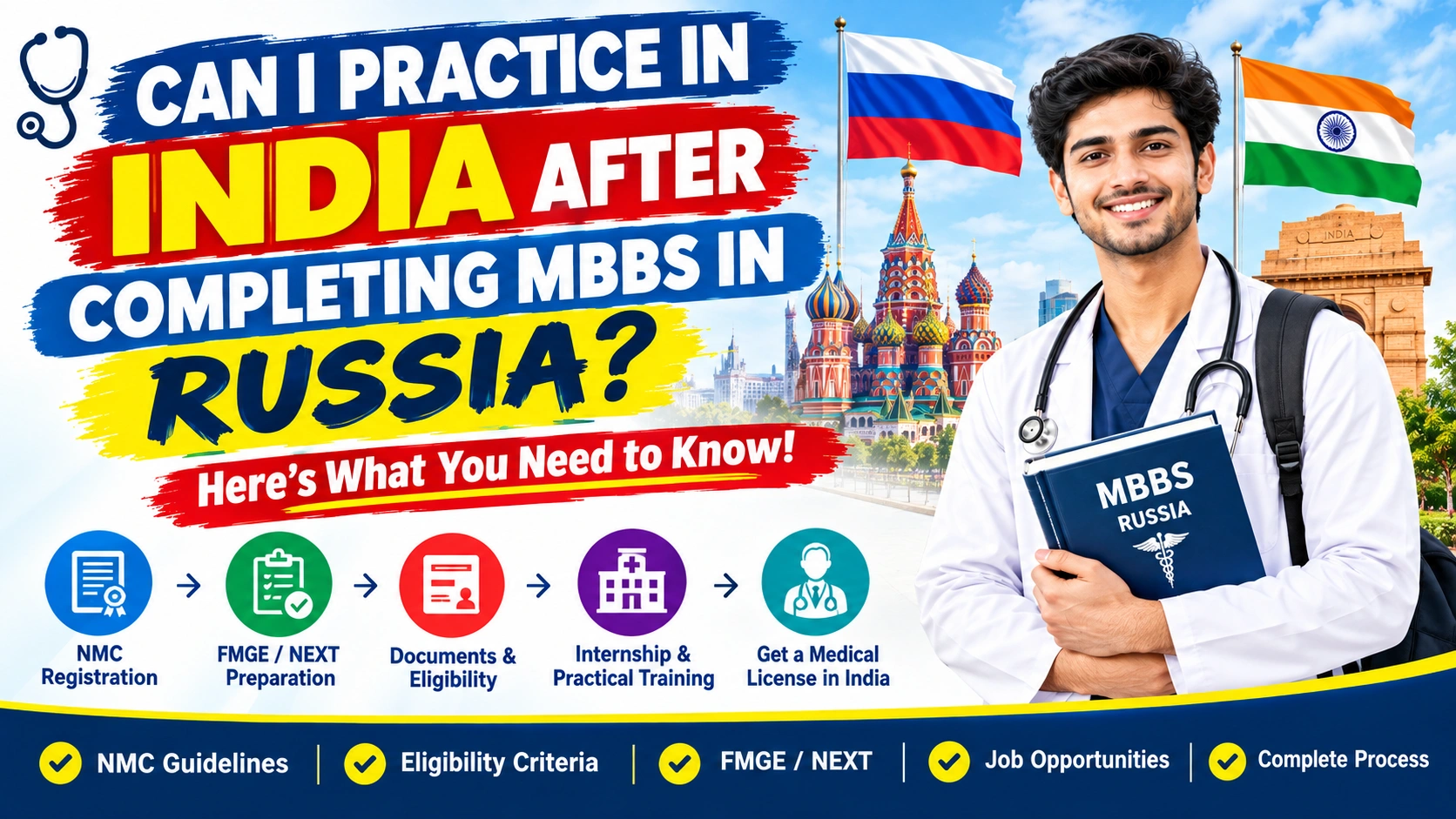
Yes, you can practice medicine in India after completing MBBS in Russia. But there is a catch. Actually, several of them.A Russian medical degree doesn't automatically give an Indian student the right to return home, register with a State Medical Council and start seeing patients. You first need to satisfy the eligibility and registration requirements applicable to Foreign Medical Graduates (FMGs) under the NEET website rather than depending on a university representative or an old YouTube video. The official NEET portal currently carries information for NEET UG 2026 and related candidate activities.This matters because Russian universities may have their own admission criteria, but Russian university admission and eligibility to practice later in India are two separate questions.A university saying, "We can admit you," isn't enough.Your question should be: "If I complete this exact program, will I satisfy the applicable Indian FMG regulations?"Big difference.
What Does NMC Require From Foreign Medical Graduates?
This is probably the most important section of the entire discussion.The
Minimum 12 months at the same foreign medical institution
Mandatory subjects prescribed by NMC
Must comply with applicable NMC requirements
Minimum 12-month supervised internship in India
Applicable examination prescribed by NMC
Permanent medical registration
Is a Six-Year Medical Course in Russia Suitable?
Does NMC Approve Russian Medical Universities?
This phrase creates a lot of confusion: "NMC-approved university."Students frequently see it in advertisements. A better approach is to check whether the foreign medical qualification and program satisfy the current NMC requirements applicable to you, rather than treating an overseas university like an Indian medical college carrying a simple NMC approval stamp.The same caution applies to WDOMS.You can use the World Health Organization (WHO) references while researching international medical education, but your eligibility to practice in India ultimately has to be checked against the applicable NMC regulations and Indian registration requirements.
What Happens After You Finish MBBS in Russia?
Now imagine you've completed the entire Russian medical program correctly. Degree received. Internship done. Documents ready.What next?You still aren't automatically a practicing doctor in India.Foreign medical graduates need to complete India's prescribed licensing pathway. The FMGL Regulations refer to clearing the National Exit Test (NExT), or such other tests or tests as may be mandated by the Commission.This wording matters because India's examination framework for foreign medical graduates has been subject to regulatory developments. Students graduating several years from now shouldn't assume that today's examination arrangement will remain unchanged by the time they return.Check the NMC and the relevant examination authority in your graduating year.Not your admission year. Your graduating year.
FMGE or NExT: What Should a Russian MBBS Student Prepare For?
This question comes up constantly.Historically, foreign medical graduates have taken the Foreign Medical Graduate Examination (FMGE) as part of the registration pathway. NMC regulations, however, provide for NExT or another mandated examination, which means a student entering a six-year foreign program today should not build the entire plan around the assumption that one particular examination format will remain unchanged years later.The sensible approach is simpler.Prepare from day one at a standard strong enough for Indian licensing examinations.Anatomy shouldn't be studied only to pass a Russian semester examination. The same goes for pathology, pharmacology, medicine, surgery, pediatrics, obstetrics and gynecology, community medicine and other core areas.Six years is enough time to build excellent fundamentals.It's also enough time to forget everything if you keep saying, "I'll start FMGE preparation in the final year."
Do I Have to Complete an Internship in India Too?
Yes, where the applicable FMGL rules require it.And this catches some students by surprise.NMC's regulations require eligible foreign medical graduates to undergo a minimum 12-month supervised internship in India after fulfilling the applicable conditions. NMC's FAQ also makes clear that this Indian internship is required in addition to the minimum 12-month internship at the same foreign medical institution for students governed by these provisions.The Indian internship isn't simply a repeat year for paperwork. It exposes returning graduates to India's hospitals, disease patterns, patient communication, clinical documentation and healthcare environment.NMC has also stated that the allocation of internship institutions for FMGs is handled by the concerned State Medical Council and that the internship should take place in institutions approved for providing compulsory rotating medical internship to Indian medical graduates.So if someone tells you, "Six years in Russia and you can immediately open a clinic in India," that's missing several steps.
Why Russian Language Still Matters in an English-Medium Course
Here's the slightly uncomfortable reality. Your lectures may be in English, but Russian patients don't suddenly start speaking English because you're an international medical student.Clinical years are different from classroom years.You need to take histories. Ask about pain. Understand symptoms. Communicate with patients and hospital staff. Follow ward discussions. A student who ignores Russian language training can eventually find that an "English-medium MBBS" becomes much less English once real patient interaction begins.This affects clinical exposure, and clinical exposure affects your competence.So don't view Russian-language classes as some annoying extra subject. Learn enough medical Russian to communicate comfortably with patients. Seriously.
Choosing a Russian University If Your Goal Is Indian Practice
The cheapest university isn't automatically the smartest option.Before taking admission for MBBS in Russia, investigate the exact General Medicine program being offered to Indian students. Ask for written information rather than accepting verbal promises from an agent.
Check these areas particularly carefully:
- Total program duration and academic structure
- 12-month internship arrangement
- Medium of instruction throughout the required course
- Hospital and clinical training arrangements
- Whether clinical training occurs in Russia
- Eligibility for registration/licensure in Russia after graduation
- Subjects included in the curriculum
- WDOMS listing and program details
- Compliance with current NMC FMGL regulations
- Number and quality of affiliated teaching hospitals
- Patient exposure during clinical years
- Russian-language training
- Previous Indian student batches
- Total six-year cost rather than first-year tuition alone
For broader university and admission research, students can also compare options through