I remember standing at an education fair in Lucknow's Gomti Nagar back in early 2020, watching a father argue with an agent's counter representative. "Just tell me one thing," he said, jabbing his finger at a glossy Kazan Federal University brochure, "will she become a doctor or not?" The agent smiled the way agents do. He didn't really answer. He talked about "affordable fees" and "no donation" and "direct admission." Nobody mentioned NEET. Nobody mentioned the FMGE licensing exam waiting at the other end. I've sat through enough of these conversations over the years to know that half the confusion around MBBS in Russia isn't about Russia at all — it's about what nobody bothers explaining upfront.
So let's actually explain it.
Who Can Even Apply — And Who Genuinely Shouldn't
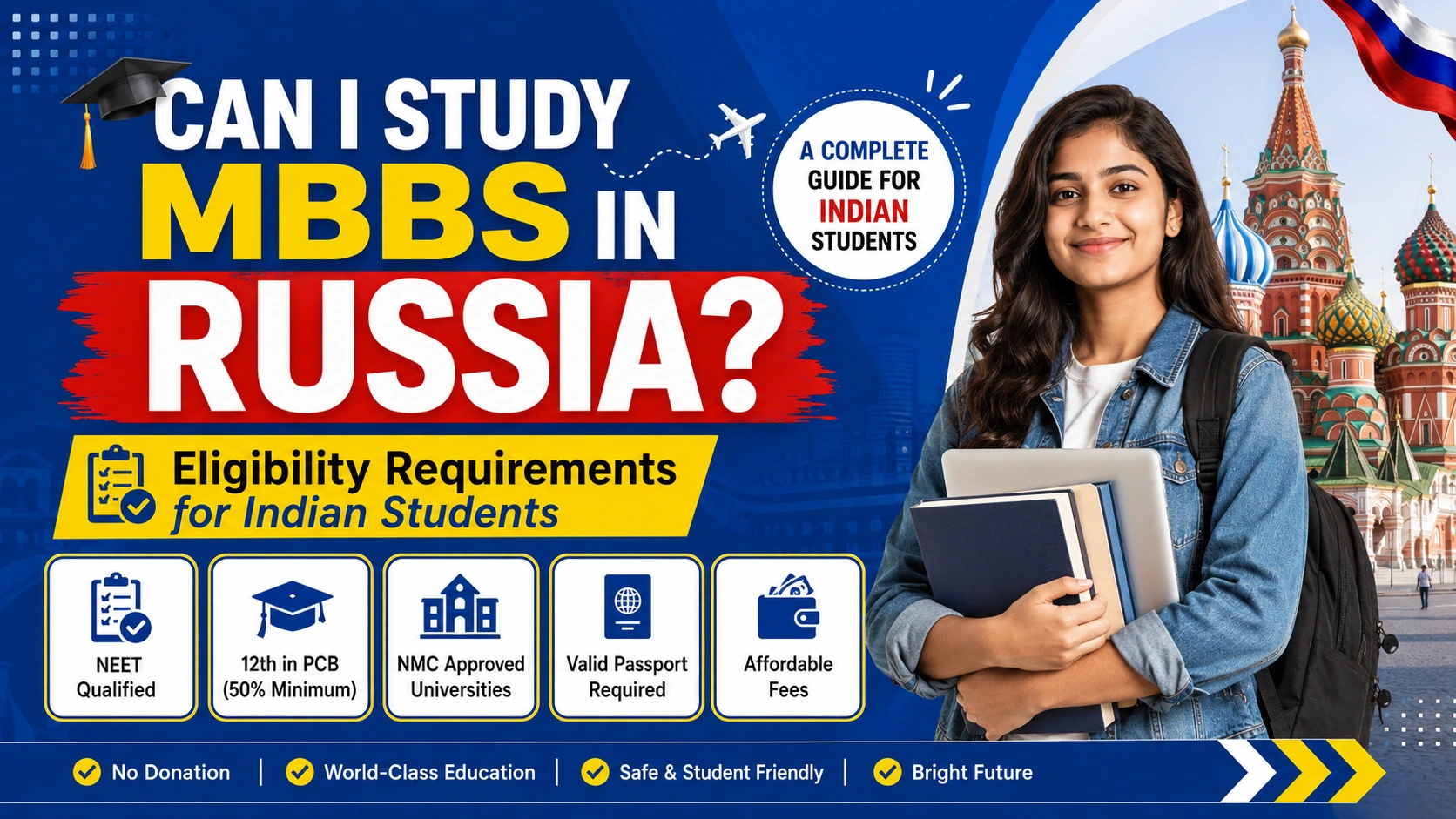
The baseline eligibility hasn't changed much in the last five years, though the enforcement around it certainly has. You need to have cleared Class 12 with Physics, Chemistry, and Biology, scoring at least 50% aggregate (40% if you belong to a reserved category). You must be 17 years or older at the time of admission. And — this is the part agents love to gloss over — you absolutely must have a valid NEET qualifying score. Not attempted. Qualified. There's a difference, and it's a difference that ruins people's plans every single year.
I've spoken to at least a dozen students in the last three years who enrolled in Russian universities without clearing NEET, banking on some vague promise that "it can be sorted later." It cannot. The NMC will not register you to practice in India without a valid NEET qualification, regardless of where you studied or how good your degree looks on paper. I've seen a boy from Kanpur — bright kid, genuinely wanted to be a surgeon — spend four years and roughly ₹22 lakh in Volgograd only to discover he couldn't sit for the FMGE screening exam because his NEET paperwork never cleared. That's not a Russia problem. That's a due-diligence problem. But it happens in Russia often because the intake cycles are fast, agents are commission-driven, and nobody slows down to check the fine print.
Why Russia, Practically Speaking
Here's where I'll be honest instead of diplomatic: Russia isn't the glamorous option. It's the practical one. Tuition at universities like Kazan State Medical University or Volgograd State Medical University runs between $4,000 and $6,500 a year — compare that to a private medical college in Karnataka or Maharashtra charging ₹80 lakh to ₹1.2 crore for the same MBBS degree, and the math starts making sense fast. Living costs in a city like Tver or Orenburg can be as low as ₹8,000–₹12,000 a month if you're cooking your own food, which — trust me — you will be, because hostel mess food gets old around week three.
Most of these universities are recognized by the WDOMS and follow curriculum standards loosely aligned with WHO recommendations, which matters when you're trying to prove your degree's legitimacy back home. That said, recognition on paper and quality of clinical exposure are two very different things, and I won't pretend otherwise.
The Part Nobody Puts in the Brochure
Winters in central Russia are not a minor inconvenience. Temperatures in Kazan regularly drop to minus 20 in January, and a proper thermal jacket, snow boots, and layering gear will cost a first-year student anywhere from ₹15,000 to ₹25,000 — money that rarely appears in the "total cost of study" estimates agents hand out. Flights home aren't casual either. A Moscow–Delhi round trip during peak season can touch ₹55,000–₹70,000, which is why most students I've talked to go home once a year, if that.
Homesickness hits harder than anyone expects. I've had a student tell me she cried through her first Diwali in Ryazan because there wasn't a single sweet shop within 40 kilometers. Small thing. Except it isn't, when you're 19 and far from home for the first time.
Language, Curriculum, and the Myth of "English Medium Everywhere"
Most universities do offer English-medium MBBS programs, and that part is genuinely true. But Russian language classes are usually mandatory from year one, because clinical rotations in years four through six require you to communicate with actual Russian-speaking patients. Skip this, and you'll struggle badly later. I've watched students breeze through anatomy and biochemistry in English only to freeze completely during ward rounds because their conversational Russian never got past "privet."
Documentation Nobody Warns You About
Beyond NEET and your 12th marksheet, you'll need a medical fitness certificate, police clearance, notarized passport copies, and — increasingly — proof of financial capability for the visa process. Processing timelines through the Russian consulate in Delhi or Kolkata can stretch to six or eight weeks during peak intake season, so anyone applying for the September batch really needs to start paperwork by June, not August. I say this every year and every year someone starts in July and panics.
Is It Actually Worth It?
Depends entirely on what you're optimizing for. If cost is your primary constraint and you're disciplined enough to self-study for FMGE independently — because clinical training abroad rarely mirrors Indian hospital protocols closely enough — then MBBS in Russia remains one of the more financially sensible options on the table. If you're expecting an Ivy League-style campus experience or five-star hostel life, you'll be disappointed. It's a grind. A cold, occasionally lonely, budget-conscious grind that produces a medical degree at the end of it, provided you clear the exams that actually matter back home.
For families genuinely weighing MBBS in Russia for Indian Student options against domestic private colleges, I'd say this: don't let an agent's commission structure decide your child's next six years. Talk to current students. Ask about the FMGE pass rates from that specific university, not the country average. And before signing anything, sit down and actually read what it means to Study MBBS in Russia — not the two-line summary, the whole thing.
A Reporter's Closing Note
I've covered this beat long enough to have seen both outcomes — the students who came back as confident, licensed doctors, and the ones who came back with a degree and no clear path to practice. The difference, almost always, traced back to whether someone checked the eligibility boxes properly before boarding that first flight to Sheremetyevo. Not glamorous advice. Just necessary.