
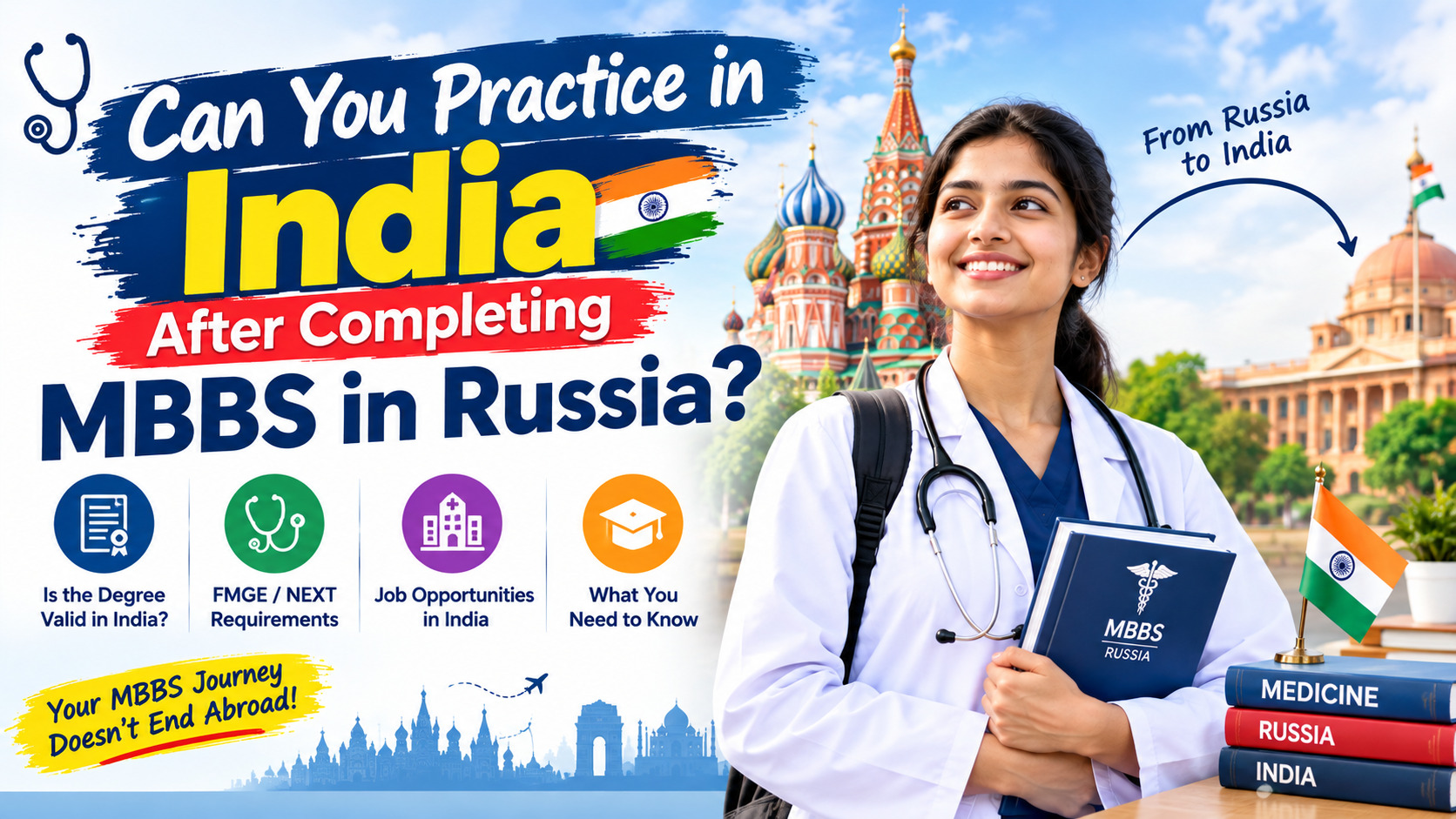
Yes, you can practice medicine in India after completing your medical degree in Russia — but simply holding a Russian medical degree isn't enough. There are a few regulatory steps between graduation and actually treating patients as a registered doctor in India. This is where many students get confused. They hear that MBBS in Russia is recognized internationally, finish six years of medical education, return home, and then discover that they still have to satisfy Indian registration requirements. So, if you're planning to study medicine in Russia, understand the complete route before paying your first-year fees. The good news? The route is clearly regulated. The National Medical Commission (NMC) has specific rules for Foreign Medical Graduates (FMGs), and the NMC's current regulations and FAQs should always be checked before admission because requirements can change for different batches of students.
Is an MBBS Degree from Russia Valid in India?
A Russian medical degree can be used as the basis for seeking medical registration in India, provided the course and institution satisfy the applicable NMC requirements. That last part matters a lot. The NMC's Foreign Medical Graduate Licentiate Regulations require a foreign medical qualification to meet prescribed conditions, including the required course duration, clinical training, internship, language of instruction and registration eligibility in the country where the degree is awarded. Students should also check their university directly in the World Directory of Medical Schools (WDOMS). WDOMS provides information about medical schools and their programmes, but there's a small catch: being listed in WDOMS by itself doesn't mean that WDOMS is giving the university an approval or endorsement. So don't choose a university just because an agent says, "It's WHO listed." Verify the actual programme and its compliance with NMC rules for your admission year.
Do You Need NEET to Study MBBS in Russia?
Yes. Indian students planning to pursue undergraduate medical education abroad generally need to qualify NEET-UG as part of the applicable eligibility requirements. The NMC has also specifically warned students considering foreign medical education not to trust institutions promising admission outside the prescribed process, including the NEET requirement.
You can check the latest examination information through the official NEET website. For students looking at MBBS in Russia in the 2026–27 admission cycle, basic academic eligibility generally includes Physics, Chemistry and Biology/Biotechnology with English at the qualifying examination level. Many universities and counselling sources mention 50% PCB for general-category applicants, with different qualifying requirements for reserved categories, but students should verify the rules applicable to their batch before admission. And one more thing. Don't confuse "qualifying NEET" with getting an Indian government MBBS seat. They're two completely different things.
What Is the Duration of MBBS in Russia?
Most Russian medical programmes followed by Indian students are around six years in duration. For example, WDOMS records show six-year medical programmes at institutions such as Pirogov Russian National Research Medical University and several other Russian medical schools. Under the NMC FMGL framework, the foreign medical graduation course must meet the prescribed minimum duration of 54 months, along with the required internship and clinical training conditions. This is one reason students shouldn't simply compare universities by saying, "Both are six years." The actual structure matters. You need to look at how much of the programme is classroom teaching, how clinical rotations are arranged, where the internship is completed and whether the entire programme fits the NMC requirements.
What Happens After Graduation in Russia?
Here's the part students usually want to know. You complete your medical course in Russia. Then what? For students governed by the current FMGL framework, the process involves meeting the foreign-course and internship requirements, qualifying the applicable Indian licensing examination, completing the required internship in India and then obtaining registration from the appropriate medical council. The NMC has stated that students admitted after November 18, 2021 are governed by the newer framework and are required to undergo the prescribed one-year mandatory internship in India after satisfying the relevant examination and eligibility requirements. The exact process can differ depending on the student's admission date and the rules applicable to that batch. This is why older YouTube videos saying "just clear FMGE and you're done" can be misleading.
FMGE or NExT: Which Exam Will You Need?
This is probably the biggest question for current students. As of 2026, FMGE is still being conducted by the National Board of Examinations in Medical Sciences. NBEMS has published FMGE results for the June 2026 session and continues to provide FMGE application and examination information. At the same time, NExT is intended to replace the existing screening-test system as the regulatory framework becomes operational. NMC-related government material states that NExT is set to replace FMGE for foreign medical graduates, subject to the applicable regulations and implementation. So, if you're joining MBBS in Russia now, don't build your entire career plan around the assumption that FMGE will remain unchanged for the next six years. The safer approach is simple: keep checking NMC and NBEMS notifications during your course.
Is One Year of Internship in India Required?
For students covered by the current FMGL/CRMI framework, yes, a one-year supervised internship in India is an important part of the registration pathway. NMC's published material states that foreign medical graduates who require an Indian internship must complete it in medical colleges or institutions approved for conducting the applicable compulsory rotating medical internship.
The foreign medical programme itself also has its own internship requirements. Under the FMGL framework, the foreign medical qualification includes a minimum 12-month internship in the same foreign institution, subject to the applicable conditions. So there can be two separate internship-related requirements in the overall journey — the internship associated with the foreign qualification and the supervised internship in India required for registration. It’s normal to be confused here. That's exactly why students should check their batch-specific NMC rules before admission.
How Much Does MBBS in Russia Cost?
Cost is one of the reasons Indian students consider Russia in the first place. For 2026 estimates, tuition at many Russian medical universities falls roughly around ₹2.5 lakh to ₹8 lakh per year, although some universities, particularly expensive institutions in major cities, can charge considerably more. Current published estimates from Russian MBBS counselling sources put the overall six-year education and living budget broadly around ₹20 lakh–₹45 lakh, depending heavily on the university, city, exchange rate and lifestyle.
Typical expenses include:
- Tuition fees: roughly ₹2.5–₹8 lakh or more per year
- Hostel: around ₹30,000–₹1 lakh per year at many universities
- Food and daily expenses: roughly ₹1–₹2 lakh per year
- Insurance and medical expenses
- Visa and registration charges
- Flights and local transportation
- Books, winter clothing and personal expenses
For example, published 2026 estimates show universities such as Bashkir State Medical University, Orenburg State Medical University, Mari State University and Perm State Medical University generally sitting in lower-to-mid fee ranges, while universities in Moscow can be considerably more expensive. Don't make the decision based on first-year tuition alone. Exchange rates move. Fees can change. Living expenses aren't identical in every city.
Which Russian University Should You Choose?
There isn't one universal "best" university for every Indian student.
A sensible shortlist should include factors such as:
- Current NMC compliance for your admission batch
- WDOMS listing and programme details
- Course duration and curriculum
- Medium of instruction
- Clinical training arrangements
- Internship structure
- Hospital exposure
- Total six-year cost
- City and living expenses
- University's support for international students
WDOMS records, for example, show Russian institutions with six-year programmes and English-language options, but the details vary by university and programme. Honestly, university selection deserves more attention than students usually give it. A cheaper university isn't automatically a better deal if the course structure creates problems later.
Admission Process for MBBS in Russia
The admission process is usually fairly straightforward, but documentation needs to be handled carefully.
1. Qualify NEET
Indian students should meet the applicable NEET-UG requirement before proceeding with foreign medical admission.
2. Select the University
Check the university, programme, duration, language, clinical training and current regulatory status.
3. Submit Documents
Typical documents include your academic certificates, passport, NEET-related documents, photographs and other university-specific paperwork.
4. Receive Admission/Invitation Documents
Once the university accepts the student, the required admission and visa documentation is processed.
5. Apply for the Student Visa
The student then completes the Russian student visa process and prepares for travel.
6. Begin the Medical Programme
Once in Russia, students complete the academic and clinical requirements according to the university's programme. The admission season can vary by university, but many Russian universities begin processing international applications several months before the academic session starts. Don't wait until the last minute, especially for document attestation, translations and visa processing.
Pros and Cons of Practising in India After MBBS in Russia
There are genuine advantages, but there are also hurdles.
Pros
- Lower cost than many private medical options in India
- Six-year medical programmes are widely available
- International student intake is common
- Several universities offer English-medium programmes
- Exposure to a different healthcare system
- Opportunity to pursue further medical training after registration in India
Cons
- Licensing requirements in India must be completed
- FMGE/NExT-related preparation can be demanding
- Indian clinical practice is different from Russia
- Language can become an issue during clinical exposure
- Internship and registration requirements can add time after graduation
- Regulations may change during a six-year course
The last point is easy to overlook. A student joining in 2026 may graduate around 2032. Rules applicable at that point can be different from today's process.
Frequently Asked Questions
Can I practice in India immediately after MBBS in Russia?
No. Completing the Russian medical degree doesn't automatically give you the right to practise in India. You must satisfy the applicable NMC requirements, qualify the required licensing examination and complete the required internship/registration process.
Is NEET mandatory for MBBS in Russia?
For Indian students seeking undergraduate medical education abroad, NEET qualification is part of the applicable eligibility framework. Always verify the current NMC and NTA requirements before admission.
Is MBBS in Russia recognized by NMC?
Recognition isn't simply about a country or a university name. The specific medical programme must satisfy the applicable NMC requirements for the student's admission batch. Students should verify the university and programme before paying fees.
Do Russian medical graduates have to clear FMGE?
FMGE continues to be conducted in 2026, but the regulatory system is moving toward NExT. Which examination applies to a particular graduate will depend on the rules and implementation in force for that batch.
Do I need to complete an internship in India?
For students governed by the current FMGL/CRMI framework, a prescribed supervised internship in India is required before permanent registration. NMC has published specific rules covering FMG internships.
Is MBBS in Russia a good option for Indian students?
It can be, particularly for students who want an overseas medical education and have a realistic understanding of the licensing process. But university selection is critical. Check the current NMC requirements, WDOMS information, course structure, clinical training and total cost before making a decision.
Conclusion
So, can you practice in India after completing MBBS in Russia? Yes — but think of graduation as one milestone, not the finish line. You need a compliant foreign medical programme, the required clinical training and internship, the applicable Indian licensing examination, the required internship in India and registration with the relevant medical council. The exact route depends on your admission batch and the regulations in force at that time. If you're considering MBBS in Russia, check the university carefully before admission and keep the official NMC notifications bookmarked throughout your course. Also use WDOMS to verify the medical school's listing and programme details. It may take a little more planning upfront. Worth it. Because with a foreign medical degree, the cheapest admission isn't necessarily the cheapest career path.