
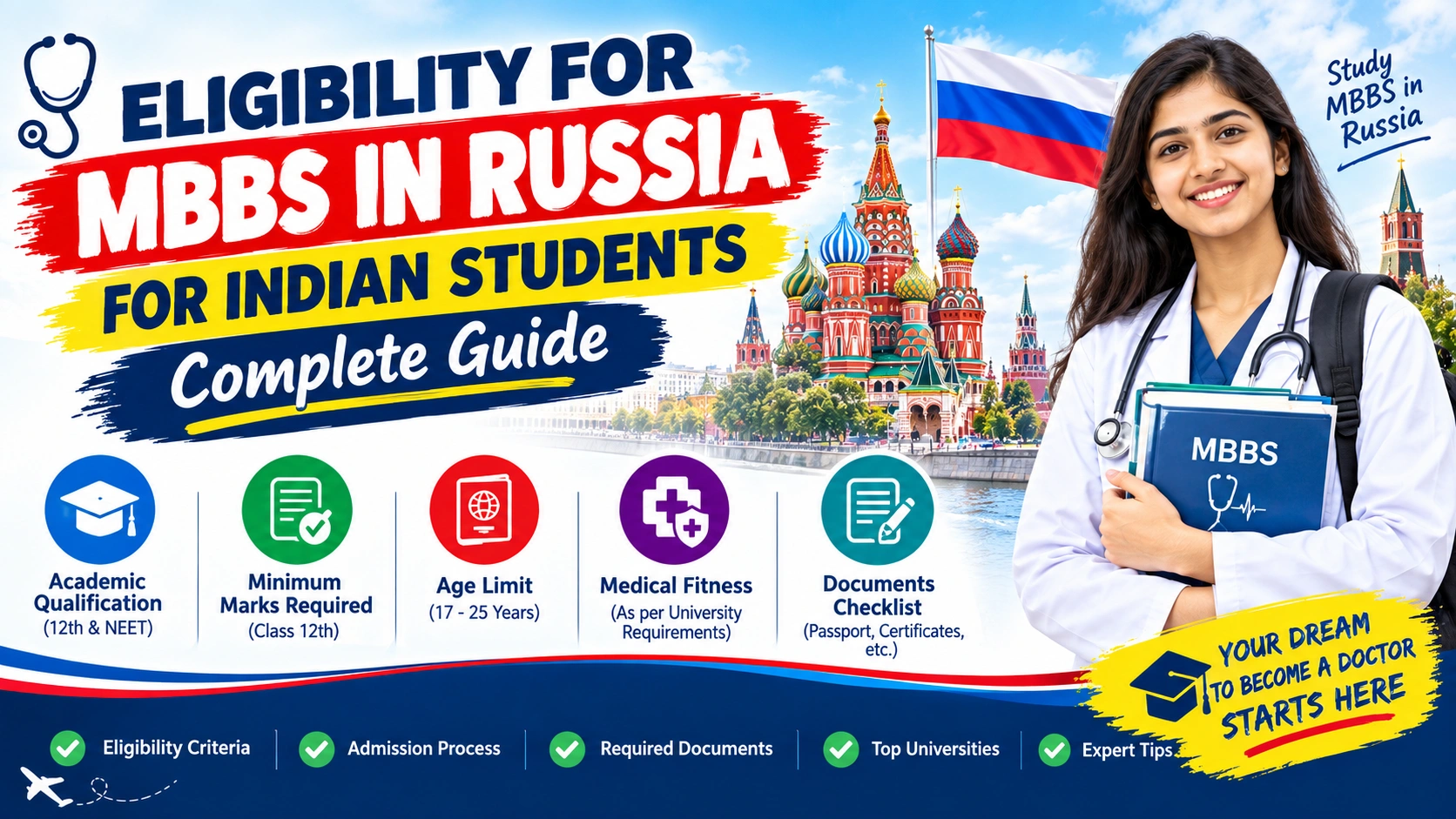
Getting admission to a Russian medical university can look surprisingly simple on paper. No huge entrance test conducted by the university, no complicated donation structure, and in many cases the application starts with basic academic documents. But that simplicity sometimes creates the wrong impression. Indian students still need to satisfy academic, NEET, age, documentation, and medical education requirements, especially if they want to return and practise medicine in India. For anyone considering MBBS in Russia, eligibility shouldn't be treated as a small admission formality. It decides whether your admission is valid, whether your medical qualification can fit Indian regulatory requirements, and eventually whether you can move toward medical registration back home. The basic benchmark usually starts with Physics, Chemistry, Biology/Biotechnology and English in Class 12, the required PCB percentage, NEET qualification, and minimum age. Sounds straightforward. Mostly, it is. The details are where students need to be careful.
Quick Overview of MBBS in Russia Eligibility
Before getting into individual rules, here is the basic picture. Most Russian universities accepting international medical students have fairly accessible admission requirements compared with highly competitive Indian government medical colleges. Still, "accessible" doesn't mean everyone automatically qualifies.
|
Eligibility Factor |
General Requirement for Indian Students |
|
Minimum age |
17 years by 31 December of the admission year |
|
Class 12 subjects |
Physics, Chemistry, Biology/Biotechnology and English |
|
PCB marks |
Generally at least 50% for General category under applicable Indian eligibility norms |
|
Reserved category benchmark |
Generally 40% PCB for SC/ST/OBC candidates under applicable Indian eligibility norms |
|
NEET |
Required for Indian students intending to remain eligible under Indian rules for overseas medical education |
|
University entrance test |
Depends on the university/admission rules |
|
English proficiency test |
Usually IELTS/TOEFL isn't demanded by many Russian universities |
|
Course duration |
Commonly around 6 years |
|
Medium |
English-medium options are available, but students should verify the actual teaching and clinical-language arrangement |
|
Passport |
Required for admission/visa processing |
|
Medical fitness |
Medical certificate and related tests are commonly requested |
These are broad benchmarks rather than a substitute for the current rules. Eligibility requirements can change, and universities may set their own academic or document conditions. Always cross-check the current regulations through the National Medical Commission before paying a university or agent.
What Academic Qualification Is Required for MBBS in Russia?
Start with Class 12. An Indian applicant normally needs to have completed 10+2 or an equivalent recognised qualification with Physics, Chemistry, Biology/Biotechnology and English. Biology isn't something you can replace casually with another subject just because a particular university's international admission page appears flexible.For General category students, the commonly applicable Indian eligibility benchmark is at least 50% aggregate in Physics, Chemistry and Biology/Biotechnology. For candidates belonging to applicable reserved categories such as SC, ST and OBC, the benchmark is generally 40% in PCB under Indian medical education eligibility rules. Candidates should verify the exact category-specific requirement applicable to their admission year.One practical issue appears every admission season. A student may satisfy a Russian university's own entry criteria but fail to satisfy Indian requirements for studying medicine abroad. That's a problem.So don't ask only, "Will this university admit me?"Ask, "Does my admission also meet the requirements I need as an Indian student who may return to practise in India?"That second question matters far more.
Is NEET Mandatory for Indian Students Studying Medicine in Russia?
Yes, NEET is a major requirement Indian applicants shouldn't ignore. Students planning medical education outside India need to pay attention to the rules applicable to Indian citizens/OCI candidates seeking a primary medical qualification abroad, particularly if they expect to pursue registration in India later.The safest approach is simple: qualify NEET in the relevant admission cycle and confirm your eligibility through the official NEET website and current NMC regulations.The qualifying score isn't a permanent fixed number. NEET qualifying marks change because the cutoff is percentile-based and depends on that year's examination results. A score that qualified someone in one year doesn't automatically tell you what will happen in another.This creates another common misunderstanding. You don't necessarily need the kind of NEET score required for a government MBBS seat in India just to seek admission at many Russian universities. But merely "appearing" for NEET and qualifying it are two different things.
here—well, this is exactly where applicants often make mistakes. Don't plan an overseas medical admission around an assumed cutoff before the official result and qualifying criteria are available.
What Is the Minimum Age for Admission?
Age eligibility is one of the simpler conditions. The student generally needs to complete 17 years of age on or before 31 December of the year of admission, subject to the applicable Indian regulations.For example, if you're applying for the 2026 intake, your date of birth needs to satisfy the age rule applicable to that admission year. Universities will check the date through your Class 10 certificate, birth certificate, passport or other accepted documents.Small detail. Big consequences.A mismatch in the spelling of your name, date of birth or parents' details across the passport and academic documents can delay processing. Get those corrected early rather than discovering the problem during invitation-letter or visa processing.
Can Students with Low NEET Scores Apply?
Here's the interesting part: a relatively low NEET score doesn't automatically close the Russian option.Russian medical universities generally don't allocate international seats through India's MCC counselling system. Their admission procedures are separate, although Indian applicants must still satisfy the relevant Indian eligibility rules. As a result, a student who qualifies NEET but doesn't obtain a government or affordable private medical seat in India may still explore MBBS in Russia.This is one reason Russia continues to attract Indian applicants.Still, don't choose a university merely because it accepts your marks. Look at the curriculum, internship structure, clinical training, teaching language, recognition/listing status and compliance with NMC's foreign medical graduate requirements.Cheap admission isn't useful if the degree creates trouble later.
Is There Any University Entrance Examination?
This depends on the university and the admission year. Some institutions may process international applications mainly through academic records and document verification, while others can have additional assessment, interview or admission requirements.So statements such as "all Russian medical universities provide direct admission without any test" should be treated carefully.Honestly, this is something students should verify university by university.A legitimate admission process should clearly tell you what is being assessed, which documents are needed, what the official tuition fee is, and how the invitation and visa stages work. If someone promises a guaranteed seat before even checking your Class 12 and NEET documents, that isn't a reassuring sign.
Does the Medium of Instruction Matter?
Absolutely. And this issue goes beyond admission.Several Russian universities offer medical programmes for international students with instruction in English, particularly during academic teaching. However, students shouldn't assume that "English-medium MBBS" means they can spend six years using only English.Clinical interaction is different.Once hospital exposure starts, Russian becomes extremely useful because patients, hospital staff and everyday communication may primarily involve the local language. Universities commonly provide Russian-language training as part of the programme.Before admission, ask for written confirmation about the language of instruction across the full programme and clinical years. Don't rely only on a consultant's brochure.
NMC Rules Matter More Than a Simple "Approved University" Label
This part deserves extra attention. Students often search for an "NMC-approved university list" and assume finding a university name somewhere is enough. Medical qualification eligibility is more detailed than that.Indian students should study the current Foreign Medical Graduate Licentiate Regulations and related notices published by the National Medical Commission. Requirements concerning course duration, internship/clinical training, medium, registration eligibility in the country where the qualification is awarded and other conditions can affect a graduate's pathway in India.In other words, don't select a university from one label alone.Students can also check whether a medical school appears in the World Directory of Medical Schools. WDOMS is useful for verifying that a medical school is listed and for reviewing available school information. But a WDOMS listing by itself shouldn't be interpreted as automatic approval for medical registration in India.That's a surprisingly common assumption.The World Health Organization is another valuable source for global health and medical education context, but Indian licensing eligibility ultimately needs to be checked against Indian regulatory requirements rather than marketing claims involving the WHO name.
Course Duration: Does Eligibility Affect the Six-Year Programme?
Most General Medicine programmes commonly chosen by Indian students in Russia run for around six years. Students should verify the exact structure of the programme offered by their selected university, particularly how clinical training and internship requirements are incorporated.Why be so specific?Because students returning to India need their foreign medical education to satisfy the applicable NMC framework. The number printed beside "course duration" in a brochure isn't enough. Actual curriculum, clinical training and internship arrangements matter too.For MBBS in Russia, check the official university curriculum before enrollment. Ask for the academic structure year by year if necessary.
Typical Fees and Why Eligibility Isn't the Only Selection Factor
Suppose you qualify academically, clear NEET and receive admission offers from three universities. Which one should you select?Not automatically the cheapest.Russian medical tuition varies significantly by university and city. As a broad planning range, students may encounter tuition around ₹2.5 lakh to ₹6 lakh or more per year at different institutions after currency conversion. Premium universities and universities in major cities can cost considerably more. Hostel expenses, medical insurance, visa extension, food, travel and personal spending come separately.
|
Expense |
Approximate Planning Range |
|
Tuition fee |
₹2.5–6+ lakh per year |
|
Hostel |
₹30,000–₹1.2+ lakh per year |
|
Food/personal expenses |
₹10,000–₹20,000+ per month |
|
Insurance/medical/visa-related costs |
Varies annually |
|
India-Russia travel |
Depends heavily on route and booking period |
|
Total six-year budget |
Often roughly ₹20–40+ lakh depending on university and lifestyle |
Currency movements can shift INR figures quite quickly, so treat these as planning estimates, not official fee quotes.A university costing ₹3 lakh per year isn't automatically better value than one costing ₹4 lakh. Clinical exposure, hospital access, student support, city expenses and regulatory compatibility deserve equal attention.
Which Documents Are Usually Required?
Paperwork isn't difficult, but it needs to be clean. Most applicants should expect some combination of the following documents:
- Class 10 marksheet/certificate
- Class 12 marksheet and passing certificate
- NEET scorecard/result
- Valid passport
- Passport-size photographs
- Birth certificate where required
- Medical fitness certificate
- HIV test/report where required for admission or visa formalities
- University application form
- Admission/invitation documents
- Visa-related documents
- Other translated, notarised or authenticated documents where requested
Document requirements differ between universities and visa procedures. Check the current list before arranging notarisation or translation because doing every document unnecessarily just adds cost.
Step-by-Step Admission Process for Eligible Indian Students
The actual admission sequence is usually less dramatic than students imagine. First, shortlist universities after checking the curriculum, fees and regulatory considerations. Then verify your academic and NEET eligibility before submitting documents.
A typical sequence looks like this:
- Check Class 12 PCB and age eligibility.
- Qualify NEET and retain the official scorecard.
- Shortlist suitable Russian medical universities.
- Verify programme structure, recognition/listing information and NMC-related requirements.
- Submit academic and passport documents.
- Receive the university's admission confirmation or offer according to its process.
- Complete the required university payment.
- Obtain the official invitation needed for the student visa process.
- Complete medical, insurance and visa formalities.
- Arrange travel after receiving the appropriate visa and final university instructions.
Many Russian universities begin international admission activity months before classes start, often around spring or summer for an autumn intake. Deadlines vary. Applying earlier usually leaves more time for invitation processing, visa work and document corrections.
Hidden Eligibility Issues Students Often Miss
This is where a technically eligible applicant can still make a bad decision.The first issue is foreign medical graduate compliance. A university might happily accept you, but admission acceptance isn't the same thing as guaranteed eligibility for Indian registration later.Second, check local registration eligibility. NMC's regulations concerning foreign medical graduates should be read carefully, including provisions connected with whether the qualification allows registration/licensure in the country where it is awarded.Third, don't ignore clinical language. Studying anatomy from an English textbook is one thing; taking patient history in a Russian hospital is another.And fourth—internship. Students should understand where, how and for how long clinical training/internship is conducted before paying the first year's tuition.These questions sound boring during admission season. Six years later, they won't.
What Happens After Completing a Medical Degree in Russia?
Graduation is only one stage for students who intend to establish a medical career in India.Foreign medical graduates need to satisfy the licensing and registration requirements applicable in India at the time they return. Historically, FMGE has been a key screening examination for foreign medical graduates, while NExT has also been part of India's regulatory discussion and framework. Since implementation details and transition timelines can change, students beginning a six-year course shouldn't assume that today's examination arrangement will remain identical when they graduate.That's why the official NMC source matters.If you start your medical course in 2026, your graduation will be years away. Prepare for the curriculum and licensing environment you'll actually face later, rather than choosing a university solely around today's FMGE statistics.
Pros and Cons of the Eligibility System
The biggest advantage is accessibility. A NEET-qualified student who satisfies the required PCB benchmark may have considerably more university options than they would through India's limited medical seat structure. Admissions can also be relatively straightforward, and tuition at some Russian public universities can remain lower than the total cost charged by many private medical institutions elsewhere.But easy entry can create complacency.Students sometimes spend months comparing fees and almost no time checking curriculum compliance. Others assume every university advertised to Indians offers the same clinical exposure. It doesn't work that way. Weather, language, food, cultural adjustment and distance from home are real considerations too.So yes, eligibility can be manageable. University selection still needs homework.
Who Should Seriously Consider MBBS in Russia?
A student who has qualified NEET, satisfies the academic requirements, has a realistic six-year budget and is comfortable adapting to another country can reasonably consider Russia.It may be particularly relevant for students who couldn't secure an affordable medical seat in India but don't want to abandon medicine altogether.On the other hand, don't choose Russia purely because someone says admission is "easy." Medicine remains medicine. Long study hours, practical training, exams, patient interaction and later licensing requirements don't disappear just because the admission process is less competitive.Before selecting MBBS in Russia, compare universities individually rather than treating the whole country as one option.
Frequently Asked Questions
Can I study MBBS in Russia with 50% marks in Class 12?
Generally, a General category Indian student with at least the applicable minimum PCB percentage and the required subjects can meet the basic academic benchmark, provided the other eligibility requirements are also satisfied. Reserved-category rules can differ. Always verify the current NMC and university requirements for your admission year.
Is NEET required for MBBS admission in Russia?
For Indian students who want their overseas medical education to remain aligned with the pathway toward registration in India, NEET qualification is a key requirement under the applicable Indian framework. Check the latest official rules rather than relying on an admission agent's verbal assurance.
Can I get admission with a low NEET score?
Potentially, yes. Many Russian universities don't require the high NEET scores associated with Indian government medical college admission. However, you still need to satisfy the applicable NEET qualification requirement and the university's admission conditions.
Is IELTS required for studying medicine in Russia?
Many Russian medical universities offering programmes to international students don't generally demand IELTS or TOEFL. The exact language requirement is university-specific, though, so verify it directly before applying.
What is the age limit for admission?
Students generally need to be at least 17 years old by 31 December of the admission year, subject to the regulations applicable at that time. Check current NMC and university criteria if you are close to the age boundary.
Is a WDOMS-listed Russian university automatically valid for India?
No. A WDOMS listing confirms directory information about a medical school; it shouldn't be treated as automatic NMC approval or guaranteed eligibility for registration in India. Indian students must separately check the current NMC requirements applicable to foreign medical graduates.
Conclusion
The eligibility criteria for MBBS in Russia aren't unusually complicated: the right Class 12 subjects, required PCB marks, appropriate age, NEET qualification and valid documents form the basic starting point. The bigger decision begins after you become eligible. Which university meets the relevant requirements? How is clinical training organised? What language will you use in hospitals? Is the internship structure suitable? What will six years actually cost?Those questions deserve more attention than a flashy "direct admission" advertisement.Check official NMC rules, verify the medical school through reliable sources such as WDOMS, read the university's current curriculum and fee schedule, and calculate the complete budget before paying anything. If all of that checks out, Russia can remain a practical medical education option for Indian students who understand both the opportunity and the responsibilities that come with it.