
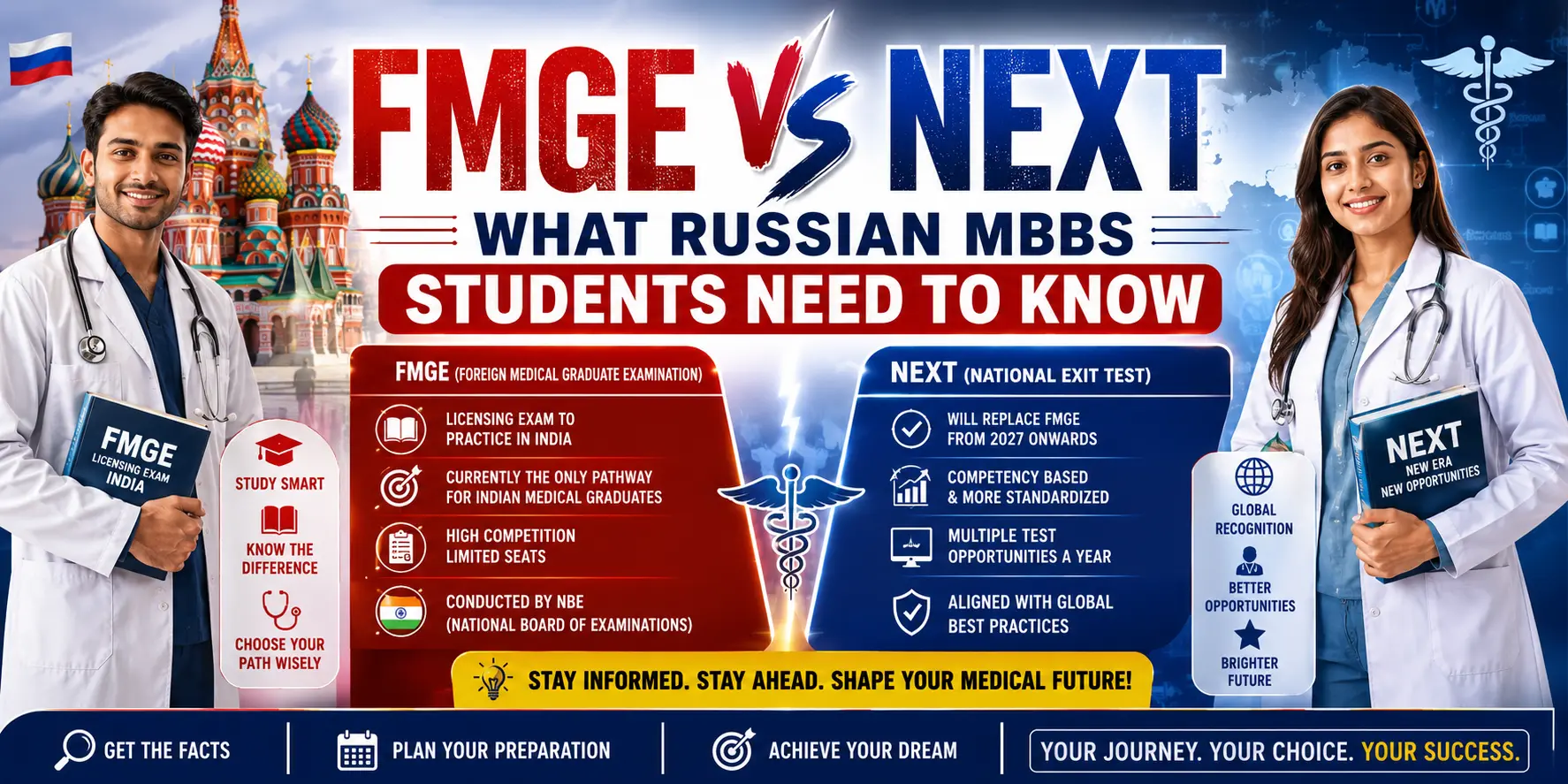
For Indian students pursuing medication overseas, mainly the ones enrolled in MBBS in Russia, understanding the distinction between FMGE and next is not optional—it's miles essential for career planning.
With India transferring toward a brand new licensing system, hundreds of students studying MBBS in Russia or making use of for MBBS admission in Russia have to now put together for a first-rate transition in how overseas medical graduates could be tested, registered, and certified.
This manual explains FMGE vs subsequent intensive, their structure, implications, and the way Russian MBBS college students have to prepare strategically.
1. What is FMGE? (overseas medical Graduate exam)
The FMGE (overseas scientific Graduate exam) is a screening test conducted by way of the country wide Board of Examinations in India for Indian citizens who have received their clinical stages abroad.
Key features of FMGE:
- performed two times a year
- 300 a couple of-desire questions
- bypass percent requirement: 150/300 (50%)
- Covers complete MBBS syllabus
- No medical practical aspect
- simply theory-primarily based exam
FMGE has traditionally been the gateway for college kids returning after completing MBBS from Russia or different international locations.
however, FMGE has been extensively criticized for:
- excessive failure rates (regularly eighty–90%)
- lack of medical assessment
- Repetitive attempts wanted for passing
- limited real-international ability testing
Because of these barriers, India is transitioning to the next.
2. What's next? (countrywide go out test)
The subsequent (countrywide go out test) is a proposed unified clinical licensing exam in India on the way to update FMGE, very last-year MBBS college assessments, and also act as a postgraduate front examination.
It is regulated under the framework of the national clinical fee (NMC).
Key Roles of subsequent:
- Licensure exam for MBBS graduates
- Screening test for overseas scientific graduates
- entrance exam for postgraduate clinical courses
3. Why subsequent is a game-Changer for Russian MBBS college students
students pursuing MBBS in Russia for Indian college students could be immediately impacted through next because:
- it is greater clinically oriented
- It checks actual-world scientific skills
- It reduces dependency on rote memorization
- It integrates internship and licensing in one machine
Unlike FMGE, subsequent is designed to evaluate whether or not a pupil is certainly suited to practice medicinal drugs in India.
4. FMGE vs subsequent: most important variations
4.1 Exam shape
FMGE:
- single concept paper
- MCQ-primarily based
- No realistic examination
Subsequent:
- 2 parts:
- subsequent Step 1 (theory-based)
- subsequent Step 2 (medical/sensible evaluation)
That is a main shift for college students doing MBBS path in Russia due to the fact that clinical talents now matter as much as theory.
4.2 motive of the exam
|
Feature |
FMGE |
Subsequent |
|
purpose |
Screening handiest |
Licensing + PG front |
|
clinical assessment |
No |
yes |
|
Internship Requirement |
After passing |
included |
|
PG Admission function |
No |
sure |
4.3 difficulty stage
FMGE is taken into consideration unpredictable, however subsequent is anticipated to be:
- greater based
- greater clinically practical
- extra aligned with Indian MBBS curriculum
students finishing MBBS in Russia 2026 ought to prepare for a greater application-based examination.
5. Why India is changing FMGE with next
The shift is pushed by using global scientific education requirements recommended through organizations including the world health corporation (WHO).
Key motives:
- FMGE does not take a look at scientific competence
- India desires uniform licensing requirements
- want to align Indian doctors with international healthcare systems
- improve patient protection and clinical great
Next is designed to make certain docs are clinically equipped, not just academically qualified.
6. impact of next on Russian scientific Universities
Russian universities have begun adapting their curriculum to make certain students remain eligible for Indian licensing assessments.
For college kids pursuing MBBS in Russia or MBBS abroad in Russia, those adjustments are very critical.
Key adaptations include:
- multiplied clinical rotations
- Early patient publicity
- English-medium + medical Russian integration
- Case-based getting to know techniques
- structured internship documentation
Those changes help college students align higher with subsequent requirements.
7. Position of WDOMS and international popularity
the world directory of medical colleges (WDOMS) performs an essential position in figuring out whether a Russian college is globally recognized.
next eligibility depends closely on:
- university recognition
- route structure validity
- clinical education standards
students planning MBBS in Russia 2026 should always affirm their university in WDOMS before admission.
8. Clinical education: the biggest difference among FMGE and next
next locations heavy emphasis on clinical competence, which is a chief shift from FMGE.
abilities tested in next:
- affected person examination
- prognosis reasoning
- Emergency control
- Prescription writing
- communique capabilities
Russian universities imparting MBBS in Russia are actually strengthening clinic-primarily based education to suit these expectancies.
9. How Russian MBBS college students need to put together for subsequent
Students enrolled in Russia for MBBS or MBBS in Russia must begin preparation early.
9.1 awareness on medical knowledge
- Spend extra time in sanatorium rotations
- research case-primarily based diagnosis
- apprehend symptom-primarily based reasoning
9.2 strengthen core subjects
- medicine
- surgical procedure
- Pediatrics
- Obstetrics & Gynecology
9.3 practice MCQs + clinical eventualities
subsequent is expected to mix each codecs.
9.4 enhance communique capabilities
mainly for affected person interaction in India.
10. FMGE vs subsequent Passing method Shift
FMGE method (old device):
- Memorization-heavy
- coaching-based totally education
- MCQ practice attention
next approach (New system):
- concept-based totally gaining knowledge of
- scientific exposure
- practical information
- decision-making potential
This shift is essential for students pursuing MBBS in Russia for Indian college students.
11. Demanding situations Russian college students may additionally Face in subsequent
even though Russian MBBS education is robust in idea, students may also face demanding situations like:
- limited exposure to Indian scientific cases
- Language variations in patient interaction
- version in disorder patterns
- need for additional coaching in India
but, universities are improving schooling systems to reduce those gaps.
12. Benefits of subsequent for Russian MBBS Graduates
no matter challenges, subsequent has several benefits:
- One single examination for licensing and PG
- greater obvious assessment device
- higher recognition of scientific talents
- reduced reliance on repeated FMGE tries
students finishing MBBS from Russia will gain from an extra standardized evaluation gadget.
13. Is FMGE nonetheless applicable?
sure—however handiest temporarily.
FMGE is predicted to phase out completely as soon as subsequent is fully carried out. Until then, students in Russian universities might also nevertheless come across FMGE relying on their commencement timeline.
14. Very last comparison precis
FMGE:
- idea-primarily based
- Screening examination most effective
- No medical testing
- restrained scope
subsequent:
- theory + clinical exam
- Licensing + PG front
- Competency-based
- future of Indian scientific licensing
Conclusion
The transition from FMGE to subsequent is one in every of the largest reforms in Indian medical education. For college students pursuing MBBS in Russia, russia MBBS, or MBBS path in Russia, information this shift is essential for lengthy-time period success.
Subsequent isn't always simply an examination—it's miles an entire remodel of how doctors are trained, evaluated, and authorized in India. Russian universities are actively adapting, but students should additionally take duty for constructing robust medical and conceptual foundations.
In the coming years, success will rely no longer simply on incomes and a diploma overseas, however on mastering the skills required to end up a competent, globally equipped clinical professional.