
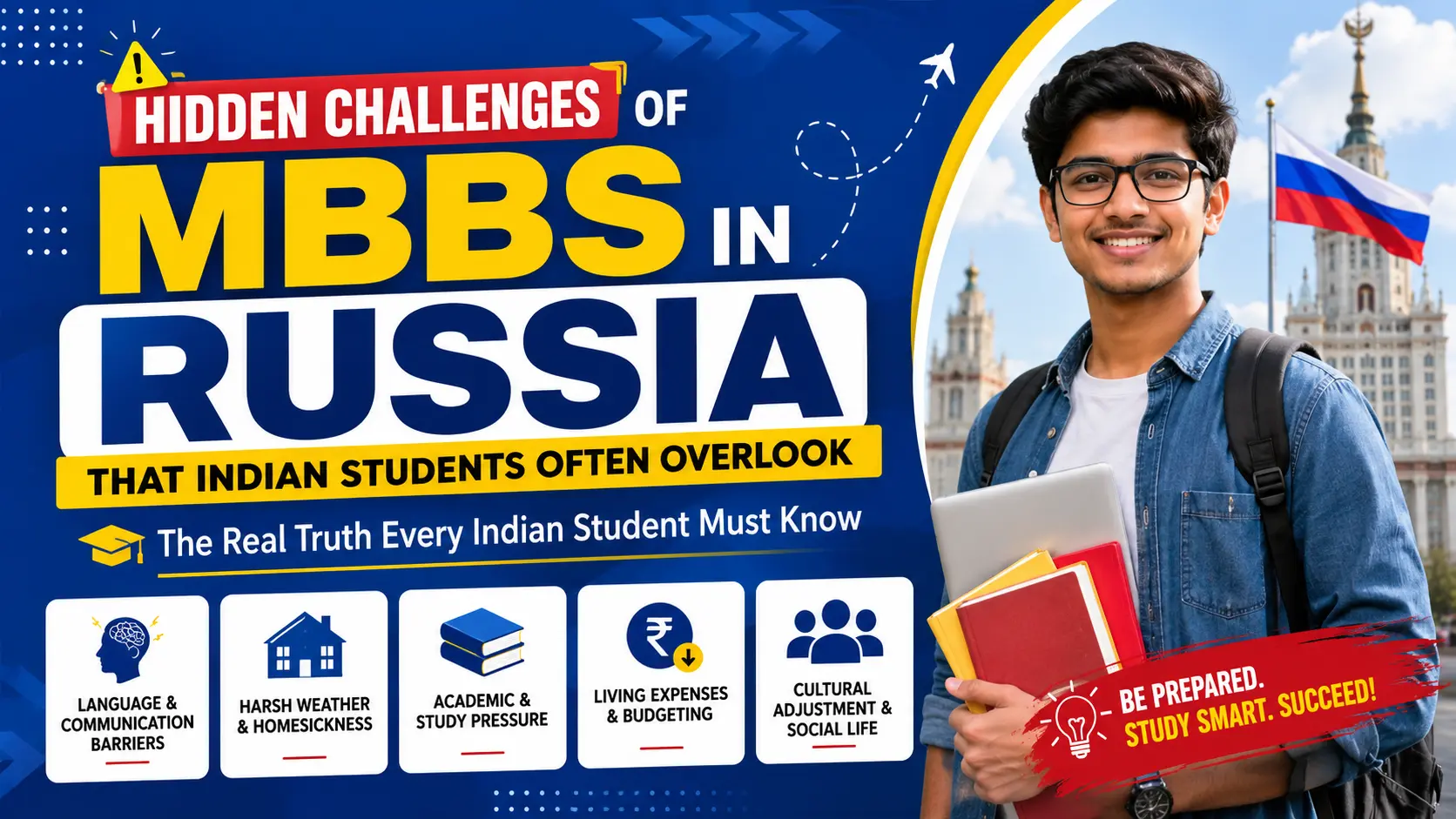
For Indian medical students, MBBS in Russia has become one of the most coveted options. This is because these programs have affordable tuition, global recognition, and less competition compared to MBBS in India. As a result, thousands of students go to Russia to fulfill their medical dreams.
While most consultancy sites only mention the perks of moving abroad for MBBS, very few explain the real hurdles students face after reaching Russia. These hurdles include severe weather, FMGE/NExT exam pressure, and language and cultural barriers. As such, the journey to becoming a doctor in Russia is not as easy as it seems.
This guide aims to provide the hidden hurdles of pursuing medicine in Russia and the eligibility, fees, application process, the universities, career prospects, and frequently asked questions in one place to provide students with the information they need to decide whether they should pursue MBBS in Russia.
Featured Snippet: Hidden Hurdles of Pursuing MBBS in Russia
The hidden hurdles of pursuing MBBS in Russia for Indian students include the language barrier, Russia’s cold climate, difficulties with the FMGE/NExT exam, limited clinical exposure in some universities, cultural differences, homesickness, and the pressure to succeed given the differences in the teaching methods and the Russian hospital and communication systems.
Overview for Pursuing MBBS in Russia
Russia is a popular study destination for overseas MBBS students because the tuition costs are lower than many countries and degrees are awarded that are acceptable around the world. Additionally, many universities are documented by the World Health Organization (WHO) and WDOMS, so they are eligible for the international licensing examinations.
When applying for Russian MBBS programs, students are often comparing options like MBBS in Russia 2026 or MBBS Russia.
However, selecting the best university under Russia MBBS University for the right choice becomes integral to success.
Eligibility Criteria for MBBS in Russia
For Indian students, applying for MBBS in Russia has some basic criteria to be met:
Academic Criteria
50% in Physics, Chemistry, and Biology (PCB) for the general category
40% in PCB for reserved categories
NEET
In accordance with the guidelines of the National Medical Commission (NMC India), it is compulsory for students to qualify for the NEET.
Age
The student must be at least 17 years of age. Students aspiring for MBBS in Russia or MBBS from Abroad must adhere to the guidelines of NMC.
Admission Process MBBS in Russia
The MBBS admission process in Russia is simple but needs to be carried out with caution:
Step 1: Select a University
Step 2: Apply Online
Step 3: Admission/Invitation Letter
Step 4: Visa Application
Step 5: Fly to Russia
For MBBS in Russia, many students depend on guidance to avoid malpractice.
MBBS in Russia Fees Structure (2026)
The MBBS in Russia Fees Structure (2026) is one of the top reasons for students' preference towards Russia.
Table 1 Overview of MBBS in Russia Fees
|
Type of Expense |
Annual Expense Range |
Total for 6 years |
|
Tuition Fees |
₹2.5–5 Lakhs |
₹15–30 Lakhs |
|
Hostel Fees |
₹0.5–1 Lakh |
₹3–6 Lakhs |
|
Living Costs |
₹1–1.5 Lakhs |
₹6–9 Lakhs |
|
Other Expense |
₹0.3–0.5 Lakhs |
₹2–3 Lakhs |
One of the most common searches for MBBS in Russia is 2026 for Indian Students.
Some Major Hidden Challenges of MBBS in Russia
1. Language Barrier in Hospitals
Although classes in Russia MBBS are conducted in the English language, communication in hospitals is Russian. This becomes a difficult challenge in clinical practice as the patients are Russian speakers. This causes a big problem for students in the clinical years of the MBBS Program in Russia.
2. Harsh Weather
With average temperatures falling to below -20°C, Russia’s weather will be hard for Indian students to adjust to.
3. FMGE / NExT Exam Pressure
Indian students will have to qualify the FMGE/NExT to practice in India after completing the MBBS from Russia. Official reference: NTA NEET Portal
4. Low Clinical Exposure in Some Universities
Practical education will be impacted if some hospitals have low patient flow.
5. Cultural Shock & Homesickness
Students will deal with:
- Food Differences
- Language Problems
- Social Isolation
6. Curriculum Difference
Russian medical education has a theory and exam focus, whereas Indian education has a focus on providing clinical training. Students planning on studying MBBS in Russia for Indians should mentally prepare for these circumstances.
Reasons to Study MBBS in Russia
Even with the obstacles, Russia is a desired study destination due to:
- Low cost of Education
- Recognition by the WHO and WDOMS
- English in the first years
- Global Exposure
- Modern Facilities
Students searching for MBBS Russia and MBBS in Russia will get these benefits.
Cons of Studying MBBS in Russia
- FMGE/NExT dependency
- Language Issues in Clinics
- Harsh Weather
- Limited Exposure in some colleges
- Long Distance
- Cultural Issues
Students planning to study MBBS in Russia 2026 will have to deal with all of these issues.
Best MBBS Universities in Russia
Table 2: Top Medical Colleges
|
University |
City |
Approximate Annual Fees |
|
Kazan |
₹5–6 Lakhs |
|
|
Ufa |
₹3–4 Lakhs |
|
|
Simferopol |
₹3–4 Lakhs |
|
|
Orenburg |
₹4–5 Lakhs |
|
|
Perm |
₹4–5 Lakhs |
|
Most students look at FMGE results when selecting Russia MBBS university.
What Next After MBBS in Russia
After MBBS in Russia, students can:
In India
- Clear FMGE/NExT
- Start practice
- Prepare for NEET PG
Abroad
- Clear USMLE (USA), PLAB (UK), AMC (Australia)
Reference: World Health Organization (WHO)
For students targeting MBBS in Russia, start studying for the exams at the earliest.
FAQs
Q1: Should Indian students prefer MBBS in Russia?
Yes, if students can tackle FMGE/NExT and language challenges.
Q2: Is NEET required for MBBS in Russia?
Yes.
Q3: What is the budget for MBBS in Russia?
₹20–₹35 lakhs.
Q4: Is it possible to practice in India after MBBS in Russia?
Yes, after FMGE/NExT.
Q5: Is Russian language compulsory?
Yes, it is.
Conclusion
MBBS in Russia is among the top choices for Indian students for affordable medical studies, but it is among the most challenging choices as well. There are many hidden challenges like FMGE/NExT, Russian, climate, cultural challenges and more. All students have to prepare and plan for these challenges BAfore making the decision.
Lastly, most platforms that promote MBBS abroad in Russia look at the bright side. Only you will know what you will have to go through to succeed with the right discipline, the right university and long term exam prep. Knowledgeable students are more successful than students who are poorly prepared, especially when it comes to a challenging field like medicine.