
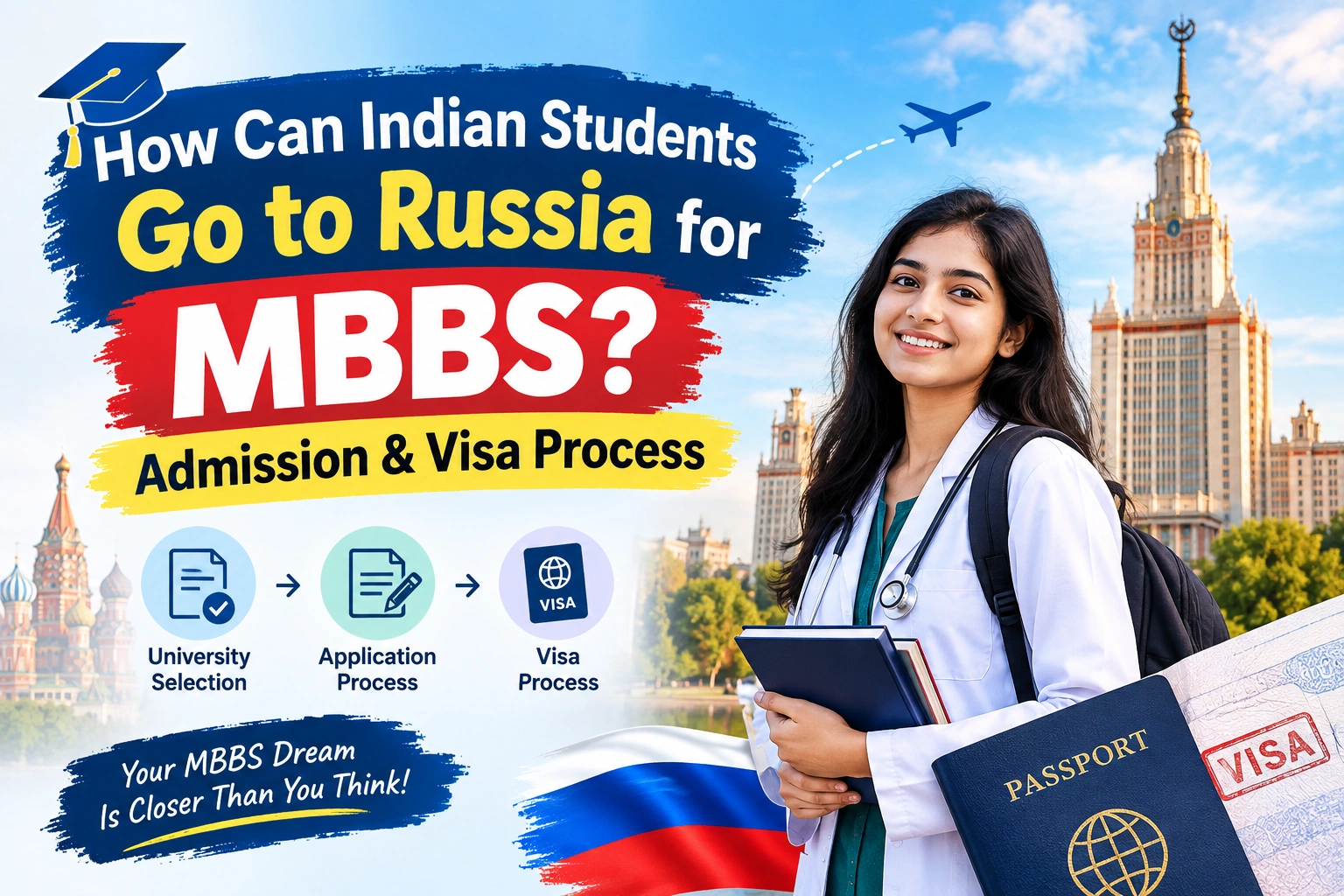
For many Indian students, MBBS in Russia becomes an option after comparing private medical colleges in India, other study-abroad destinations, and the total cost of becoming a doctor. Russia has established medical universities, a long history of medical education, and several institutions listed in the World Directory of Medical Schools (WDOMS). But getting there isn't simply a matter of paying a university fee and booking a flight. There are eligibility rules, university checks, admission paperwork, an invitation, and a student visa to handle. The good part? Once you understand the sequence, the process becomes much easier to manage. The MBBS in Russia route generally starts in India with checking your NEET eligibility and selecting a suitable university, then moves through admission, documentation, invitation, visa application, and finally travels to Russia.
Why Do Indian Students Choose Russia for MBBS?
Russia has been attracting international medical students for years, including students from India. One reason is that some Russian medical universities offer medical programmes in English, while the overall fee structure can be lower than many private medical options in India, depending on the university and city. The course is commonly structured over about six years, although the exact programme structure and clinical requirements should always be checked directly with the university.
WDOMS records show several Russian medical schools with six-year medicine programmes, and some list English among their languages of instruction. For example, the directory lists six-year programmes at institutions such as Syktyvkar State University Medical Institute, while other Russian medical universities have their own programme structures and admission requirements. Still, don't select a university just because someone says its fees are low. Honestly, that's one of the easiest ways to make an expensive mistake.
What Are the Eligibility Requirements for MBBS in Russia?
The basic academic route is familiar to Indian medical aspirants: complete Class 12 or equivalent schooling with the required science subjects and meet the applicable NEET requirement for studying medicine abroad. The National Medical Commission states that Indian citizens and OCI candidates intending to obtain a primary medical qualification abroad must qualify NEET.
Students generally need Physics, Chemistry and Biology/Biotechnology along with English at the senior-secondary level, subject to the applicable Indian regulations and the university's own admission conditions. Some Russian universities may also conduct their own document checks or entrance assessments. Before applying, check three things carefully: your Class 12 subjects, your NEET qualification, and the exact eligibility criteria published by the university for the intake you're applying for. The official NEET website should be your first reference for the examination side of the process.
Is NEET Required for MBBS in Russia?
Yes, for Indian citizens and OCI candidates seeking a primary medical qualification abroad, NEET qualification is a key requirement under the applicable NMC framework. This doesn't mean your NEET score automatically guarantees admission to a particular Russian university. University admission is a separate process.
The NMC specifically advises students going abroad to verify the university, course details, fees, duration, internship arrangements and other conditions directly with the institution rather than relying on an old list of "approved universities." So if an agent tells you, "NEET isn't required, we'll manage everything," stop there. Verify the claim independently.
How Much Does MBBS in Russia Cost?
Fees vary quite a bit from one Russian medical university to another. As a broad planning figure, Indian students may find tuition commonly discussed in the range of roughly ₹2.5 lakh to ₹6 lakh per year, while some universities and programmes can be higher. Hostel, insurance, food, travel, visa-related expenses and other charges come separately. That means a six-year academic and living budget can easily reach several tens of lakhs, depending on the university and lifestyle. Exchange rates also matter because university fees are normally quoted in Russian currency or another specified payment currency.
Don't rely on one "Russia MBBS total fee" figure copied from a website. Ask the university for the current fee schedule, hostel charges, payment deadlines, refund rules and any additional institutional charges before transferring money. The MBBS in Russia guide can also help students understand the different cost components, but the university remains the final source for its own fees.
Which Russian Universities Can Indian Students Consider?
There isn't one universal university that suits every Indian student. Location, tuition, hostel facilities, clinical exposure, teaching language and university policies all matter. WDOMS currently contains records for numerous Russian medical schools. Its listings include institutions such as Siberian State Medical University, Russian National Research Medical University named after N. I. Pirogov, Bashkir State Medical University, Samara State Medical University, Smolensk State Medical University and others.
But there's a detail students often miss: being listed in WDOMS does not itself mean that WDOMS is endorsing or accrediting a medical school. WDOMS explicitly says that listing a school doesn't constitute recognition, accreditation or endorsement. For an Indian student, the check has to go further. Review the Russian university's current status, programme, language of instruction and compliance with the requirements that apply to foreign medical graduates in India.
What Are the Steps to Get Admission for MBBS in Russia?
The admission process usually starts several months before the academic session. Exact deadlines differ between universities, so don't wait until the last minute.
1. Check Eligibility and NEET Status
First, make sure you satisfy the Indian requirements for studying medicine abroad. Keep your NEET result, Class 10 and Class 12 documents and passport information ready.
2. Select the University
Compare tuition, hostel fees, city, language of teaching, clinical training and the university's current documentation. Check the institution through WDOMS and verify information directly with the university.
3. Submit the Application
Once you've selected a university, submit the application and required documents. Commonly requested documents can include your passport, academic certificates, photographs, NEET documents and other forms specified by the university.
4. Receive the Admission or Offer Documents
If the university accepts your application, you'll receive the relevant admission confirmation or contract documents. Read the fee conditions carefully before making payment.
5. University Arranges the Invitation
For international students, the university or its authorised process generally handles the documentation needed for the Russian entry invitation. Keep this document safe because it becomes important for the visa stage.
6. Apply for the Student Visa
After receiving the necessary invitation and admission documents, apply for the appropriate Russian student visa through the applicable Russian consular/visa channel in India. Don't confuse a short-stay Russian e-visa with the student visa needed for a long-term medical programme; India's Ministry of External Affairs notes that the Russian e-visa permits only a short stay of up to 16 days and isn't a substitute for long-term study arrangements.
What Documents Are Needed for the Russian Student Visa?
Your exact checklist can vary depending on the current Russian visa requirements and your university, but students should generally be prepared with documents such as:
- Valid Indian passport
- Russian university admission documents
- Official invitation issued for the study purpose
- Completed visa application
- Passport-size photographs
- Educational documents
- Required medical or health-related documents, where applicable
- Visa fee and service charges
- Other documents requested by the Russian consular authorities
Check the latest requirements before submitting anything. Visa rules can change, and a document checklist from an older admission cycle may no longer be enough. The Ministry of External Affairs advises Indian students going abroad to obtain the appropriate study visa, verify that the university is accredited and recognised, and understand the laws and living conditions of the destination country.
What Happens After Reaching Russia?
Landing in Russia isn't the final step. There are still university formalities to complete. Your university will normally guide you through enrolment, accommodation, registration and other local procedures. Keep your passport, visa, admission documents, migration documents and university paperwork organised from day one.
Also remember that medical education isn't only about classroom lectures. Students may need to learn Russian to communicate effectively during clinical exposure, especially where interaction with local patients and hospital staff is involved. Even if the academic programme is taught in English, basic Russian can make daily life and clinical communication much easier. A small thing. Big difference.
Can Indian Students Practice Medicine in India After MBBS in Russia?
This is where students need to be especially careful. Completing a medical degree abroad doesn't automatically mean you can start practising medicine in India. The NMC's Foreign Medical Graduate Licentiate Regulations set requirements concerning the duration and structure of foreign medical education. NMC's FAQ states that the foreign medical degree programme should have a minimum duration of 54 months and that the medium of instruction should be English, along with other requirements concerning theory, practical and clinical training.
The NMC also provides requirements concerning the additional internship/clinical training component and the conditions for registration in India. The regulatory framework has also been updated through NMC notifications and FAQs, so students joining a programme now should check the latest rules rather than depending on advice given to students several years ago. For this reason, always check the latest information directly on the NMC website before paying a university or consultant.
What Are the Extra Costs Students Should Plan For?
Tuition isn't the whole budget. A realistic financial plan should include hostel accommodation, food, airfare, visa expenses, medical insurance, local transportation, winter clothing, residence-related expenses and personal spending. Travel costs can also change considerably depending on the season and city. Russian winters are another practical consideration. Students arriving from warmer parts of India may need to spend extra on suitable clothing, especially during the first year.
The World Health Organization can be useful for general health information, while university and government sources should be used for programme-specific requirements. You can refer to the WHO for general health guidance and the WDOMS directory when researching medical schools. WDOMS itself recommends using its information to help prospective students and regulators make informed decisions about medical schools.
Pros and Cons of Studying MBBS in Russia
For some students, the main attraction is the combination of established medical universities, international student communities and comparatively moderate tuition at selected institutions. English-taught options are also available at some universities.
The other side needs equal attention. Students must deal with a different climate, language barriers, travel distance, currency fluctuations and the requirements that apply if they later want medical registration in India. University selection also matters a lot. Two universities can have very different fees, facilities and student experiences. So, MBBS in Russia can be considered only after checking the full picture, not just the advertised tuition fee.
Frequently Asked Questions
Can I study MBBS in Russia after Class 12?
Yes, eligible Indian students can apply after completing the required senior-secondary education and qualifying NEET, subject to the university's admission criteria and applicable NMC rules.
How long is MBBS in Russia?
Medical programmes in Russia commonly run for around six years. However, students should verify the exact duration, curriculum and internship structure of the specific university before admission. WDOMS records, for example, show six-year medicine programmes at several Russian institutions.
Is NEET mandatory for Indian students?
Yes. NMC guidance states that Indian citizens and OCI candidates intending to obtain a primary medical qualification abroad must qualify NEET.
Do Russian medical universities offer English-medium programmes?
Some do. WDOMS listings show Russian medical programmes with English as one of the listed languages of instruction. However, students should verify the exact language of the programme they are applying for directly with the university.
Do I need a Russian student visa?
Yes, students travelling to Russia for a long-term medical programme need the appropriate study visa and supporting admission/invitation documentation. A short-stay e-visa isn't a replacement for a long-term student visa.
Can I return to India and practise after graduation?
You must meet the applicable Indian regulatory requirements for foreign medical graduates. The NMC's FMGL framework includes requirements relating to course duration, English-medium education, clinical training and other conditions for registration. Check the latest NMC rules before choosing a university.
Conclusion
Going to Russia for medical education involves much more than getting an admission letter. Start with NEET and academic eligibility, research the university carefully, verify its programme and current status, understand the complete cost, complete the admission formalities, obtain the required invitation, and then apply for the correct student visa.
Take your time with the university selection. Really. If you're researching MBBS in Russia, use official sources such as NMC, NEET and WDOMS alongside the university's own current admission information. That extra verification can save you from problems years later, especially when your goal is ultimately to practise medicine in India.