
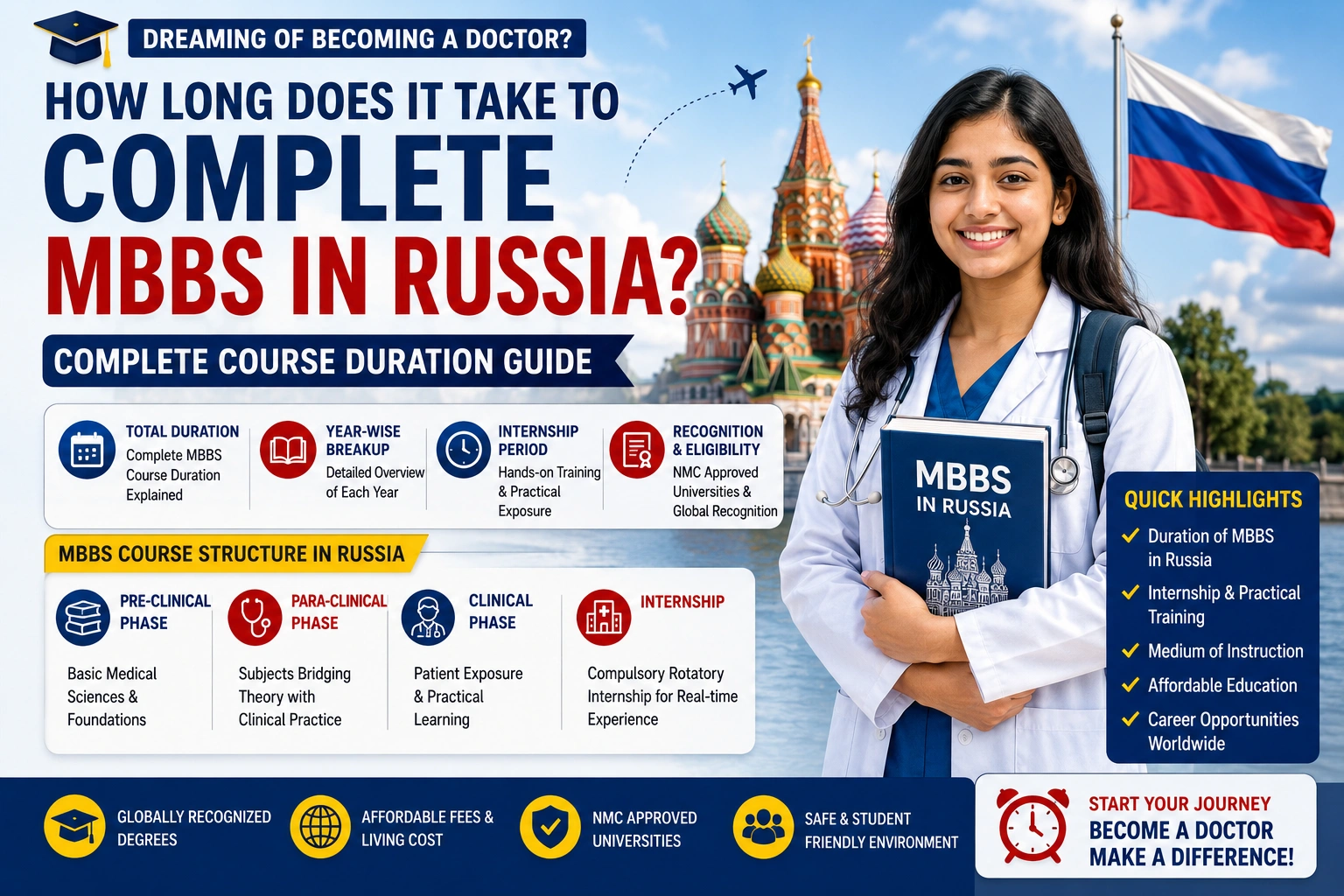
MBBS in Russia often attracts Indian students who are interested in pursuing medical education abroad, as Russian medical universities provide structured medical education and clinical facilities. They also offer programs that typically last six academic years. Students should realize that the journey doesn't end with the university exam. The length of time it takes to become a doctor in India can be affected by the course structure, clinical requirements, internships, licensing rules and Indian medical regulations.
The curriculum of a typical General Medicine course in Russian medical schools is six years long. The World Directory of Medical Schools' (WDOMS)and WHO, which lists Russian medical schools, shows six-year General Medicine programs, some of which are offered in English and others in Russian. Before admission, Indian students should check the course duration of their university against the National Medical Commission requirements.
MBBS Course Duration in Russia at a Glance
|
Course Component |
Average Duration |
|
General Medicine degree |
6 Years |
|
Classroom and laboratory training |
Mostly first year students |
|
Clinical Training |
Integrate into future years |
|
Exams at Universities |
The course |
|
Indian graduates have additional requirements |
According to current NMC regulations |
Students in India are most likely to see a six-year period when they research MBBS programs in Russia. Russian General Medicine programs are often more clinically oriented than other countries, where the medical program is described as a 5-year academic course followed by an internship.
Why is MBBS usually six years old in Russia?
Medical education takes much more time than the conventional undergraduate degree, because students need to develop both theoretical and clinical skills. The Russian General Medicine Curriculum normally moves from the foundational medical sciences into clinical subjects and supervised exposure to patients.
In the first part of the course, students study topics such as histology and microbiology. These subjects provide the scientific basis needed to understand disease processes.
The curriculum becomes more clinical as students advance. As students progress, the curriculum becomes more clinical. Students can connect classroom concepts to actual patient care through clinical exposure.
WDOMS records of Russian medical schools show that the six-year General Medicine program is used by different institutions. However, the exact qualification title and teaching language, as well as curriculum arrangements, can vary.
The Year-Wise Structure for MBBS in Russia
Basic Medical Sciences
In the first two years, students are taught about the body and basic medical sciences. Students can study introductory subjects such as anatomy, physiology and biochemistry.
It can be a demanding stage because the students must build a solid foundation before they begin treating patients. Students from abroad also need to spend time getting used to the academic system, and where appropriate, Russian medical terminologies.
Transition from Clinical Medicine in Years 3-4
In general, the middle years are a transitional period from basic sciences into clinical medicine. Students start studying in more depth diseases, diagnostic methods and pharmacological treatments.
Practical classes and exposure to clinical settings are becoming increasingly important. Students may be trained in clinics, hospitals affiliated with the university or other healthcare facilities.
Even if the main academic program is in English, it can be very useful for Indian students to learn basic Russian. Understanding local medical terms can help you communicate with hospital staff and patients.
Years 5-6: Advanced clinical training
In general, the final two years have a more clinical focus. Students are exposed to major specialties, and they also receive practical training that aims to improve their decision-making skills and patient management.
There are differences in the exact rotation patterns and subjects between universities. Applicants should check their curriculum before assuming all Russian universities follow a similar timetable.
The university and Russian regulations require that students complete the academic and clinical requirements for their medical qualification by the end of the 6th year.
Does MBBS include an internship in Russia?
It is a very important question for Indian students. This depends on your university program and requirements.
Students from India should not assume they are eligible to practice medicine in India simply because they have completed six years of academic study. NMC’s current rules include Foreign Medical Graduate Licentiate Regulations, and mandatory internship-related regulations.
In the FMGL FAQ published by the NMC, it is stated that foreign medical graduates must complete the prescribed course as well as internship/clinical clerkship. The internship requirement is 12 months at the same foreign medical facility under the specified framework. The FMGL FAQ also specifies that the foreign medical graduates must complete the entire course within 10 years of their joining date.
Students should check the academic and clinical pathways of the university they are considering before paying their admission fees.
Does NEET require MBBS in Russia
Students from India who wish to study a foreign medical degree must meet all Indian eligibility requirements. This includes the NEET requirement.
For the most recent information on the NEET exam, you should check NEET's official portal. You should also consult NMC regulations for requirements regarding medical education or foreign medical graduates.
The NEET qualification does not automatically make all Russian medical universities suitable for Indian students. Students should independently verify the university's course structure, duration of clinical training, degree acceptance and compliance with applicable NMC regulations.
How WDOMS helps students check a Russian Medical University
Students should not rely on advertising from consultants or agencies to choose a university. They should do their own research.
The World Directory of Medical Schools can be used to check if a school is listed, and review information about their medical programs. The WDOMS can give details about a program, such as its name, the duration, the language of instruction, and any admission requirements. As an example, several Russian listings of medical schools show six-year General Medicine courses.
WDOMS is not a guarantee of a medical license in India. Students from India must also consider the NMC requirements that apply to foreign medical graduates.
What is the six-year duration for Indian students?
Although the basic six-year university program is still valid, the timeline for Indian students can be affected by their academic progress, exams, university requirements, and compliance with Indian licensing laws.
Students who finish their academic program within the six-year time limit may do so if they complete each year in a timely manner. Nevertheless, additional examinations, delays in academics, interruptions, or other circumstances may extend the duration.
The path after graduation is also something that should be looked at separately. The current NMC framework has additional requirements for foreign medical graduates in relation to internships and licensing. This includes the National Exit Test (or another mandatory test if applicable) or other mandated tests.
What should students check before admission?
Selecting a Russian medical school is not just about the duration of the course. Students should check carefully before admission:
- Accreditation and status of the university
- List of WDOMS programs and listing
- Duration of medical program
- Language of instruction
- Clinical Training Arrangements
- Hospital and Patient Exposure
- Structure of an internship or clinical clerkship
- After graduation, you will receive a degree.
- Current NMC Regulations: Eligibility
- Students in India must meet the NEET requirements
- Total living and tuition expenses
- Exams and academic progress: Rules for examinations
If there are any questions about the course structure, students should ask the university for written information.
How long does it take to become a practicing doctor in India?
Not necessarily. The six-year period is usually referring to the duration of the medical program at a foreign university. Additional regulatory steps could apply to an Indian student who wants to practice medicine in India after graduation.
The NMC lists the Foreign Medical Graduate Licentiate Regulations 2021 along with FAQs on the subject and mandatory rotating internship regulations as part of its undergraduate medical education regulations. Consequently, students should plan their education around the complete foreign-medical-graduate pathway rather than considering only the university's advertised course duration.
It is important to make this distinction because "six years MBBS" in Russia and "total required time to be eligible to practice in India" do not always mean the same thing.
Conclusion
The standard answer for most Indian students to the question of how long MBBS in Russia takes is six years. The WDOMS list of Russian medical schools commonly shows six-year General Medicine degrees, but the qualifications, teaching languages and individual curriculum may differ.
Students should consider more than just the six-year period and look at clinical training, internship arrangements and NEET eligibility. They should also check WDOMS and the most recent NMC requirements. It is best to check all of these factors before choosing a university, as foreign medical education regulations are subject to change and Indian graduates have different requirements.
Understanding the timeline for MBBS admission in Russia can help students avoid unexpected delays. It will also allow them to make an informed decision regarding their future medical education.