
I remember a father at a Delhi education fair last October, gripping a folder full of brochures, asking me the same question three different ways. "Six years total, right? Or is it five with internships separate? My son's agent said something different last week." He wasn't confused because he was careless. He was confused because half the consultants in this business give half-answers dressed up as full ones.
That's the honest starting point for this piece. Not a definition. A dad, a folder, and a number nobody had bothered to explain properly.
The Real Timeline Nobody Breaks Down Clearly
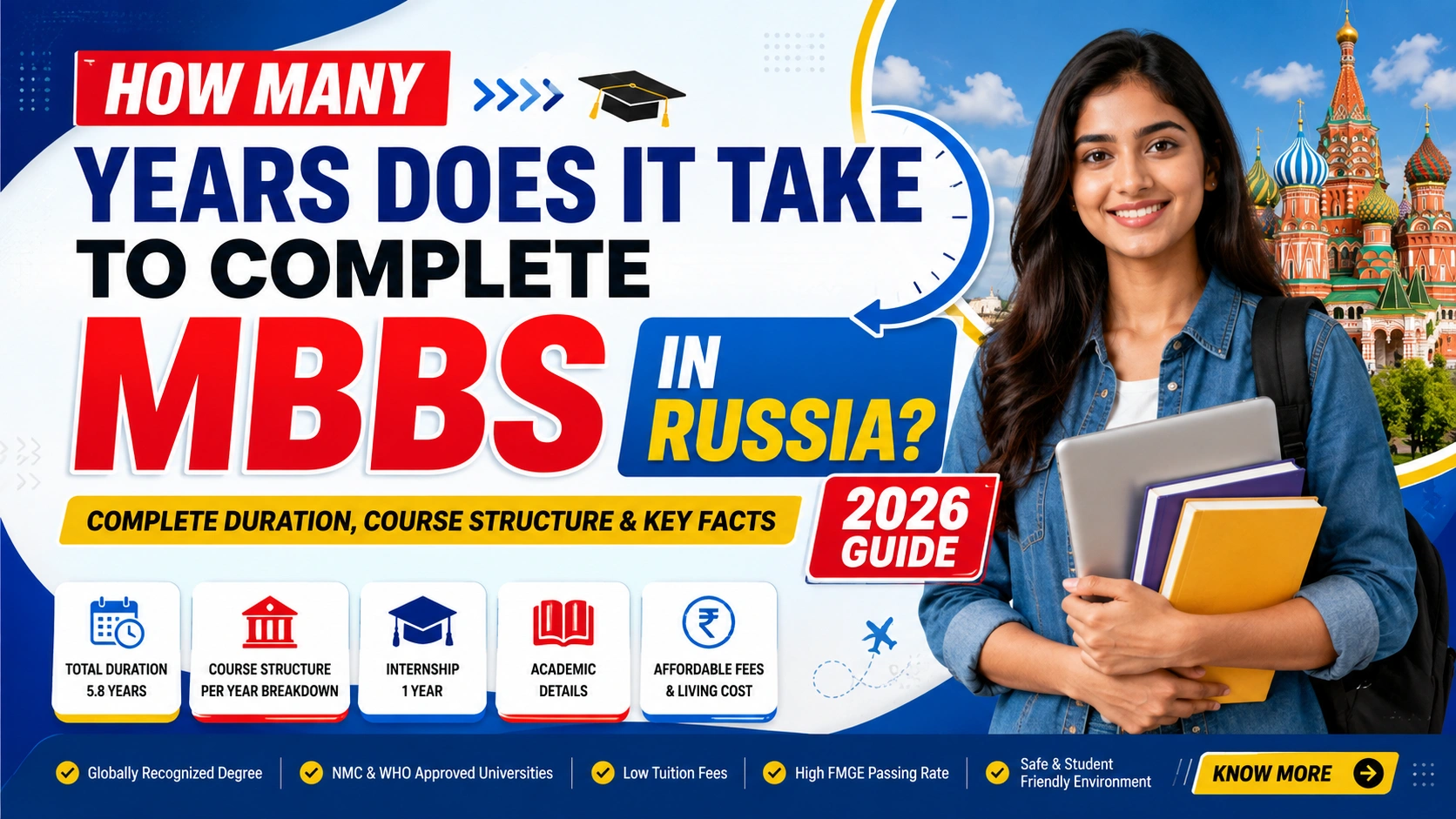
MBBS in Russia runs six years for the academic program itself, taught in most universities as a unified specialist degree rather than the separate MBBS-then-BS structure Indian students are used to. I've sat through orientation sessions at Kazan Federal University and Crimea Federal University where this gets explained on day one, and yet students still land back in India a year later asking why nobody told them about the internship.
Here's the piece that actually trips people up. After those six years, if you want to practice in India, you don't just fly home and start seeing patients. You sit the FMGE — the Foreign Medical Graduate Examination — and depending on when you enrolled, you may also need a compulsory rotating internship, either in Russia or back home, before the NMC considers you eligible to register. So when someone tells you "five years and you're a doctor," they're not lying exactly. They're just leaving out the part that matters most.
Why Six Years, Not Five
Short answer: because that's how Russian medical education has always been structured, long before Indian students started arriving in large numbers in the 2000s. The first year is mostly general sciences — physics, chemistry, biology, and Russian language classes that genuinely matter more than students expect. Years two through four move into pre-clinical and para-clinical subjects. The final two years are clinical, with actual hospital postings in cities like Volgograd, Orenburg, and Tver.
I've spoken to graduates from Volgograd State Medical University who told me the clinical years felt rushed compared to what they'd expected, not because the teaching was weak, but because ward rotations at Russian teaching hospitals are structured differently — shorter postings, faster subject turnover. It's not worse. It's just not what a first-year student pictures when they imagine "clinical training."
What the First Semester Actually Feels Like
Nobody puts this in the brochure, so I will. Your first winter in Russia will cost you more than you budgeted. A proper thermal jacket, decent boots, and thermal layers can run you anywhere from 8,000 to 15,000 rupees if you buy locally rather than lugging everything from India — and most students end up buying twice because what they packed from home wasn't built for minus 20 degrees in Kazan or Ufa.
Then there's the food adjustment. I've watched Indian students in hostels in Rostov-on-Don figure out, within about three weeks, that cooking dal and rice on a shared hostel stove is a survival skill nobody teaches you in Kota. Homesickness peaks around month two, almost predictably, right when the winter darkness sets in and flights home start looking tempting on the booking apps — a Moscow-to-Delhi return ticket during peak season can cross 55,000 to 70,000 rupees, which is exactly why most students go home only once a year, usually during the summer break.
None of this changes the six-year math. But it shapes how those six years actually feel, and that's worth knowing before you sign anything.
The Myth Agents Love to Repeat
I want to push back on something here, because I hear it constantly at fairs and in WhatsApp groups run by "seniors" who are actually paid promoters. The claim goes: "Russian MBBS is only five years faster than India." It's not faster. It's the same six years as most reputable Indian and international medical programs, just structured with a different rhythm.
Some universities do advertise accelerated tracks or credit transfers that shave off a semester for students with prior coursework, but that's the exception, not the rule, and it rarely applies to Indian students entering straight after Class 12. If an agent tells you five years flat, ask them to show you the university's official curriculum document. Most won't have one ready. That alone should tell you something.
Where NEET and Global Recognition Actually Fit In
Before any of this timeline matters, you need to have cleared NEET, because without a valid NEET score, no Russian medical university admission counts for practicing in India, regardless of what any consultant promises. Once you're in, the degree's international standing matters just as much as the years spent earning it. Most established Russian medical universities are listed with the WHO and appear in the WDOMS directory, which is the database Indian authorities and most foreign licensing bodies actually check — not some vague "WHO-approved" sticker on a university website, which frankly means less than agents pretend it does.
I'd tell any parent to verify WDOMS listing themselves before paying a single rupee in fees. It takes ten minutes and it's the single most useful thing you can do in this entire admission process.
So, Is It Really Worth Six Years Away From Home?
For students genuinely committed to medicine and open to a different cultural and academic rhythm, MBBS in Russia offers a legitimate, internationally structured path — six years of study, a curriculum recognized well beyond Russia's borders, and considerably lower fees than private Indian medical colleges. For families researching MBBS in Russia for Indian student options this year, the timeline itself isn't the risk. The risk is walking in with half-information about internships, FMGE, and what those six years actually cost beyond tuition.
I've met students who thrived in Kazan and Volgograd, and I've met a few who came home mid-way, overwhelmed by winters and homesickness nobody warned them about. The degree works. The country works. But only if you go in with your eyes open, not just your folder full of brochures.
Anyone seriously considering studying MBBS in Russia this year should sit down with the actual university curriculum, not a WhatsApp forward, before making a six-year decision.