
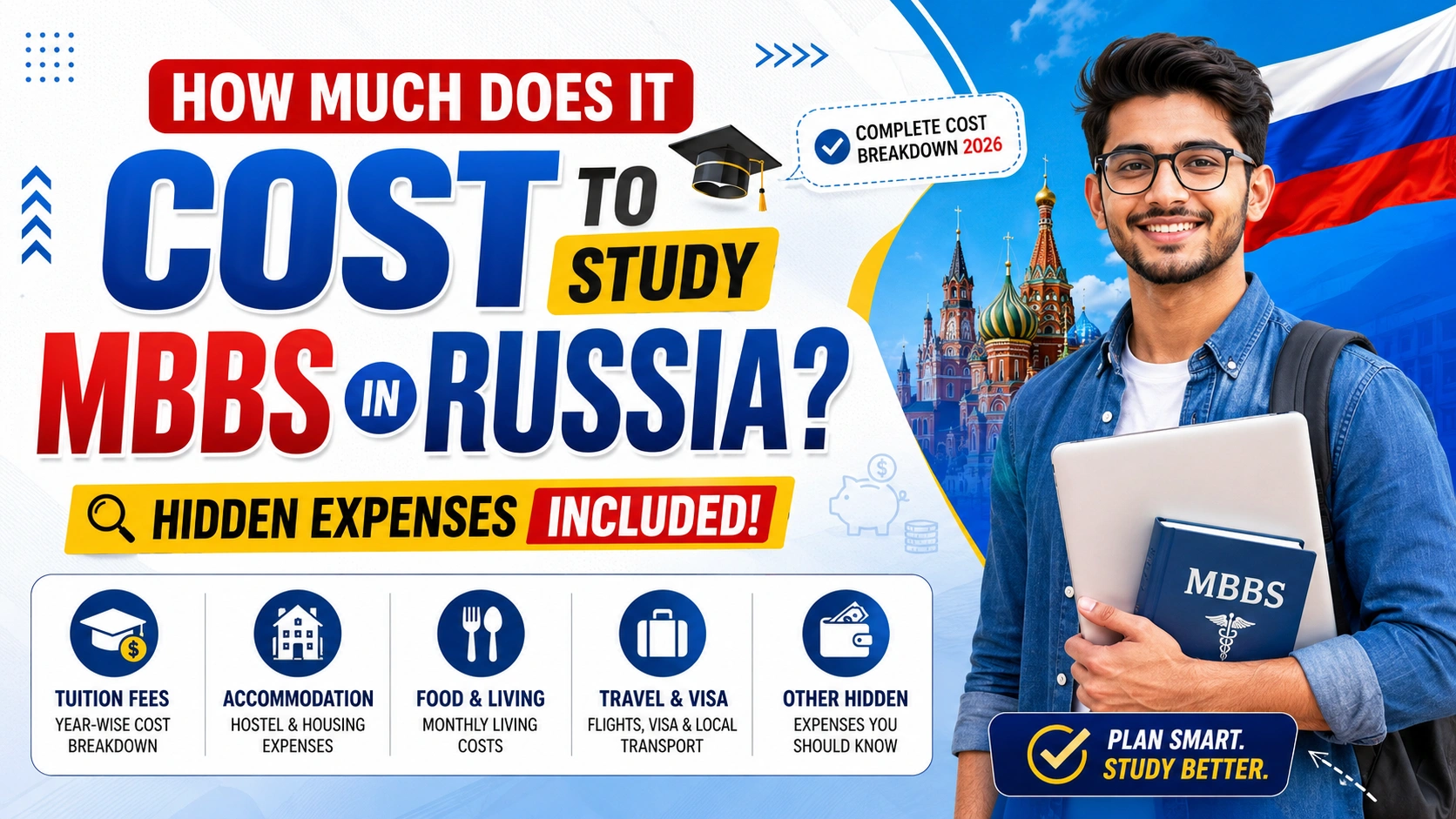
Russian medical universities are becoming a popular option for MBBS in Russia among Indian students. They provide infrastructural support and flexible payment options for students with different financial backgrounds. Even with these payment options available, students should know that the tuition coverage is only a small part of the total expense.
Other expenses should be accounted for, including but not limited to, visa expenses, airfare, food, medical insurance, local and intercity travel expenses, study materials, currency conversion, and any personal expenses. When considered, these expenses can alter the total expected budget.
Taking Sechenov University as an example, their 2026/27 batch for the General Medicine Program charges 1,300,000 Russian Rubles per year. They also charge separately for other preparatory programs.
It is advisable that students who want to study MBBS in Russia consider all of the above expenses and estimate the total cost for all six years, as opposed to constructing a budget based on tuition cost alone.
What Is the Total Cost of MBBS In Russia?
The total cost of MBBS In Russia can be anywhere between ₹20 lakh to ₹50 lakh for the entire course due to other varying expenses such as living situation, the city of the university, food, travel, and personal expenses. Tuition is the largest portion of the cost, while accommodation, food, insurance, travel, and visa expenses account for the other expenses.
The total cost of studying in Russia can vary greatly between universities. It is best to inquire directly with the universities.
MBBS In Russia: Main Cost Components
The total budget should be broken down into more categories rather than just looking at annual tuition.
1. Tuition Fees
Tuition tends to be the largest component of the budget. Tuition Fees are determined by the university, the city, the language of the course, and the academic year.
As a rough planning guide, international medical programs may cost anywhere from ₹3 lakh – ₹8 lakh or more per year. Programs from top tier schools in big cities may cost significantly more.
As an example, Sechenov University lists the tuition for General Medicine at 1.3 million rubles for 2026/27.
2. Hostel and Accommodation
Accommodation offered by the university may be considerably cheaper than renting a private apartment. Charges for hostel accommodation are dependent on the university and the type of hostel room.
Students should check if the costs for electricity, heating, internet, laundry, and other services are included in the hostel fees, or may be incurred separately.
3. Food and Daily Living
Food costs are an expense that varies significantly depending on lifestyle. MBBS in Russia for Indian students who prefer to cook, and therefore spend on groceries, may spend significantly less than students who eat out frequently.
A reasonable monthly budget should include:
- Groceries
- Mess or hostel food
- Local transportation
- Mobile data
- Personal items
- Entertainment
- Winter Clothing
4. Medical Insurance
Medical Insurance is a significant expense that should be included in budgeting costs. According to Russia's official Study in Russia portal, Voluntary Medical Insurance is Mandatory for Foreign Students.
Students should check with their university for the required coverage and cost to renew the insurance.
Hidden Expenses Students Forget
The cost of studying abroad cannot be captured with the tuition cost alone.
|
Hidden Expenses Per Item |
Planning Range Per Item |
|
Student Visa |
₹5,000 to ₹15,000+ |
|
Medical Insurance |
₹5,000 to ₹15,000+ Per Year |
|
Airfare |
₹25,000 to ₹60,000+ Per Trip |
|
Winter Clothing |
₹10,000 to ₹30,000 |
|
Books |
₹5,000 to ₹20,000 Per Year |
|
Transportation |
₹1,500 to ₹5,000 Per Month |
|
Mobile / Internet |
₹500 to ₹1,500 Per Month |
|
Personal Expenses |
₹3,000 to ₹10,000 Per Month |
|
Bank Charges |
Variable |
|
Emergency Expenses |
Reserve Separate Fund |
Approximate Budget for 6 Years for Indian Students
A realistic budget must include both academic and non-academic expenses.
|
Academic and Non-Academic Expense |
Approximate Budget |
|
Tuition |
₹18,00,000 to ₹40,00,000+ |
|
Hostel |
₹1,50,000 to ₹5,00,000+ |
|
Food |
₹3,00,000 to ₹7,00,000 |
|
Insurance |
₹30,000 to ₹90,000+ |
|
Visa/Documentation |
₹50,000 to ₹1,50,000+ |
|
Flights |
₹1,50,000 to ₹3,50,000+ |
|
Personal/Local Expenses |
₹2,00,000 to ₹5,00,000+ |
|
Emergency/Miscellaneous |
₹50,000 to ₹1,50,000+ |
|
Estimated Total |
₹27,00,000 to ₹64,00,000+ |
MBBS Eligibility Criteria in Russia
Taking the MBBS in Russia route involves consideration of both Indian and Russian requirements on the part of Indian applicants.
The following should be verified:
- Completion of Class 12 with a valid certificate or its equivalent
- Completion of courses in Physics, Chemistry and Biology/Biotechnology
- Attainment of specified minimum qualifying marks
- NEET qualification, if needed
- Possession of a passport
- Verification through a Medical Certificate and any other certificates as required
- Entrance examination requirements as specified by the university
For detailed and updated information on the NEET information portal, refer to the NEET information portal. According to the National Testing Agency (NTA), NEET-UG is a unified entrance examination for medical undergraduate courses in India.
Admission Process for MBBS in Russia
The outlined steps below are part of the admission process:
Step 1: Confirm Eligibility
This involves verification of qualifications, the NEET requirements, age limits, and university requirements.
Step 2: University Selection
Considerations at this point include tuition, hostel fees, the language of teaching, available clinical exposure, the location, university recognition, and student support.
For a list of universities and programs open to international students, refer to the Russian government's Study in Russia platform.
Step 3: Document Submission
These requirements vary, but commonly include: a passport, medical documents, academic certificates, photographs, and translated/legalized documents.
As stated in the international admission guidelines of Sechenov University, foreign applicants are required to meet the credentials and notarized translation stipulations.
Step 4: Admission Confirmation.
This is part of the university's internal process, and is the later outcome of a successful assessment.
Step 5: Visa Application
Documents provided by the university should be used for completion of the visa application process.
Step 6: Travel and Finalize Registration
Upon their arrival in Russia, students undertake university registration, complete the accommodation and other migration-related processes.
Leading Russian Medical Institutes
Prominent Russian medical institutes that international students consider include:
- Sechenov University
- Volgograd State Medical University
- Bashkir State Medical University
- Dagestan State Medical University
- Smolensk State Medical University
- Kazan Federal University
With a substantial infrastructure for clinical training and a large international student population, Bashkir and Volgograd State Medical Universities are also preferred by many students.
However, students are advised not to choose a university only because it is listed in any “top university” list. Always check the course, recognition status, admission processes, and fee structure before making any payment.
Considerations of Recognition & NMC
Indian students returning to India should especially consider the National Medical Commission (NMC)****’s current rules.
The NMC has set the criteria for foreign medical graduates and also governs the Foreign Medical Graduate Licentiate Regulations.
Students must verify the information on the official website of the NMC, check recognition status of the university using the WDOMS database, and assess the university’s curriculum and eligibility requirements before securing admission.
Students may refer to the WHO website for a trusted source of health-related information. However, students should keep in mind that recognition by the WHO listing does not automatically make the applicant eligible to practice medicine in India.
Advantages of Pursuing MBBS in Russia
Cost-effective
The presence of a large number of universities in Russia with varying fee structures allows students to select universities that are best suited to their requirements.
Established Medical Education System
Many Russian universities have long histories in providing medical education, having their own clinical training centers.
International Student Environment
The Russian Universities host students from many countries, including Bashkir State Medical University, which has more than 5000 foreign students from 64 countries.
Six-Year Medical Program
Many Russian General Medicine programs are six years long and conducted full time. General Medicine at Sechenov University, for instance, is a six year long specialist degree program.
Disadvantages and Challenges
Studying medicine abroad also requires advance planning.
The common challenges are:
- Cold weather and cultural adjustment
- Learning Russian for daily and clinical conversation
- Changes to currency value
- Long distance travel from India
- Extra cost of documentation
- Changes in university fee structure
- Adjusting to the foreign health and education system
They have to keep in mind that obtaining a medical degree from a foreign country is not enough to practice in India. Students have to complete Indian medical licensing and regulatory requirements.
Career Scope After MBBS in Russia
Depending on the country you intend to work in, there are various options for what you can do after completing medical education.
Some of these options are:
- Move Back to India and complete the required licensing pathway
- Medical Residency or Further Postgraduate Education
- Clinical Work after fulfilling local licensing regulations
- Medical Research
- Work in Public Health
- Administration of Hospitals
- Healthcare-Focused Teaching and Research
Which career option you choose also depends on qualification and the Country’s licensing requirements.
How to Reduce the Overall Cost
Here are a few more ways students can cut expenses.
- They should always compare universities and not just accept the first offer.
- They should choose economical hostel accommodation.
- They should cook instead of eating out.
- They should buy winter clothes locally or during the sales.
- They should pay attention to the currency exchange rate and bank fees.
- They should keep an emergency fund.
- They should double check each fee before paying them.
- They should contact the university to obtain a fee schedule.
- They should see if the hostel and insurance fees are required.
- They should set a budget for their travel costs each year.
Most importantly, students should not apply to a university simply because an agent offers an exceptionally low “total package.”
MBBS In Russia Cost FAQ
Is MBBS in Russia cheaper than studying MBBS in India?
This depends on which Indian medical school is being compared. Government medical schools are much cheaper, while private institutions can be more expensive. Russia has some of the many affordable international medical schools, but the total budget for the six years has to be taken into consideration.
How much money is MBBS in Russia?
Students can expect to pay about ₹27 lakhs to ₹64 lakhs or more to study MBBS in Russia for six years. This total includes tuition, accommodation, food, insurance, travel, and personal expenses. Costs will vary by university and each student's lifestyle.
What are the hidden costs?
Major ongoing costs will include tuition, accommodation, and food. International travel, insurance, visas, winter clothes, currency exchange, and emergency expenses should also be included in the budget.
Is NEET compulsory for Indian students?
Yes, Indian students should adhere to NEET and NMC requirements when opting to study medicine abroad. Current NEET updates should be taken from the NTA website.
Is hostel accommodation part of tuition?
In most scenarios, students should not be assured the hostel charges will be included in tuition. Most colleges will have a separate hostel fee that will require confirmation directly from the university.
After admission, can prices increase?
Yes. Fees and other costs can be modified year to year. Sechenov University has stated admission related tuition is revised every year.
Conclusion
The cost of MBBS In Russia is not restricted to the tuition fees reflected in the admission brochure. Cost estimation for food and accommodation, insurance, travel, visa, documentation fee, maintenance cost, and cost during stay has to be factored.
To cover most of these costs Indian students should formulate a budget for 6 years. It is advised not to consider just the low tuition fees, but consider total costs, the clinical training, the support provided to students, the academic structure, and the NMC regulations when comparing universities.
Thorough and detailed budgeting will help understand if studying in Russia aligns with the academic requirements and the financial capabilities of the family.