
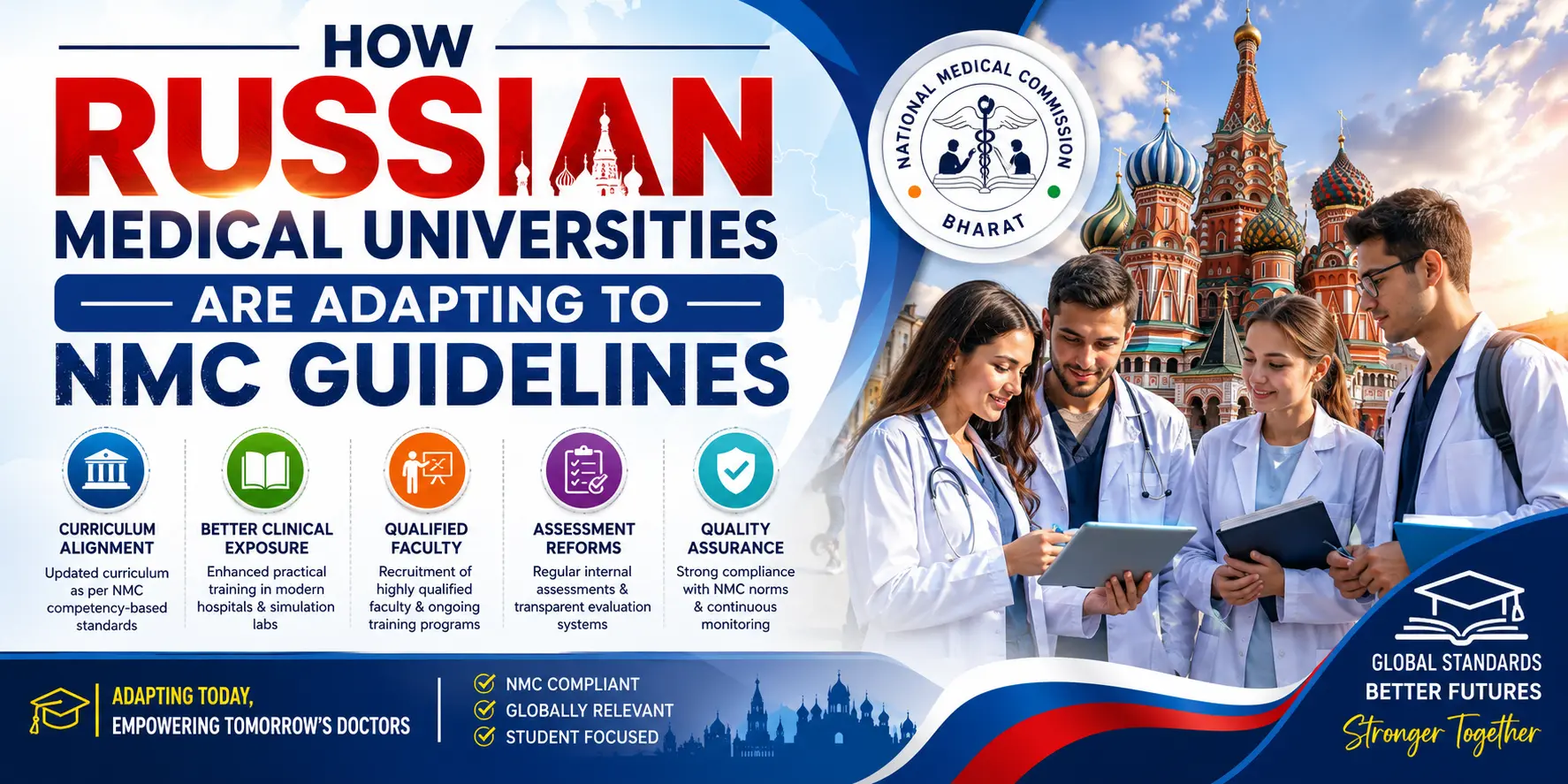
Over the past few years, Russian medical universities have made big structural and educational modifications to align with India’s evolving regulatory framework for overseas scientific Graduates (FMGs). With the national medical commission (NMC) introducing strict guidelines beneath the FMGL guidelines 2021, Indian college students making plans to pursue medicine overseas need to make sure their schooling matches Indian licensing requirements.
This is in particular essential for college students thinking about MBBS in Russia, as Russia remains one of the maximum favored locations for Indian scientific aspirants. However, the gadget is not pretty much affordable—it is now approximately compliance, documentation, and eligibility for FMGE/next.
information the NMC Framework That Drives those changes
To apprehend how Russia universities are adapting, it's critical to first recognize what they are adapting to.
The NMC has now not issued a “listing of accredited universities.” As a substitute, it enforces compliance guidelines beneath the FMGL guidelines 2021, which define whether or not a foreign clinical graduate can exercise in India. These policies require:
- A minimum course length equal to Indian MBBS standards
- mandatory internship or clinical clerkship
- complete-time, non-on-line scientific schooling
- A licensing pathway within the U.S. of look at
- No fragmented or switch-based schooling
you may evaluate official regulatory context via the national medical commission framework.
further, global reputation standards consisting of world health organisations (WHO), and university list structures just like the world directory of scientific colleges (WDOMS), are an increasing number of used as verification benchmarks.
1. Transition to 6-12 months dependent clinical packages
One of the most vital variations in Russia is the reinforcement of the 6-12 months MD (fashionable remedy) application, which aligns intently with NMC necessities.
Key modifications:
- complete 6-year duration (no shortened MBBS tracks)
- integrated medical publicity from early years
- established health center-primarily based schooling
- Standardized curriculum throughout federal universities
This guarantees compliance with the NMC requirement of a minimum 54 months of educational schooling plus internship publicity.
For Indian students getting to know about MBBS in Russia or MBBS in Russia admission in Russia, this alignment substantially reduces eligibility dangers for FMGE/next.
2. Strengthening scientific schooling and health facility exposure
Russian universities have upgraded medical training to satisfy worldwide competency expectancies.
main upgrades encompass:
- earlier introduction to sanatorium rotations (from 3rd yr in many universities)
- accelerated patient interaction underneath supervision
- Standardized medical skill labs
- Emphasis on sensible diagnosis and case-primarily based mastering
Those upgrades are critical due to the fact NMC recommendations strongly emphasize arms-on scientific education, now not just theoretical learning.
College students pursuing MBBS courses in Russia now obtain greater established bedside education, which aligns with India’s competency-primarily based medical training model.
3. Integration of obligatory Licensing exam in Russia
One of the biggest shifts is the requirement (directly or circuitously supported through many universities) for college students to prepare for and pass Russia’s local licensing method.
Why this topics:
NMC policies require that the foreign degree must allow the student to be eligible for registration inside the country or take a look at.
Russian universities are increasingly supporting:
- coaching for nation scientific licensing checks
- Russian language training for scientific verbal exchange
- established examination-orientated modules
This ensures students aren't best graduating however additionally becoming eligible practitioners domestically before returning to India.
This at once improves the credibility of MBBS Russia levels for FMGE/next eligibility.
4. Elevated consciousness on English-Medium medical packages
To fulfill Indian pupil demand and NMC expectations, Russian universities have multiplied complete English-medium MBBS programs.
Key trends:
- entire English preparation in pre-medical years
- slow creation of clinical Russian for patient interplay
- Bilingual aid most effective in clinical years (now not educational substitution)
This is critical because NMC tips that the medium of education should no longer compromise clinical understanding or verbal communication skills.
Many college students choosing MBBS in Russia for Indian college students prefer universities wherein English is fully maintained during instructional years.
5. More potent Documentation and Compliance Transparency
Any other predominant model is stepped forward transparency in documentation and compliance verification.
Russian universities now increasingly more offer:
- specific transcripts with problem hours
- verified internship and medical rotation certificates
- Accreditation documentation aligned with global requirements
- clear admission and course shape letters
These files are important for FMGE/next eligibility in India.
For students exploring MBBS abroad in Russia or MBBS in Russia, documentation best is now a key determining issue.
6. Alignment with worldwide medical schooling requirements
Russian clinical universities are also aligning themselves with international benchmarks to ensure broader reputation past India.
Key alignments consist of:
- list in WDOMS where applicable
- Compliance with WHO instructional frameworks
- Compatibility with ECFMG necessities (for US pathways)
- Adoption of competency-primarily based training fashions
This improves the international mobility of graduates, not just Indian licensing eligibility.
College students pursuing MBBS in Russia 2026 are now more and more positioned for global scientific careers.
7. Multiplied tracking due to NMC FMGE/subsequent pressure
The approaching transition from FMGE to next has made compliance even stricter. As a result:
- Universities are averting any quick-term or extended MBBS models
- Attendance and medical education records are strictly maintained
- on-line or hybrid clinical education is being phased out
- medical competency documentation is emphasized greater than ever
This shift ensures that students finishing MBBS at Russia are academically and clinically prepared for Indian licensing exams.
8. Russian Universities getting rid of Non-Compliant systems
earlier problems like:
- Fragmented internships
- Shortened academic years
- fallacious scientific exposure
- Unstructured bilingual teaching
are actually being systematically eliminated.
Universities are restructuring programs to ensure full alignment with Indian requirements so that graduates remain eligible for FMGE/next and clinical registration in India under NMC regulations.
9. Effect on Indian students selecting Russia
For Indian aspirants, these diversifications mean:
benefits:
- greater predictable FMGE/next eligibility
- better clinical exposure
- more potent global popularity
- progressed transparency in admissions
What students should still verify:
- direction length (need to be 6 years)
- clinical schooling high-quality
- college accreditation
- Language structure
- Licensing eligibility in Russia
If nicely decided on, MBBS from Russia remains one of the most solid and less expensive options for Indian medical education overseas.
Conclusion
Russian clinical universities are actively evolving to meet NMC recommendations through improving curriculum shape, scientific schooling, licensing pathways, and documentation requirements. While there's no formal “NMC approval listing,” compliance with FMGL policies is now the real benchmark for eligibility in India.
For Indian college students planning to pursue MBBS in Russia, russia MBBS, or MBBS in Russia for Indian college students, the point of interest ought to be on selecting universities that strictly follow those up to date standards.
In 2026, success is not pretty much getting admission abroad—it's far from selecting an application that guarantees a legitimate clinical career in India and the past.