
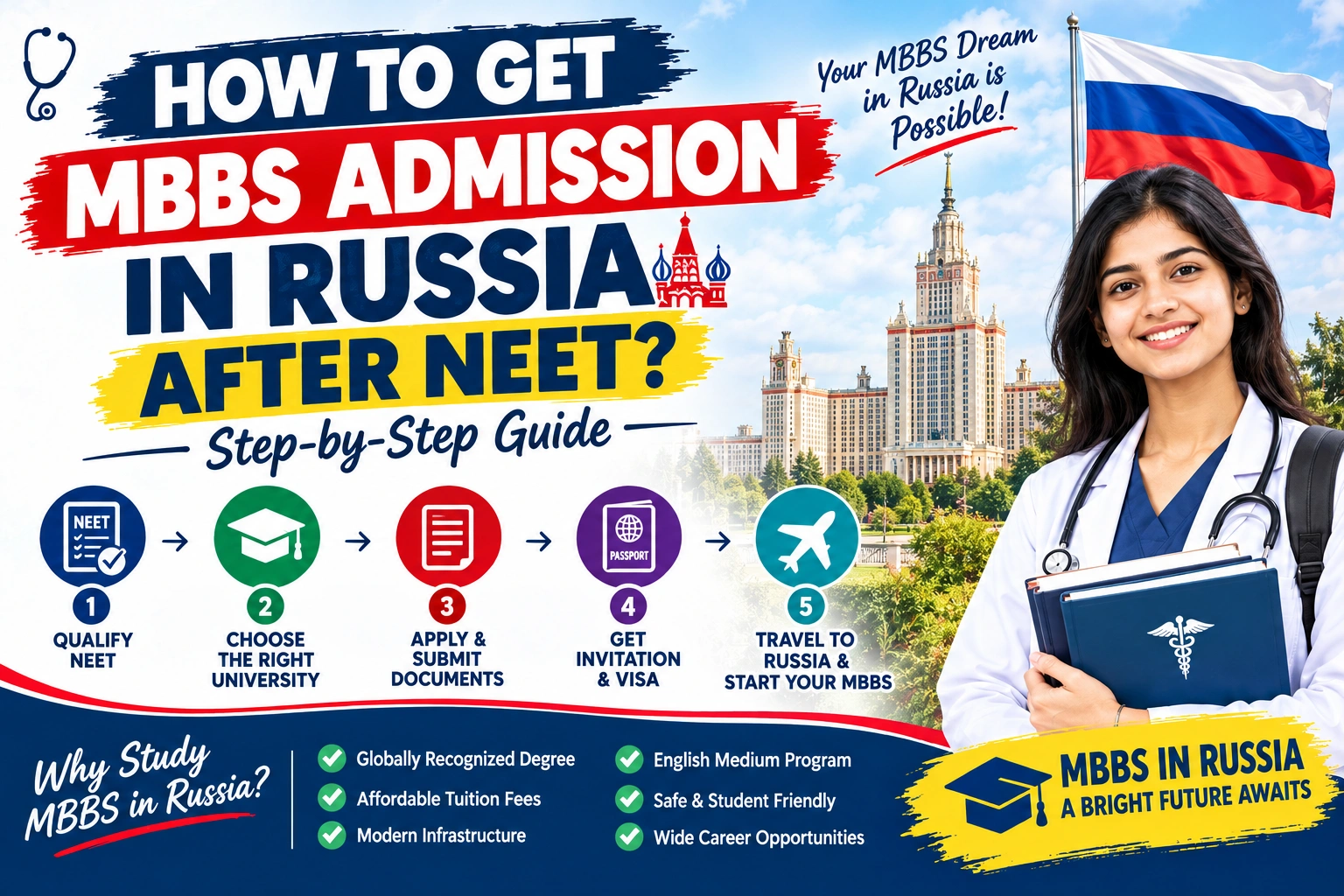
NEET result is out. You have qualified, but an Indian private medical college looks too expensive, or your score isn't giving you the government seat you expected. This is exactly where many students start considering MBBS in Russia. And then comes the confusing part — what exactly happens after NEET?The admission route is actually simpler than many students assume. There is usually no separate Russian medical entrance examination for international applicants at many universities, though university-specific screening or admission requirements can apply. But simple doesn't mean you should rush. Choosing the wrong university, ignoring NMC rules, or taking admission into a course that doesn't meet Indian registration requirements can create a much bigger problem six years later.So, NEET qualification is only the starting point. University selection, document verification, admission letter, visa, fee payment, travel and, most importantly, checking whether the medical program meets current NMC requirements — all come after that.Here is how the complete process works.
Is NEET Mandatory for MBBS Admission in Russia?
For an Indian student who plans to obtain a foreign medical qualification and later pursue registration to practise medicine in India, NEET qualification is a key requirement. Students should always check their current result and notices through the official NEET website rather than depending on screenshots or information circulating through counselling groups.There is one distinction students often miss. You don't necessarily need the kind of NEET score required for an Indian government medical college to consider Russia. What matters for the foreign-medical route is satisfying the applicable NEET eligibility requirements and all other regulatory conditions.That changes the equation considerably.A student may qualify NEET but still have a rank at which an affordable government MBBS seat in India is unlikely. Instead of paying ₹60 lakh, ₹80 lakh or even more at some private options in India, that student may explore Russian universities where the overall academic cost can be considerably lower.But don't treat "NEET qualified" as "everything is approved." It isn't.
Eligibility Requirements You Should Check Before Applying
A qualified NEET score is one part of the file. Russian universities also evaluate your academic documents and basic eligibility before issuing admission.
For most applicants, the broad checklist looks like this:
|
Requirement |
Typical Expectation |
|
Academic qualification |
Class 12 or equivalent |
|
Main subjects |
Physics, Chemistry, Biology/Biotechnology and English as applicable |
|
NEET |
Qualification required for Indian students intending to follow the Indian registration route |
|
Age |
Generally at least 17 years as required under applicable admission rules |
|
Passport |
Valid passport required for visa processing |
|
Medical fitness |
Medical certificate generally required |
|
HIV report |
Commonly requested for admission/visa documentation |
|
Course language |
Verify that the medical program meets NMC's English-medium requirement |
|
Program structure |
Must be checked against current NMC FMGL requirements |
Eligibility rules can change, and individual Russian universities can ask for additional paperwork. Before paying a non-refundable amount, compare the university's current admission conditions with the latest rules published by the National Medical Commission.
Honestly, this verification matters more than a fancy university brochure.
Step-by-Step MBBS Admission Process After NEET
Once NEET is cleared, students usually want to secure a university immediately. Fair enough. But admission should happen in a sequence, because paying first and checking recognition later is exactly backwards.
Step 1: Download and Preserve Your NEET Documents
Start with the boring stuff. Save your NEET scorecard, application details and other relevant records properly. Keep both digital and printed copies.Don't depend on an old WhatsApp attachment six months later.Students should also verify the official result and related notices directly through NTA's NEET portal. For future documentation and registration, having clean, authentic records saves unnecessary trouble.
Step 2: Shortlist Russian Medical Universities Carefully
Now comes the part where most families spend maximum time — university selection.Russia has several universities that admit international medical students, but they aren't identical. Tuition fee, city expenses, hostel facilities, patient flow, English-medium teaching, climate, Indian student population and clinical exposure can vary significantly.
A rough comparison may look like this:
|
University |
Approx. Annual Tuition Range* |
Location |
|
Bashkir State Medical University |
₹3.5–5 lakh |
Ufa |
|
Orenburg State Medical University |
₹4.5–6.5 lakh |
Orenburg |
|
Kazan State Medical University |
₹5.5–8 lakh |
Kazan |
|
Kursk State Medical University |
₹5–7 lakh |
Kursk |
|
Kabardino-Balkarian State University |
₹2.5–4.5 lakh |
Nalchik |
*Indicative ranges only. Currency conversion, university revisions and additional charges can change the INR figure substantially. Always obtain the current official fee schedule before making payment.Don't select a college only because somebody says, "This one is cheapest." Cheap tuition can look attractive until hostel, insurance, visa extension, food and miscellaneous university charges enter the calculation.For students researching MBBS in Russia, comparing the full six-year financial picture is much more useful than comparing only first-year tuition.
Step 3: Check the University and Medical Program Properly
This step deserves extra attention.Search the institution in the World Directory of Medical Schools and check the exact medical school rather than relying on a consultant's statement that it is "WHO approved" or "internationally recognised."A small clarification here. Students regularly use terms such as "WHO-approved university," but the World Health Organization should not be treated as an agency that individually approves foreign medical colleges for Indian registration. Likewise, a WDOMS listing by itself doesn't guarantee eligibility to practise in India.The deciding issue for an Indian student is whether the actual course, internship, clinical training and licensing pathway satisfy applicable NMC regulations.Here—well, this is where students really need to slow down.
Step 4: Verify NMC FMGL Compliance Before Paying
This is probably the most important step in the entire admission process.Under NMC's Foreign Medical Graduate Licentiate Regulations, the foreign medical program for covered students must meet specified requirements. Among them are at least 54 months of medical education, a minimum 12-month internship at the same foreign medical institution, English as the medium of instruction, required subjects and eligibility for registration/licensure in the country where the degree is awarded. NMC also requires applicable foreign medical graduates to complete the prescribed supervised internship in India and clear the mandated licensing examination for permanent registration.So don't ask only:"Is this university recognised?"Ask better questions.
Does the exact course satisfy the minimum duration? Is the internship structured according to current NMC rules? Is clinical training physically conducted where required? Is the complete medical program taught in English? Does the qualification make the graduate eligible for the relevant licence/registration in Russia?The NMC itself continues to advise students going abroad to perform proper due diligence because problems involving curriculum, duration, clinical training or internship can affect registration eligibility in India.That's the real checkpoint.
Step 5: Submit Your University Application
Once you have shortlisted a suitable institution, the formal application can begin. Universities or their authorised admission channels generally ask for scanned copies first.
Commonly requested documents include:
- Class 10 marksheet/certificate
- Class 12 marksheet/certificate
- NEET scorecard
- Valid passport
- Passport-size photographs
- Birth certificate, where requested
- Medical fitness certificate
- HIV test report
- Application form and supporting declarations
Some documents may need translation, notarisation, apostille/legalisation or another form of authentication depending on current university and visa requirements.Names and dates must match. Seriously. A spelling difference between the passport and school certificate can become an annoying issue later.
Step 6: Receive the Admission or Offer Letter
After reviewing your academic records, the university may issue an admission/offer letter if you meet its requirements.This document normally confirms that the institution is prepared to admit you, subject to its remaining conditions and payments.Read it before paying anything.Check the university name, course name, academic year, fee mentioned, student details and any refund terms. If the letter doesn't clearly identify what you are being admitted to, ask questions first.
Step 7: Pay the Required Initial University Fee
At this point, students may need to pay the application, registration, tuition or other university-prescribed amount.Payments should ideally be made through traceable official channels. Keep invoices and receipts. Don't hand over a large amount simply because somebody says the seat will disappear by evening.The total cost of MBBS in Russia isn't limited to tuition either. Depending on the university and city, students should budget for hostel charges, food, medical insurance, visa-related expenses, documentation, flights, winter clothing and personal spending.A realistic overall budget for many universities can fall somewhere around ₹25–45 lakh across the full program, although premium universities, exchange-rate movements and lifestyle choices can push the figure higher. This is an estimate, not a universal fee.
Step 8: Wait for the Official Invitation Letter
Admission letters and invitation letters are not always the same thing.The invitation is an important document used in the Russian student-visa process. Processing time varies, so students shouldn't book non-refundable flights just because the initial university offer has arrived.Admission season commonly becomes active after NEET results and continues through the months leading into the autumn academic intake. Exact deadlines differ by university, though, and late admission can create visa and travel pressure.Earlier is easier.
Step 9: Apply for a Russian Student Visa
Once the required invitation and supporting papers are ready, you can proceed with the student-visa application under the current Russian consular requirements.Students generally need documents such as their passport, visa application, photographs, invitation and medical/HIV documentation, although the exact checklist should always be verified from the relevant Russian visa authority at the time of application.Make copies of everything.After arriving in Russia, additional migration registration and university formalities may also be required. The university's international student department generally guides newly admitted students through these procedures.
Step 10: Travel to Russia and Complete University Registration
Flight booked. Bags packed. But there is still paperwork left.After arrival, students generally complete physical document verification, hostel registration, migration formalities, medical checks where applicable, fee formalities and university enrolment.Original academic documents may be checked against the copies submitted earlier. Carry them safely in cabin baggage rather than putting every important certificate in checked luggage.And yes, carry warm clothes. Russian winters aren't a marketing detail.
How Long Does MBBS in Russia Take?
Most Indian students entering suitable Russian medical programs should plan around a six-year medical education pathway, depending on the university's exact structure and the program that satisfies applicable requirements.Don't confuse "six-year course" with the minimum NMC requirement alone. The NMC FMGL framework specifies a minimum 54 months of education plus a 12-month internship at the same foreign medical institution for students covered by the regulations.Clinical training matters just as much as classroom duration.A university offering attractive fees but unclear hospital training is not automatically a good deal. Medicine is learned around patients too. Lots of them.
What Does MBBS in Russia Really Cost After Admission?
Here is where advertised fees and actual family budgets often stop matching.Suppose tuition is approximately ₹4 lakh per year. That doesn't mean your yearly spending ends at ₹4 lakh. Add hostel, food, insurance, visa extension, travel, local transportation, documentation and personal expenses.
A broad yearly estimate could look like this:
|
Expense |
Approximate Range |
|
Tuition |
₹2.5–8 lakh/year |
|
Hostel |
₹40,000–₹1.5 lakh/year |
|
Food & daily expenses |
₹1–2 lakh/year |
|
Insurance/medical/documentation |
₹15,000–₹50,000+ |
|
Airfare |
₹30,000–₹70,000+ per trip |
|
Visa/migration-related expenses |
Variable |
Exchange rates move. Airfares jump. University fees get revised.So keep a contingency fund rather than building a six-year plan around today's exact rupee conversion.
The FMGE/NExT Question Students Should Think About Before Admission
A common mistake is thinking about the Indian licensing examination only in the final year. That's late.Under the current NMC regulatory framework, foreign medical graduates must satisfy the applicable licensing and registration requirements before obtaining permanent registration in India. The FMGL Regulations refer to clearing NExT "or such other mandated tests or tests," while current implementation and examination arrangements should always be checked through official NMC/NBEMS notifications rather than assumed years in advance.For students taking admission now, the safer approach is simple: follow the regulations that apply to your admission batch and monitor official changes during the course.University choice affects preparation too. Strong basic sciences, regular clinical exposure, disciplined self-study and early familiarity with Indian examination patterns can make a huge difference later.Six years pass faster than you think.
Hidden Costs Students Often Forget
First-year advertisements can be dangerously attractive. Sometimes the tuition shown is genuine, but it isn't the complete amount a family will spend.Possible additional expenses include document translation, apostille/legalisation, medical tests, insurance, visa processing and extensions, migration formalities, hostel deposits, local transport, winter clothing, SIM/internet costs, flights and occasional increases caused by currency movement.One more thing — consultancy charges.If an agency is involved, ask for a written breakup of what you are paying and which amount goes directly to the university. "Package fee" without a clear explanation isn't enough.
Pros and Cons of Taking Admission After NEET
Why do Indian families still consider Russia? Mainly because the entry route can be relatively straightforward and several universities offer medical education at a total cost below many Indian private-college options.There are genuine advantages: multiple established universities, comparatively manageable tuition at selected institutions, international student communities and a long history of medical education.The challenges are equally real. Russian weather can be difficult initially, local language skills become useful — particularly during patient interaction — food and lifestyle need adjustment, and the student carries responsibility for meeting Indian licensing requirements after graduation.So MBBS in Russia can make sense. But only after proper university selection.Cheap + foreign doesn't automatically equal good.
FAQs
Can I take MBBS admission in Russia if I only qualify NEET?
NEET qualification can make you eligible to proceed with the foreign medical admission route, subject to the applicable eligibility rules and the admission requirements of your chosen Russian university. A very high Indian government-college cutoff score isn't necessarily required merely to apply abroad.
Is there any entrance exam for MBBS admission in Russia?
Many Russian universities admit international students primarily on the basis of their academic eligibility and submitted documents, but admission policies vary. Some institutions may have their own assessment, interview or other requirements. Check the current official university policy before applying.
Is a WDOMS-listed Russian university automatically NMC approved?
No. A WDOMS listing should not be interpreted as automatic NMC approval or automatic eligibility for registration in India. Indian students need to ensure that their complete foreign medical education satisfies the applicable NMC regulations.
How much does MBBS in Russia cost for an Indian student?
A practical total estimate for many options can be around ₹25–45 lakh for the overall program, but there is no single Russia-wide figure. University, city, exchange rate, hostel choice, flights and personal spending can change the total considerably.
When should I apply after NEET?
Applications generally become active around the period following NEET results for the relevant academic intake. Applying earlier gives you more time for university verification, invitation processing and visa formalities instead of rushing everything near the academic-session deadline.
Can I practise in India after completing MBBS from Russia?
Potentially yes, but graduating from Russia alone doesn't provide an automatic licence to practise in India. You must meet the NMC rules applicable to your batch, including requirements concerning the foreign course, internship, clinical training, foreign registration/licensing eligibility, Indian internship and the prescribed licensing examination.
Conclusion
Getting admission after NEET isn't the difficult part. Getting the right admission is.If you are seriously considering MBBS in Russia, don't choose a university from a fee poster or because another student from your city is already there. Check the exact medical program, course duration, internship structure, English-medium instruction, clinical training, WDOMS information, university fees and current NMC regulations first.Do that homework before sending money.Once those boxes are genuinely checked, the process becomes fairly straightforward: qualify NEET, shortlist universities, verify compliance, submit documents, secure admission, obtain the invitation, complete the visa process and travel for enrolment.For university comparisons, fee estimates and admission-related guidance, students can also explore the latest information on MBBS in Russia before finalising their shortlist.