
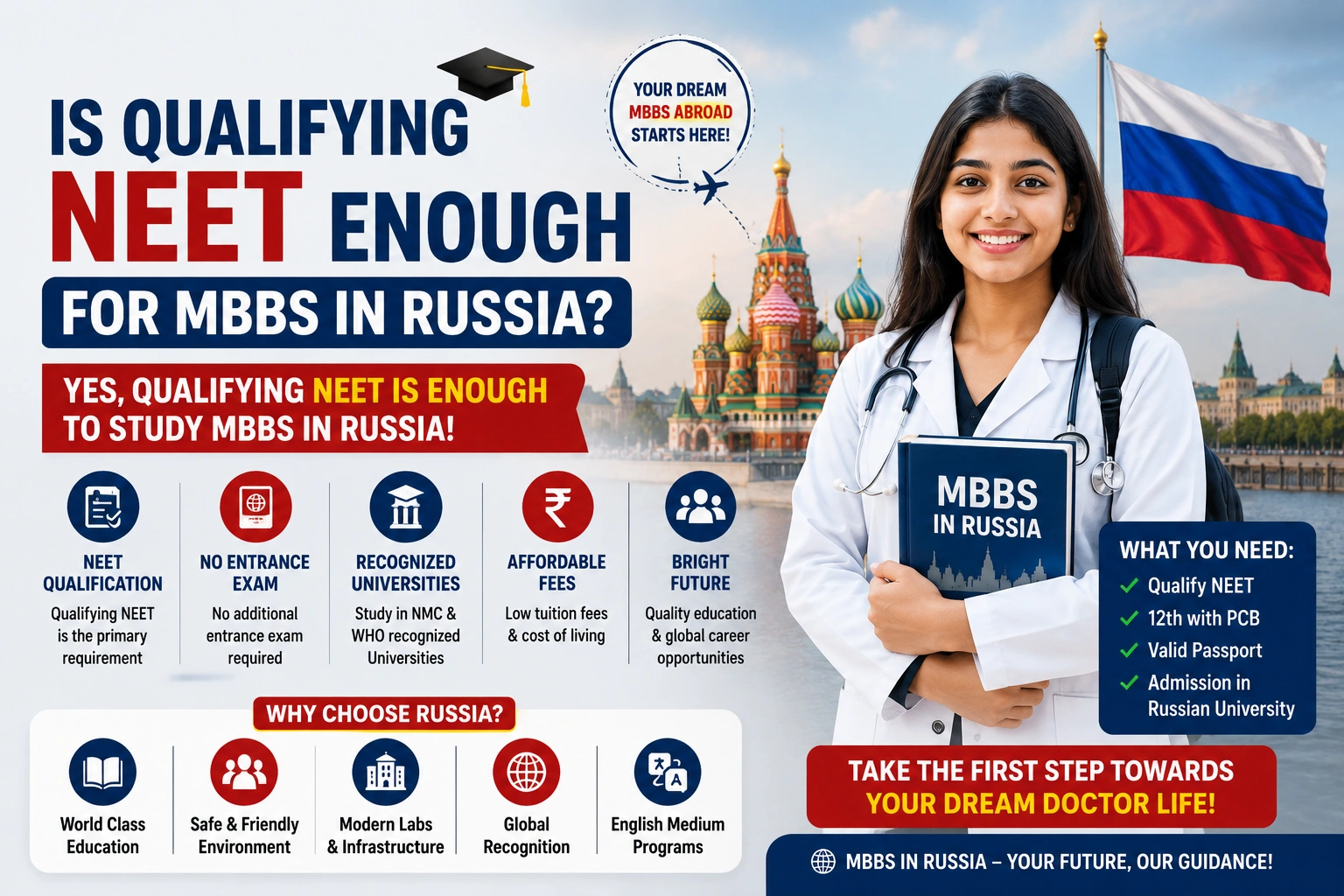
Every year, thousands of Indian students choose to study MBBS in Russia because of the affordable tuition fees, internationally recognized universities, advanced medical infrastructure and English-medium courses. One of the most frequently asked questions by NEET aspirants concerns whether merely qualifying for NEET will be enough to gain admission into an MBBS in Russia.
The short answer to this question is yes, but only under certain conditions. The NEET qualification is a requirement for Indian students who want to study MBBS and practice medicine in India. NEET is not enough to guarantee admission. The student must also meet academic criteria and choose a university which complies with NMC regulations. They should also ensure that the school is listed in WDOMS. According to the latest eligibility guidelines, Indians must pass NEET in order to study abroad and then register for registration in India.
Why is NEET mandatory for MBBS in Russia
Many students think that Russian universities have their own entrance exams. Most recognized Russian medical schools do not require an Indian applicant to take a separate entrance examination. They expect that students will meet the eligibility requirements prescribed by Indian authorities.
NEET is now a requirement for Indian students pursuing MBBS in other countries. Students who do not qualify for NEET may have difficulty obtaining registration in India to practice medicine after they complete their degree.
Students should not ignore the importance of passing the NEET examination, even if the university does not require high marks.
Does Qualifying for NEET alone suffice?
The NEET qualification is an important step, but is just one of many in the admissions process. Before being admitted to a Russian university, students must meet several other requirements.
Included are:
- Completed Class 12 in Physics, Chemistry, Biology and English.
- Minimum qualifying marks for PCB according to categories
- Age minimum of 17 years for admission.
- Valid passport and admission documents.
- Selecting a university according to NMC guidelines
All of these requirements must be met to ensure a smooth and easy admission process.
Basic Criteria for MBBS in Russia
Students from India who wish to study medicine in Russia must generally meet the following requirements.
Education Qualification
Students must have a Class 12 diploma from an accredited board, with Physics, Chemistry and Biology.
The following are generally accepted academic requirements:
- General Category – Minimum 50% PCB
- Minimum 40% PCB for SC/ST/OBC
- As a compulsory course
Candidates must also meet the NEET cut-off according to the annual announcement.
Is a higher NEET score an advantage?
The admission to MBBS programs in Russia is usually based more on NEET scores than exceptionally high scores.
The higher the NEET score, the better your chances of getting into some universities. However, many Russian universities will accept students that simply pass.
Many students with a moderate score are admitted without having to pay donations or capitation fees. This makes Russia a more attractive destination than many private medical schools in India.
Why do Indian students choose Russia after qualifying NEET?
For several reasons, Russia continues to attract thousands of Indian students each year.
The country provides a medical education that is internationally recognized at tuition rates that are comparatively low. The majority of universities offer modern laboratories, advanced hospital facilities for clinical training, faculty with experience, and separate dormitory facilities for international students.
Some of the major benefits include:
- Education costs: affordable overall education
- Many universities offer MBBS courses in English.
- Modern Teaching Methodology
- Medical degrees are recognized globally
- No donation or capitation fees
- Strong Clinical Exposure
- Students from abroad should feel safe in their environment
- Students from India are a large community
This makes Russia a popular destination for students who have passed the NEET exam but cannot secure a government-sponsored medical seat in India.
The importance of choosing the right university
Students who choose a university before verifying the status of its recognition will not be able to qualify for NEET.
Students should check that the university they are considering is listed on the World Directory of Medical Schools, and adheres to the National Medical Commission (NMC) regulations before applying.
The World Health Organization (WHO) as well as official university websites should be checked by students. The importance of recognition is crucial for licensing exams and future career opportunities.
By choosing a recognized school, students are assured that they will be eligible to continue their education after graduation.
Documents required for admission
Once students have earned their NEET, the admissions process is usually straightforward.
Documents that are commonly required include:
- Class 10 Marksheet
- Class 12 Mark Sheet
- NEET Scorecard
- Valid Passport
- Passport-size Photos
- Birth Certificate
- Medical Fitness Certificate
- Invite Letter from the University
- Student Visa
It is important to check requirements with each university before submitting your application.
Admissions Process after NEET Qualification
After students have qualified for NEET, admissions usually follow a systematized process.
Step 1: Select Universities
Find out which universities offer English-medium MBBS.
Step 2: Verify Recognition
Verify that the university adheres to NMC regulations and appears in WDOMS.
Step 3: Submit Application
Upload your academic documents, passport and NEET scorecard.
Step 4: Receive Admission Letter
Students who meet the criteria will receive an invitation or admission letter after submitting their documents.
Step 5: Applying for Visa
After receiving confirmation from the University, complete visa documents.
Step 6: Traveling to Russia
After completing the travel formalities, students can start their MBBS journey.
Common mistakes students should avoid
Many students are only concerned with gaining admission, and ignore their long-term eligibility.
Some of the most common mistakes are choosing universities without verifying their recognition status, disregarding NMC guidelines, relying on consultants alone without independent verification or assuming that all English-medium programs follow Indian regulatory requirements.
Before making any financial commitments, students should always confirm official information.
Can students practice in India after MBBS in Russia
Students can practice medicine in India if they have completed MBBS training in Russia and meet all regulatory requirements.
Students must also meet the licensing requirements at the time they register in India. The mere possession of an overseas medical degree does not grant automatic permission to practice medicine in India.
Conclusion
Qualifying NEETis undoubtedly an important step toward pursuing MBBS in Russia. However, it shouldn't be considered as the only requirement. The student must also meet the academic criteria, choose an NMC-compliant institution, check the WDOMS list, prepare all required documents and carefully complete the admissions process.
MBBS in Russia offers Indian students a quality medical education and international exposure as well as excellent career opportunities. It is not just about achieving NEET, but also choosing the right university to align with Indian regulatory requirements as well as future professional goals.