
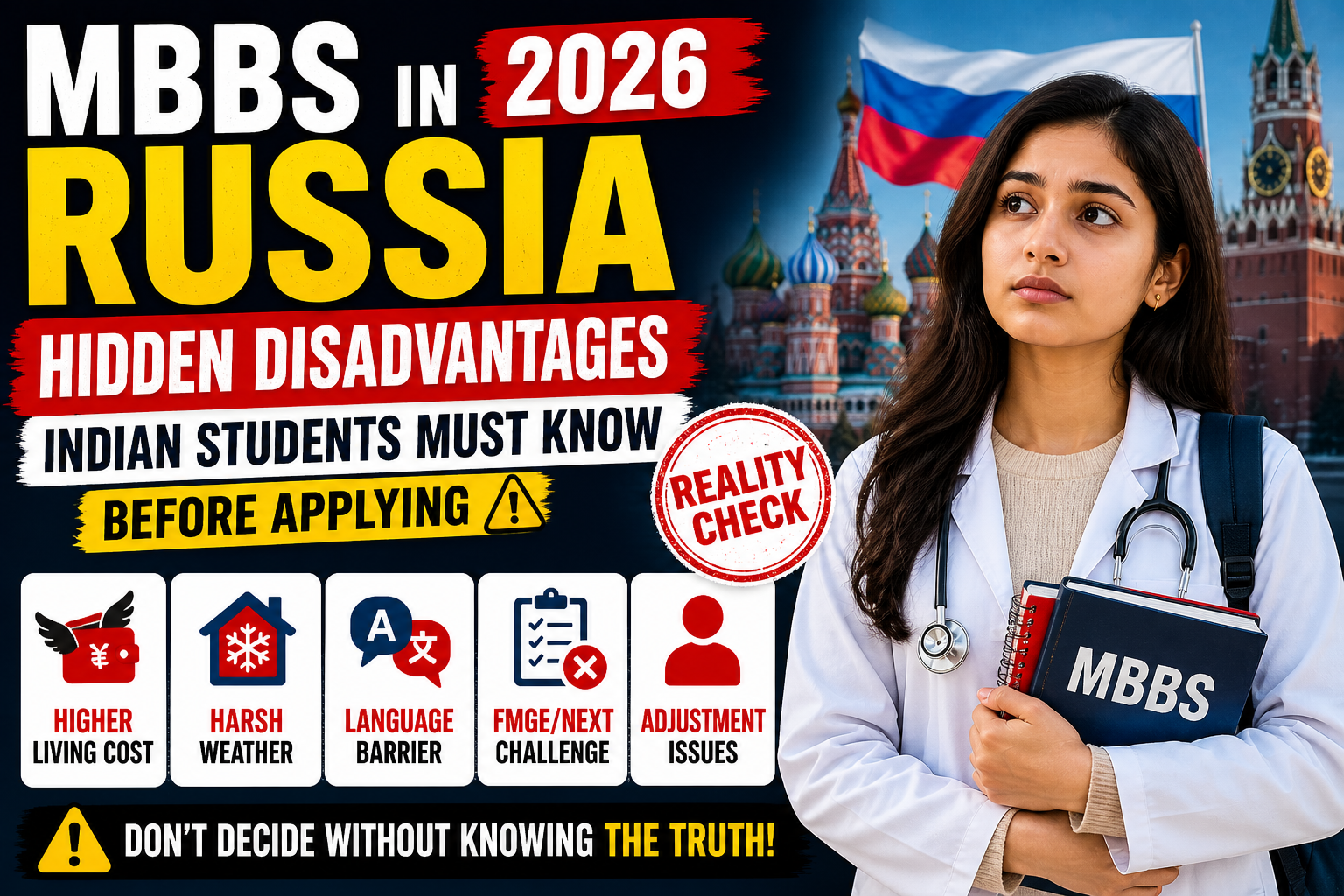
Every year, thousands of Indian students choose MBBS in Russia due to its affordability and global recognition. With limited government seats and expensive private medical colleges in India, Russia appears to be a practical alternative.
However, while most platforms highlight only the advantages, very few discuss the real challenges. Understanding the disadvantages of studying mbbs in russia for indian students is extremely important before making a life-changing decision.
This article gives a complete reality check so you can make an informed choice.
Why Students Still Choose MBBS in Russia
Before diving into disadvantages, it’s important to understand why study mbbs in russia is so popular:
- Affordable tuition fees
- No donation or capitation system
- English-medium programs
- Globally recognized degrees
- Simple admission process
Despite these benefits, students often underestimate the challenges they may face later.
Major Disadvantages of MBBS in Russia for Indian Students
1. FMGE/NExT Licensing Exam Difficulty
One of the biggest challenges after completing MBBS in Russia is clearing the licensing exam in India.
Indian students must pass FMGE/NExT as per National Medical Commission (NMC) guidelines to practice in India. Many students struggle because:
- Curriculum differences between Russia and India
- Lack of coaching or preparation during MBBS
- Concept gaps in clinical subjects
Even though students qualify NEET before admission, passing FMGE/NExT requires a completely different level of preparation.
2. Language Barrier in Clinical Practice
Although universities offer English-medium education, practical hospital training often requires interaction with local patients.
This creates a language barrier because:
- Patients mostly speak Russian
- Clinical communication becomes difficult
- Learning basic Russian becomes necessary
For many students pursuing mbbs in russia for indian students, this becomes a major challenge during internships.
3. Extreme Weather Conditions
Russia’s climate can be harsh, especially for Indian students.
- Temperatures can drop below -20°C
- Long winters affect daily routine
- Adaptation can be physically and mentally challenging
Students coming from warmer regions may struggle initially, affecting their focus on studies.
4. Cultural Adjustment Issues
Living in a completely different country involves cultural adaptation:
- Different food habits
- Language differences
- Lifestyle changes
- Limited Indian community in smaller cities
While metro cities offer better comfort, smaller university towns may feel isolated.
5. Limited Practical Exposure in Some Universities
Not all universities provide equal clinical exposure.
Some issues include:
- Limited patient interaction
- Less hands-on experience
- Overcrowded hospitals with many international students
This is why choosing the right university listed under World Directory of Medical Schools (WDOMS) and recognized by World Health Organization (WHO) is crucial.
6. Self-Discipline is Required
Unlike Indian colleges, foreign universities often require self-study.
- Less strict academic monitoring
- More independent learning
- Need for consistent self-discipline
Students who rely heavily on coaching may struggle in this system.
7. Recognition Depends on Guidelines
While degrees are globally recognized, practice depends on compliance with:
- National Medical Commission (NMC)
- World Health Organization (WHO)
- World Directory of Medical Schools (WDOMS)
If a university does not meet required standards, students may face issues later.
8. Additional Expenses & Hidden Costs
Although mbbs in russia fees are affordable, students should consider:
- Visa renewal charges
- Travel expenses
- Health insurance
- Currency fluctuations
These costs can add up over time.
9. Homesickness & Mental Health Challenges
Living away from family for 6 years can impact emotional well-being.
- Homesickness
- Loneliness
- Academic pressure
Students need strong emotional resilience and support systems.
10. Competition After Graduation
After completing MBBS in Russia, students compete with:
- Indian graduates
- Other foreign medical graduates
Clearing exams like FMGE/NExT, USMLE, or PLAB requires serious preparation.
How to Overcome These Disadvantages
The good news is that these challenges can be managed with proper planning.
Choose the Right University
Select universities recognized by WHO and listed in WDOMS.
Start FMGE/NExT Preparation Early
Don’t wait until final year—start from 2nd or 3rd year.
Learn Basic Russian
Helps in clinical practice and daily life.
Stay Connected with Indian Community
Join student groups for support.
Maintain Discipline
Consistent study habits are key to success.
Is MBBS in Russia Still Worth It?
Despite the disadvantages, mbbs in russia for indian students can still be a good option if:
- You are self-disciplined
- You plan early for licensing exams
- You choose the right university
- You are ready to adapt
The key is awareness and preparation.
Who Should Consider MBBS in Russia
You should consider study mbbs in russia if:
- You cannot afford Indian private colleges
- You are comfortable living abroad
- You are ready to work hard for FMGE/NExT
- You want international exposure
Conclusion
Understanding the disadvantages of studying mbbs in russia for indian students is essential before making a decision. While Russia offers affordable and globally recognized medical education, it also comes with challenges like licensing exams, language barriers, and cultural adjustment.
Choosing MBBS in Russia can be a great opportunity if approached with the right mindset, preparation, and awareness. With proper planning and dedication, students can overcome these challenges and build a successful medical career globally.