
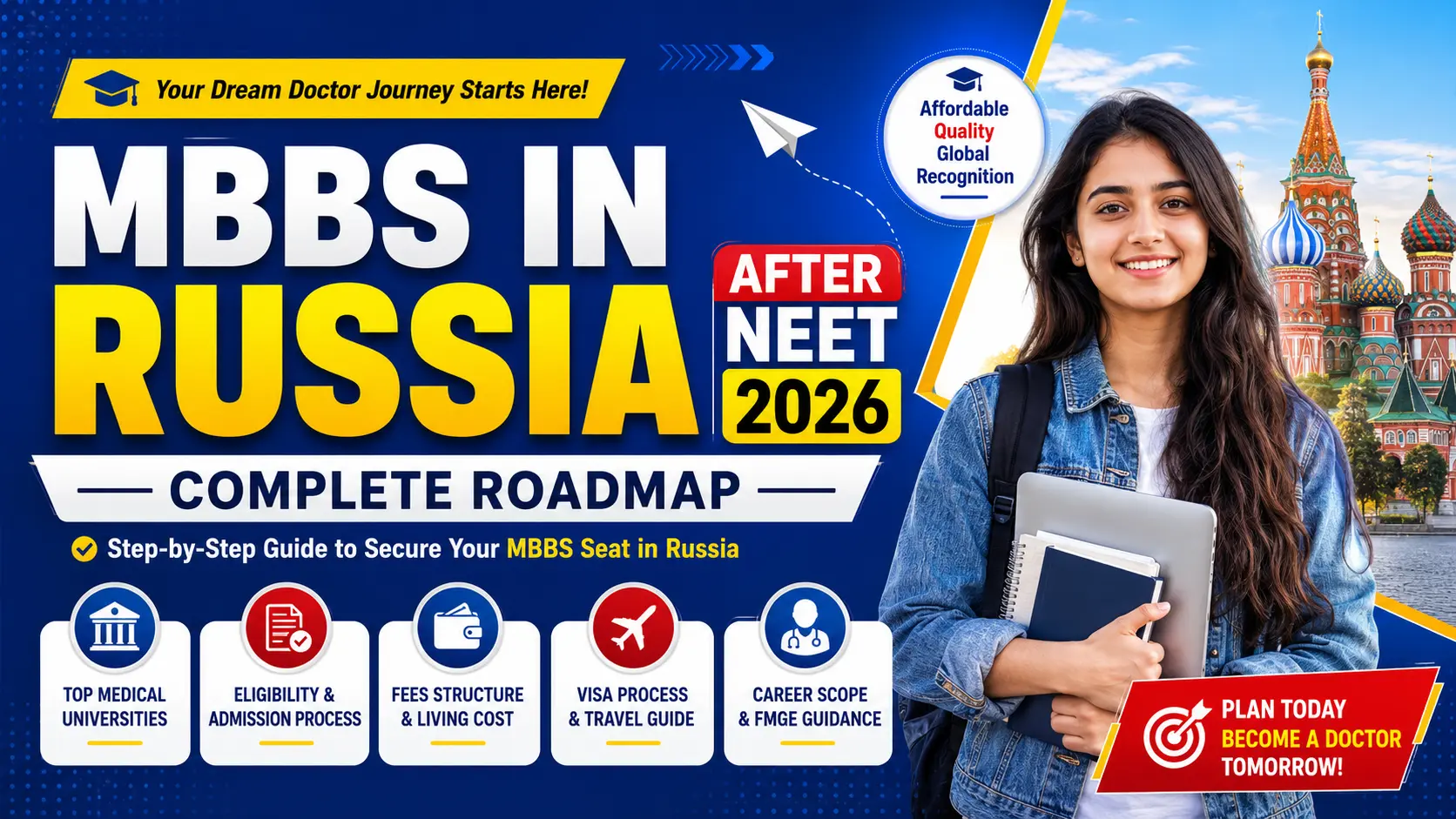
Studying MBBS in Russia from 2026 onwards will be one of the more feasible options for Indian medical aspirants wishing to study medicine abroad. Each year, thousands of students wishing to study medicine in India but failing to obtain a government medical college seat, opt to study in Russia. Russia has low priced medical college tuition, has universities with a high global standing, and has simple admission procedures.
Some of the oldest and globally reputed medical universities are in Russia. They are listed in WDOMS (World Directory of Medical Schools) and have recognition from all global medical bodies. For Indian students, what matters the most is even with a low score in NEET, if the eligibility criteria are met, students would be able to pursue MBBS in Russia 2026. This complete roadmap will discuss the NEET and NMC, the admission process, fee structure, eligibility criteria, how to select universities, and the career scope for students pursuing MBBS in Russia.
Why Choose MBBS in Russia After NEET 2026?
MBBS in Russia from 2026 onwards will be one of the more feasible options for students pursuing studies abroad. Each year, students wishing to pursue studies abroad are finding it more difficult to secure admission due to the rising competition and Russia is a good alternative.
The advantages Russia has to offer are:
- Lower cost of MBBS when compared to Indian Private Colleges
- No Donation/Capitation Fee
- English is the medium of instruction
- Advanced medical infrastructure and hospitals
- MBBS degrees that are recognized globally (WHO and WDOMS listed universities)
- High Quality Clinical Exposure
For students searching "MBBS in Russia after NEET 2026", the admission criteria is merely qualifying NEET, and not necessarily obtaining a high rank.
2026 NEET Requirements for MBBS in Russia
Completion of NEET is now necessary for all Indian Citizens who intend to pursue MBBS abroad, including in Russia.
Per NMC regulations:
- Completion of NEET is essential
- NEET scores are valid for three years for the MBBS eligibility certificate
- There is no high cutoff for Indian students for Russian universities
- Indian students only need to complete NEET, with no rank requirement
This makes pursuing an MBBS in Russia viable for Indian students who score low on NEET.
In the absence of a NEET score:
- Students cannot obtain an NMC eligibility certificate
- They are also not eligible to take the FMGE or NEXT in India
Therefore, NEET is a legal requirement more than a formality.
Importance of the WHO and WDOMS for Pursuing MBBS in Russia
Indian students must first understand the recognition standards before selecting a Russian MBBS university.
Role of the WHO
The WHO does not directly accredit universities; however, they do support the establishment of Global Medical Standards and Listings.
WDOMS and Its Impact
WDOMS (World Directory of Medical Schools) is important because:
- It indicates the global recognition of the university
- It is a prerequisite for FMGE/NEXT
- It is recognized in numerous nations, including the United States, the United Kingdom, and Canada
Most of the leading Russian MBBS universities are WDOMS listed, guaranteeing the global recognition of their degrees.
NEET 2026 MBBS Eligibility Requirements in Russia
Students seeking to study MBBS in Russia must satisfy the following basic requirements:
- 10+2 (Higher Secondary) with PCB
- At least 50% marks in aggregate (40% for SC/ST/OBC)
- Completion of NEET is required
- Students must also be 17 years of age on or before 31 December of the year in which they are seeking admission
- A valid passport is required
For the majority of Russian universities, there is no requirement to complete the IELTS, TOEFL, or any other entrance examination.
Step-by-Step Roadmap to MBBS Admission in Russia
The MBBS admission process in Russia is fairly direct and has been intentionally designed with students in mind. First, a university is selected based on preference, ranking, and budget before the marksheets for secondary and higher secondary school, the passport, and the NEET scorecard are sent to the selected university. The admission letter is issued after the documents have been validated, and the student then applies for a student visa at the Russian Embassy. After receiving the visa, the student pays the onboarding fees, books the flight to Russia, and completes the university registration once arrived. Classes begin shortly after the registration process is completed. There are no entrance exams or interviews, making the process even more enticing.
Indian Students MBBS in Russia Cost 2026
Probably the most significant reason why most people choose to pursue MBBS in Russia is its affordability.
The estimated breakdown is as follows:
- Tuition expenses are in the range of ₹ 2.5 to 5 lakh per year
- Hostel expenses are in the range of ₹ 50,000 to ₹ 1 lakh per year
- Total MBBS expenses in the range of approximately ₹ 15 lakh to ₹ 30 lakh
Private medical colleges in India have free courses that are much more expensive than those offered in Russia with courses that have global accreditation.
Benefits of Pursuing MBBS from Russia
- Cost-efficient medical education
- No donation or hidden fees
- Degrees recognized globally
- Courses offered in English
- State of the art facilities
- Safe campuses
- High success rate in FMGE coaching offered by universities
These benefits make MBBS in Russia for Indians a great option for study abroad.
Difficulties Studying MBBS in Russia
While Russia is appealing, there are challenges to be prepared for:
These include the cold weather, language barriers during clinical practices (which require knowledge of the Russian language as used in hospitals), distance and travel costs, culture, and the FMGE/NEXT exam in order to practice in India.
MBBS Course Model in Russia
The MBBS program in Russia is structured to 6 years as follows:
- Year 1: Basic medical and foundation sciences
- Years 2 and 3: Knowledge of theories and pre-clinical studies
- Years 4 to 6: Clinical training and practice
The program offers substantial exposure to real life interaction with patients strengthening the clinical skills of the students.
Career Opportunities After MBBS in Russia
MBBS from Russia makes it possible to return to India to take the FMGE or the NEXT exam to practice as medical doctors, or take MD/MS in India or abroad. It also opens the following gateways:
- License medical practice in the USA with the USMLE
- UK medical practice with the PLAB
- A multitude of international hospital services
- Careers in research and medical academic practices
The Russian MBBS degree offers great global career prospects, beyond the boundaries of Russia, if properly utilized.
Rationale for Studying MBBS in Russia After NEET 2026
MBBS in Russia is a solution for students who have successfully passed the NEET, but have been unable to secure a government MBBS seat in India.
Reasons for Consideration:
- Enrolment is not reliant on a NEET rank
- Cost of education is relatively low
- Degree is structured and recognized internationally
- No entrance test is required
This explains the continued interest in the MBBS in Russia 2026 program from Indian students.
Conclusion
Pursuing MBBS in Russia after taking NEET 2026 is a great option for Indian students who want to be doctors. Even students with low NEET scores can opt for this program, given they meet basic requirements. MBBS abroad enrollment in Russia is even more attractive given the low-cost education, internationally recognized degrees, and robust clinical training. WDOMS recognized universities, NMC framework, and FMGE/NEXT are all requirements students must be aware of to practice in India. Helpful and reliable resources about MBBS in Russia provide essential information on admission guidelines, multiple universities, and fee structures. MBBS in Russia after NEET 2026 offers great potential and unique opportunities for a rewarding career to all the aspiring students who wish to become doctors.