
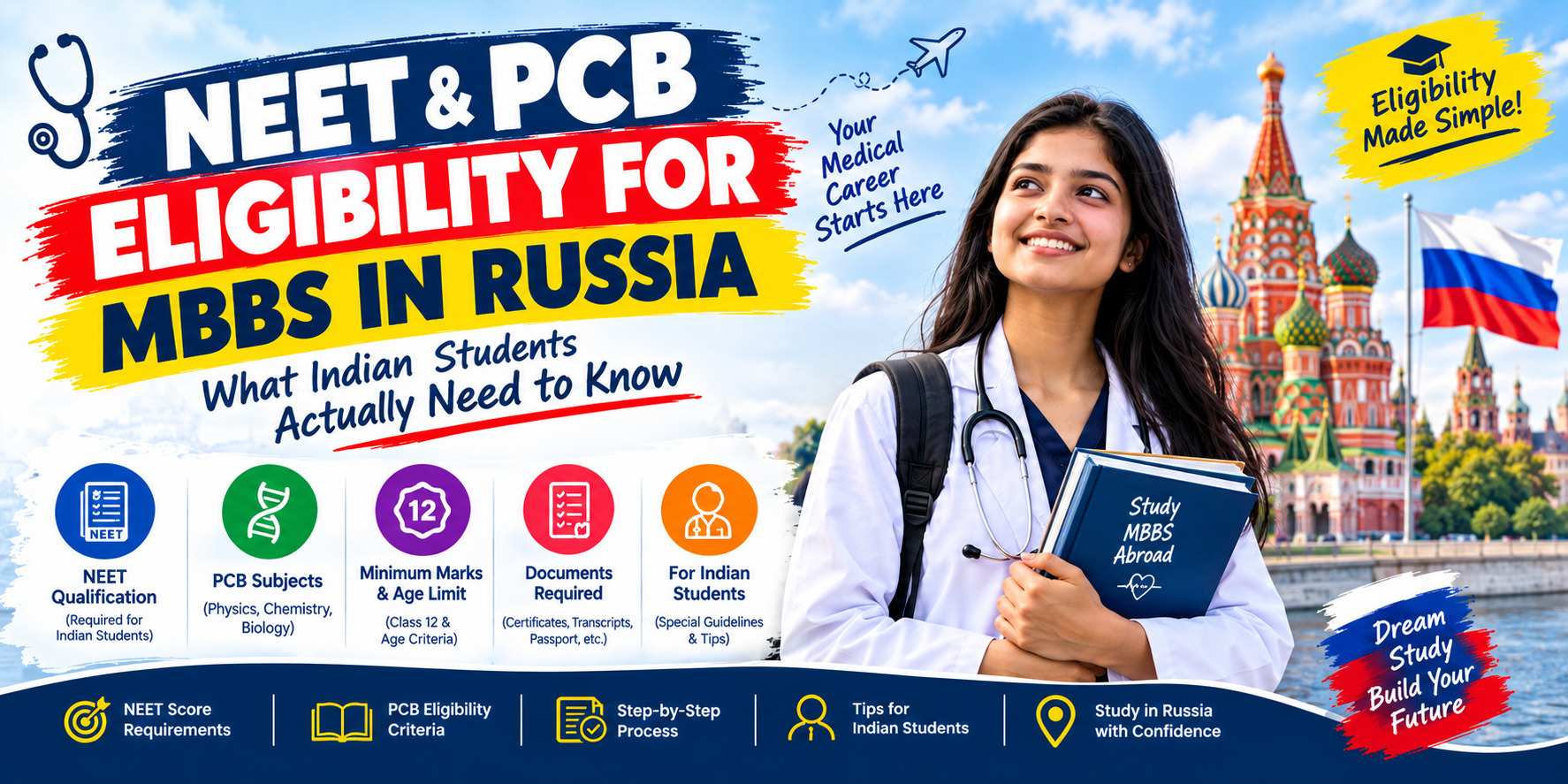
Every year around this time, my inbox fills up with the same panic. "“Sir, my NEET score is quite low. Is MBBS in Russia still possible?”" And honestly, most of the time, the answer is yes — but with conditions nobody bothers explaining properly. Let's fix that.
Do You Even Need NEET for MBBS in Russia?
Short answer: yes. No shortcuts here. If you're an Indian student and you want a medical degree that's actually recognized back home, NEET isn't optional. It's the gateway exam mandated by the National Medical Commission for anyone pursuing MBBS abroad, Russia included. Skip it, and you can still study — but you won't be allowed to practice medicine in India. Ever. That's not a rumor, that's policy, straight from NMC. A lot of students think NEET is only for government colleges in India. Wrong assumption, and a costly one if you find out too late.
PCB Requirement — The Basics
You need Physics, Chemistry, and Biology in your 10+2. That part's non-negotiable across almost every university offering MBBS in Russia. Minimum marks? Generally 50% aggregate in PCB for general category students, and around 40% for reserved categories. Some universities are a touch flexible on this, but the NEET qualifying score matters more than your board percentage in most admission committees' eyes. Here's the thing though — Biology as a separate subject matters more than people realize. A few students come to me having taken Biotechnology instead of straight Biology, thinking it's the same thing. It's not always accepted the same way. Always double-check with the specific university before applying.
NEET Cutoff — What Score Actually Gets You In?
This is where things get interesting. For MBBS in Russia, you generally don't need a competitive NEET score like you would for AIIMS or top government colleges in India. Just clearing the NEET qualifying cutoff is usually enough — that's roughly 137 marks out of 720 for general category (this number shifts slightly every year, so please verify on NEET's official site before assuming anything). Compare that to the 600+ scores needed for decent government seats in India, and you'll understand why so many students look eastward. But — and this is important — a low NEET score getting you admission doesn't mean the degree is any less rigorous once you're there. Russian medical universities are known for strict internal exams. Passing NEET gets your foot in the door. What you do after that is entirely on you.
Fees and University Comparison
Money talk. Let's be real about it. MBBS in Russia typically costs anywhere between ₹18 lakh to ₹35 lakh for the entire 6-year program, tuition included. Compare that to private medical colleges in India where fees can cross ₹1 crore easily, and the gap becomes obvious.
|
University |
Approx. Annual Fee (INR) |
Duration |
|
Kazan State Medical University |
₹4-5 lakh |
6 years |
|
Crimea Federal University |
₹3.5-4.5 lakh |
6 years |
|
Volgograd State Medical University |
₹4-5.5 lakh |
6 years |
|
I.M. Sechenov University |
₹5.5-7 lakh |
6 years |
These figures are approximate — exchange rates and university policies shift, so treat this as a ballpark and confirm current numbers directly with the university or a verified consultancy before committing anything. Living costs add another ₹2-3 lakh per year depending on the city. Moscow and St. Petersburg run pricier than smaller university towns. Something students don't factor in enough, honestly.
Recognition — NMC, WHO, and Why It Matters
This is the part where I tell students to slow down and actually read. Not every Russian medical university is automatically fine for Indian students. You need one that's listed and recognized by the NMC, and ideally also appears in WHO's international medical education database or the World Directory of Medical Schools. If a university isn't on these lists, your degree could become worthless back home — no FMGE eligibility, no license to practice, nothing. Pay close attention here. A shiny brochure and a low fee don't mean much if the university isn't properly recognized. I've seen students realize this only after finishing their degree. Painful conversations, those.
FMGE / NExT — The Exam After the Exam
Graduating from a Russian medical university doesn't automatically let you practice in India. You'll need to clear FMGE (soon transitioning into NExT, the National Exit Test) to get your license. This exam has a reputation. Pass percentages have historically hovered in the 20-30% range for foreign medical graduates, though this varies year to year. It's tough. Not impossible, but tough enough that coaching and consistent study during your MBBS years actually matters, not just cramming at the end. Students who take their Russian coursework seriously, rather than treating it as a formality, tend to clear FMGE/NExT with far less struggle. That's not just advice — that's a pattern I've watched play out for years.
Admission Process — Step by Step
- Clear NEET with the qualifying cutoff score.
- Shortlist NMC-approved universities.
- Apply directly or through a registered consultancy — check credentials either way.
- Get your admission letter and invitation letter from the university.
- Apply for your Russian student visa.
- Fly out — admissions typically run around August-September, though some universities have a smaller intake cycle in February.
Simple on paper. Messier in reality, especially the visa documentation part. Give yourself buffer time.
Hidden Costs Nobody Warns You About
Visa fees, health insurance, hostel deposits, translation of documents, sometimes even a compulsory Russian language prep course before the main program starts. None of these are huge individually, but they add up to lakhs if you're not budgeting properly from day one.
Pros and Cons, Quickly
Pros: Lower fees, globally recognized degree (if NMC/WHO listed), decent infrastructure at established universities, exposure to a different healthcare system.
Cons: Language barrier in early years, harsh winters that genuinely affect some students' mental health, FMGE clearance pressure, and homesickness that's rarely talked about openly.
FAQs
Is NEET compulsory for MBBS in Russia?
Yes, without exception for Indian students seeking future practice rights in India.
What NEET score is needed?
Just the qualifying cutoff — no competitive score required, unlike Indian government colleges.
Can I study MBBS in Russia without PCB?
No. PCB in 10+2 is mandatory, generally with 50% aggregate for the general category.
Is the Russian MBBS degree valid in India?
Only if the university is NMC-recognized and appears in the WDOMS listing.
How long does the course take?
Six years, including internship, similar to most international MBBS programs.
Do I need to clear FMGE after returning?
Yes — FMGE, transitioning to NExT, is mandatory before you can practice in India.
Conclusion
MBBS in Russia isn't a magic shortcut and it isn't a scam either — it's somewhere in between, depending entirely on which university you pick and how seriously you take the years after admission. Do your homework on NMC status before you sign anything. If you want help shortlisting universities that actually make sense for your NEET score and budget, reach out — happy to walk you through it properly.