
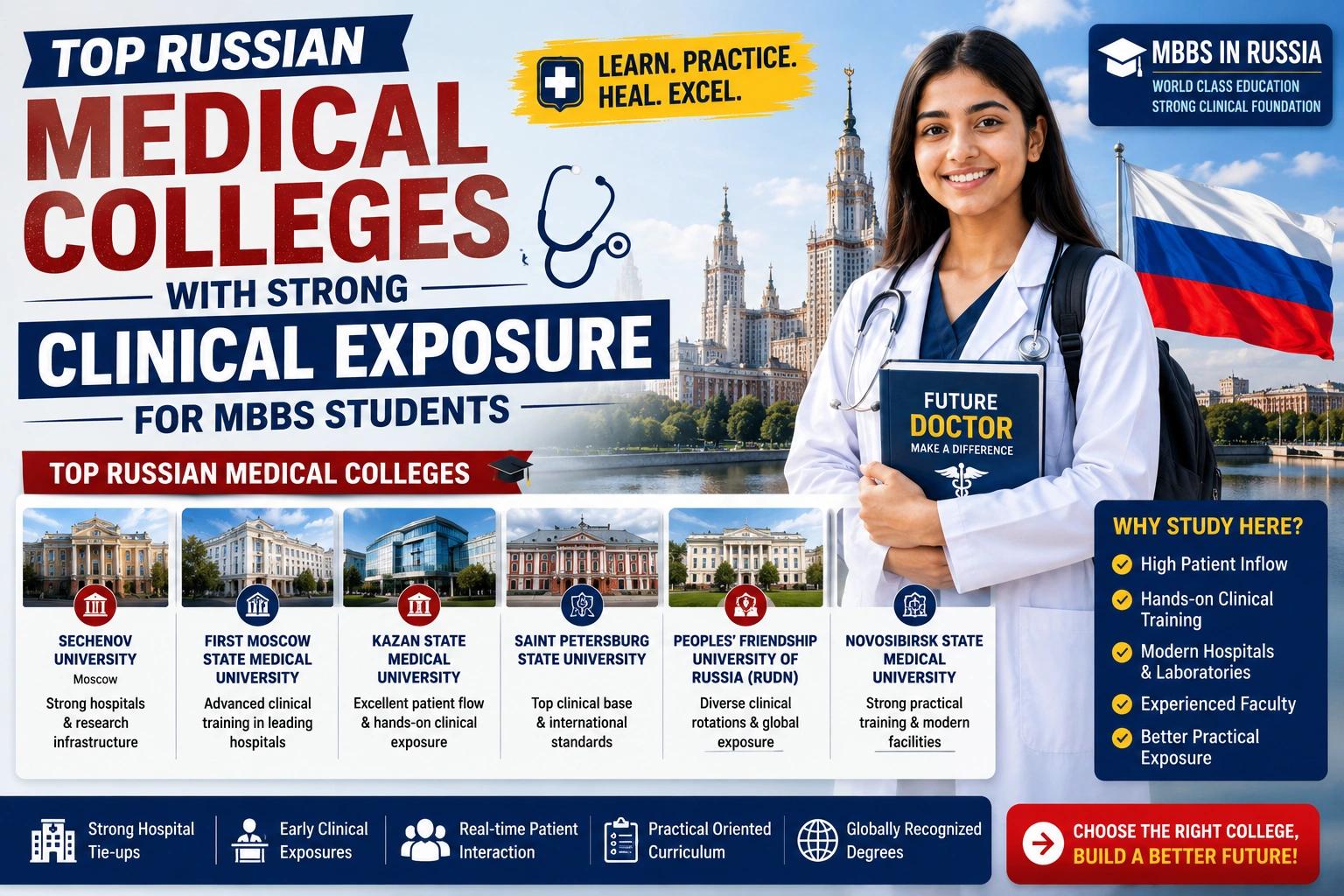
It is not just about the tuition fees or reputation of the university. The quality of the clinical training is important for an Indian student who plans to study MBBS in Russia. It can directly impact their practical skills, confidence when dealing with patients and future licensing requirements. Russia has a number of established medical schools where students can receive classroom instruction alongside laboratory work and simulation-based training, hospital postings and supervised clinical rotatings.
Before applying for admission, Indian students must also check whether the university and its programme of study meet the National Medical Commission requirements. The NMC's Foreign Medical Graduate Framework places emphasis on English-medium instruction and practical and clinical training.
Why clinical exposure is important in MBBS in Russia
The clinical exposure stage is where medical students start to connect theoretical concepts with actual patients and healthcare scenarios. Students may choose to attend departments in hospitals such as emergency medicine, psychiatry and obstetrics-gynecology. The specific departments, teaching hospitals and rotating structure will vary from university to university.
A solid clinical programme should include more than just occasional hospital visits. Students should be given regular opportunities to observe physicians, learn about patient histories, take part in case discussions, practice examination techniques under supervision, and develop their clinical decision-making abilities. Exposure to various patient conditions is also useful for Indian students as they prepare for their licensing exams and work in India.
Top Russian medical universities renowned for clinical training
International students are interested in several established Russian medical schools because of their teaching facilities, academic infrastructure and history of medical education. Among the universities that Indian students are most likely to evaluate are Kazan Federal University (RUDN University), Bashkir State Medical University (RUDN University), Volgograd State Medical University (RUDN University), Orenburg State Medical University (RUDN University), Tver State Medical University (RUDN University), First Moscow State Medical University & Crimea Federal University.
Kazan Federal University
Kazan Federal University, one of Russia's most prestigious universities, has a large environment for academic learning and research. It also offers clinical training and medical education. Students will benefit from the exposure to modern teaching infrastructure and different medical departments. The location of the school in Kazan provides students with access to an urban healthcare environment that is developed.
The university's reputation should not be the only factor considered when evaluating the university for Indian applicants. They also need to consider the medical program, current eligibility requirements, clinical curriculum, and recognition requirements that are applicable to the admission year.
Bashkir State University of Medical Sciences
International students also consider the Bashkir State Medical University, located in Ufa. The medical education program combines theory with clinical training and practical exposure. Students can gain experience in affiliated healthcare facilities while studying major medical disciplines.
It is especially useful for students in the latter years of their programme when they move away from the basic sciences and towards diagnosis, treatments, and patient management.
Volgograd State Medical University
The Volgograd State Medical University is a medical school with a long history and draws students from all over the world. The clinical training at the university covers all major medical specialties, and students can study medicine in an environment that is hospital-oriented.
Before applying, international students should confirm the teaching language and clinical rotations as well as the documentation provided by the institution. They shouldn't rely solely on promotional statements.
Orenburg State Medical University
Orenburg State Medical University offers another option to students looking for medical education in Russia. The clinical subjects are an important part in the last stages of medical training, as students move towards the practical application of knowledge gained during the pre-clinical year.
You can evaluate the university based on factors like hospital affiliations and availability of clinical departments. Other criteria include faculty experience, simulation equipment, student-teacher interaction, and opportunities for supervised learning.
Perm State Medical University
Perm State Medical University, one of Russia's oldest medical institutions, is known for the quality of its medical education and research. During their training, students can experience a wide range of clinical disciplines.
Students from India should ask not only if a university provides clinical exposure but also how often students are posted to hospitals, and what types of activities are included.
What is a typical clinical exposure?
After students have completed their foundational courses, the clinical component of an MBBS program becomes more intense. Students may be exposed to:
- Teaching and patient observation at the bedside
- Discussions on clinical cases
- Take a history and perform a physical examination
- Postings in medicine and surgery
- Paediatrics and obstetrics-gynaecology training
- Emergency and Diagnostic Exposure
- Practicals in laboratory and pathology
- Simulation-based Medical Training
- Clinical rotations supervised
- Lectures and demonstrations in hospitals
Even in clinical training, learning Russian is useful. Even if the academic programme is in English, it may be necessary to have basic Russian language skills for interaction with patients. Students who have a practical understanding of the language can communicate better in clinical settings.
NMC, NEET, and WDOMS - What Indian students should check
Before paying for admission or consulting fees, it is important to check the eligibility and recognition of the applicant. Indian students planning to study medicine abroad generally need to satisfy the applicable NEET requirements and should verify the foreign medical institution and qualification against the current requirements of the NMC.
A useful resource to check if a school is listed is the World Directory of Medical Schools. Students should be aware that WDOMS listings alone are not a guarantee of eligibility for Indian medical registration. Check the applicable NMC regulations separately.
As part of the broader verification process, students should also check out information from the World Health Organization. Before admission, students should verify the university, course, and accreditation.
Clinical Training and Future Licensing for India
Many students believe that completing MBBS in another country automatically gives them the right to practice medicine in India. This is not true. The NMC licensing requirements for Indian medical graduates from foreign institutions are the same as those of Indian medical graduates.
In its FAQ, the NMC explains that internship and clinical placement are two separate phases of practical training. The FAQ also states that foreign graduates seeking Indian eligibility for internship must meet certain conditions. These include the required duration of the medical course, the internship requirements, English medium instruction, prescribed topics, and the relevant licensing exam or test.
Students should therefore obtain written information about the length and structure of their clinical training and internship from their university, instead of assuming that postings in hospitals automatically meet all Indian regulatory requirements.
Compare Russian Medical Colleges based on clinical exposure
Comparing the two should be based on facts and figures, not advertisements. Students should ask the following questions before choosing an institution:
- What hospitals are affiliated to the medical university
- When do clinical placements start?
- How many hours of clinical or rotational training are included?
- Students are taught in hospitals that have an affiliation with the University.
- Are simulation laboratories available?
- What is the preferred medium of instruction for clinical training?
- Does Russian language training exist?
- What documentation does the University issue for internships?
- Does the program meet the most recent NMC requirements applicable?
- Does the university appear in WDOMS currently?
These questions can help students differentiate between universities that have a real clinical integration and those with limited practical exposure.
Conclusion
Russia offers Indian students the opportunity to study at established medical universities and gain international exposure through practical training, academic experience abroad, and hospital-based education. The best university may not be the one that has the lowest fees or most appealing advertisements. All factors should be taken into consideration, including clinical exposure, hospital infrastructures, curriculum structures, teaching languages, regulatory compliance, and student support.
Students should verify their university's status independently by checking NMC requirements, WDOMS and the programme structure. They should also confirm with the university the exact program structure and the licensing path they will require after graduation. This can help students to make an informed decision, and not choose a medical school based solely on the promotional claims.