
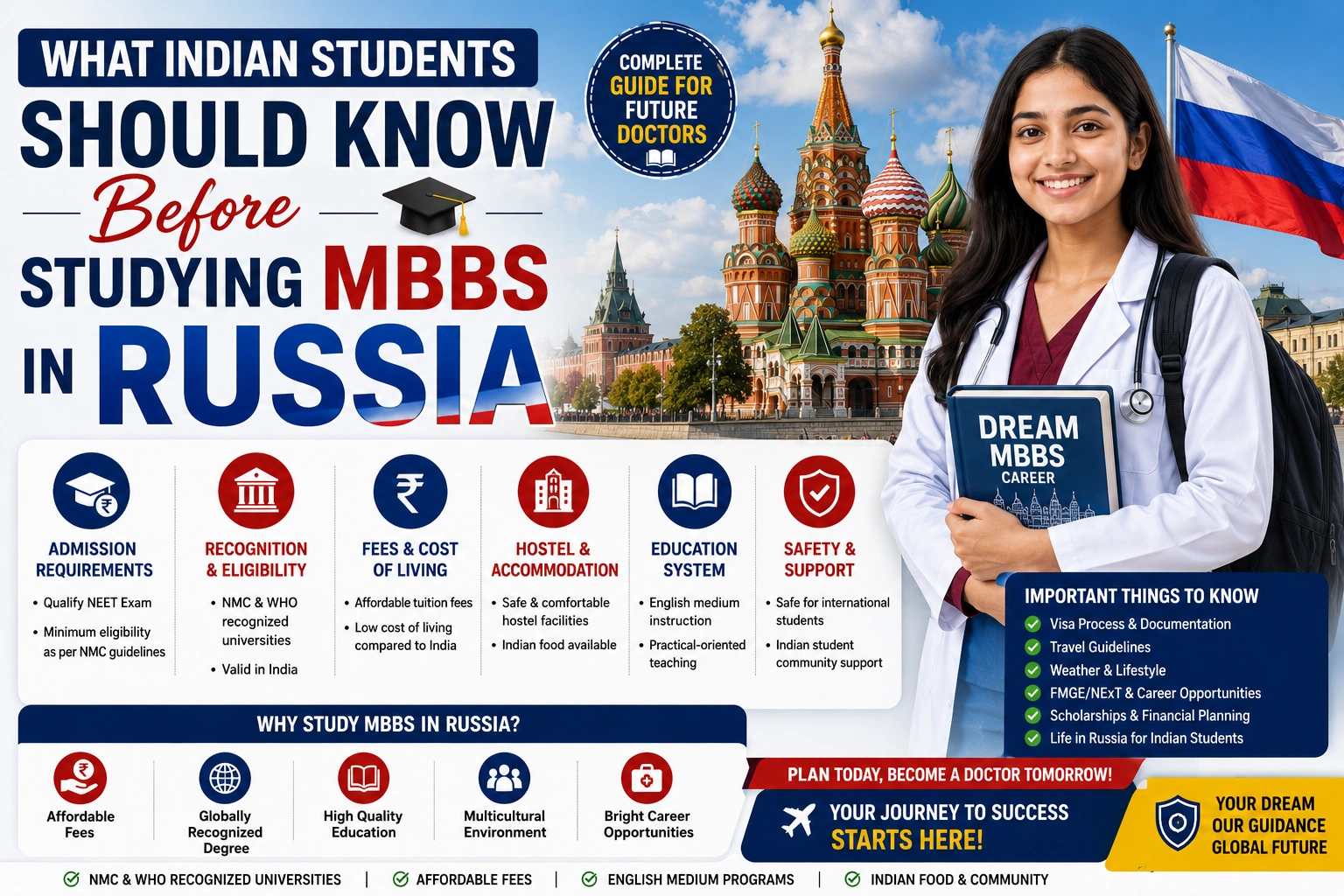
For students in India that want to become a doctor but have been unable to secure a medical seat in India, studying MBBS in Russia is an option that is worth exploring. Russia offers low-cost degrees through universities that have well established programs and that cater to international students. While low-cost degrees may entice you to select a certain foreign medical university, studying at a medical university abroad is a big decision that is not to be taken lightly and requires a lot more than just comparing fees.
When Indian students choose to study MBBS in Russia, there are many important factors to consider such as NEET admissions, choosing a university, course and clinical study duration, language, climate, living expenses and the regulations required for practicing medicine in India post graduation.
If you are a student or an Indian citizen who is a holder of an OCI and is determined to obtain the primary medical qualification from outside of India, be advised by the National Medical Commission (NMC) that you will need to qualify for the NEET exam as you should not be misled by the false information that states you can bypass the NEET exam for a foreign medical degree.
Why Do Indian Students Choose MBBS in Russia?
MBBS in Russia for Indian students is very popular due to the low-cost degrees as well as the international medical programs that are offered. As per the estimates provided in 2026, tuition for medical schools in Russia will be between ₹2.5 to ₹6 lakhs per year, but this varies by university.
English medium programs for international students are another selling point. Students should, however, note the difference between the English medium teaching in classrooms and the English communication during the clinical training. Besides, when the training involves dealing with and treating patients, the Russian language gets involved, too.
This means that students must conduct thorough research on the universities, taking into consideration the clinical training and the language support offered, rather than just concentrating on the tuition fee.
NEET Requirement for Indian Students
Students must understand the NEET requirement if they are considering applying for MBBS admission in Russia.
As per the NMC, Indian nationals and OCI card holders who plan to acquire their primary medical qualification outside of India need to qualify for the National Eligibility-cum-Entrance Test.
This means that students searching for “MBBS in Russia without NEET” need to take extra caution. A foreign university’s admission process cannot replace the Indian regulatory system’s process.
Only qualifying for NEET is a part of the process. Students need to ensure that the chosen university program meets the foreign medical graduate’s requirements.
Eligibility for MBBS in Russia
Students need to ensure that they have reviewed the university’s criteria as well as India’s criteria for the MBBS in Russia admission process prior to starting the process.
Most universities will need students to have completed their Class 12 with a minimum of the subjects Physics, Chemistry and Biology or Biotechnology, and have a minimum score as well as meeting the age requirement. Also, as per the NMC rules, qualification for NEET is also a pre-requisite for Indian students.
Because universities have different admission policies, students should inquire about the eligibility criteria directly from their preferred institution(s) instead of using a generic list that an agent may provide.
Duration of MBBS in Russia
The duration of MBBS in Russia at different universities is typically around a six-year period. Each university has the right to create its own program design and academic and clinical structure, therefore students should confirm the duration and structure of the course before deciding to enroll.
Many factors need to be considered when selecting a university. The program should offer adequate theoretical and practical education, clinical training and exposure. The NMC has defined the minimum requirements regarding the foreign medical education of their graduates for the purpose of their clinical training as stated in the foreign medical graduate (FMG) advisory. In this regard, the NMC has defined minimum training requirements applicable to the FMG standards.
Choosing the Right Russian Medical University
When selecting a university in Russia for MBBS, getting the most value for your money is a factor to consider; however, it is probably less important than many others.
Students should determine whether or not the university has a well-established medical program, clinical training, and teaching facilities, as well as a program that meets the relevant requirements of India.
Students can obtain information about the medical schools using WDOMS; however, students should not consider the listing of WDOMS to be an automatic eligibility to practice in India. The university and specific program should be evaluated based on the latest NMC guidelines.
Students should avoid phrases like “NMC-approved MBBS university.” The NMC lays out its own rules for the regulation of foreign medical graduates, so students should check the actual regulation rather than relying on marketing speak.
Understand the Total Cost, Not Just Tuition
Students looking at Russia MBBS fees are often persuaded to consider Russia because of the lower tuition seen at many of the Russia medical universities.
Tuition estimates for 2026 suggest ₹2.5–₹6 lakh annually at many universities, and hostel fees are estimated to be ₹40,000–₹1 lakh annually.
The total cost of the entire Russia MBBS program still includes things like food, local transportation, medical insurance, visa and passport fees, flights, study materials, and personal expenses.
A student should prepare a complete financial plan for the entire 6 years rather than a budget based on only the estimated tuition.
Clinical Training and the Russian Language
This is a very critical issue that students tend to overlook.
Many universities teach some parts of the medical curriculum in English, However, clinical training involves interacting with and understanding Russian patients and the Russian medical staff.
Many of the Indian students also cite the language of training as a huge barrier during the clinical training.
Students should be asking what Russian language training and Clinical training will be set up for the International students.
Weather Effects and Adjustments on Students in Russia
Indian students will notice changes in temperature as they arrive in different climates. Unlike India, where students have learned to deal with hot and mild climates, temperatures in Russia are mostly low with long, harsh winters. However, students should not shy away from learning to adapt to different climates. They should deal with it positively by dressing appropriately in winter gear and booking winter-ready accommodations.
There are seasonal changes throughout the year. Students need to prepare themselves for the harsh climate to make their transition to studying in Russia more comfortable.
When traveling abroad, it is important to assess the distance from your home as studying abroad can lead to feelings of homesickness. This is especially true when studying abroad as a student of medicine for several years. Staying in touch with family and friends free online, and building a community with other students can ease homesickness the most.
Hostel and Accommodation
When considering where to stay when traveling abroad for university, most international students agree on university hostels as they are often the most convenient and economical accommodation.
Before planning on studying medicine in Russia, students should inquire about:
- Availability of hostels for international students.
- Distance of the hostel from the main academic campus.
- Sharing rooms with other students.
- Use of heating facilities in the hostel.
- Availability of internet.
- Hostel food and kitchen facilities.
- Hostel rules for security and access.
- Annual charges for staying in the hostel.
Estimates for 2026 suggest that the price of staying in hostels for the entire year will range from ₹40,000 to ₹1 lakh at many Institutions, although the actual price may differ.
Documents Students Will Need to Prepare for Admission
It is advisable to prepare necessary documents early to avoid the frustration of last minute changes that could result in delays of admission and visa formalities.
Typical documents that may be needed are:
- Class 10 certificates and marksheets.
- Class 12 certificates and marksheets.
- NEET scorecard and qualification.
- Valid passport.
- Photographs for the passport.
- Medical fitness report.
- If applicable, an HIV test report.
- University admission forms.
- Visa invitation forms.
- Other university-related documents.
The specific documents vary based on university and visa requirements, so students need to check for the most recent version before submitting their applications.
Procedures for Admission
The steps for MBBS admission in Russia include choosing a university, checking eligibility, providing required documents, and completing the admission and visa processes.
Do not be hasty in this process. Admission agents may show you a number of universities, some of which may have pretty similar fee structures. Take your time to evaluate the program and university, accommodation, location, clinical training and overall costs.
A written fee structure is much better than what you may be hearing. Students should be asking whether the quoted fee is for the entire course, one semester, or one year.
What About WDOMS And Recognition?
When students explore universities in Russia for MBBS, they come across many advertisement claims related to WHO, NMC, and WDOMS.
It is important to understand these terms.
The World Directory of Medical Schools (WDOMS) is a directory of medical schools across the globe and students can use this to check the details and existence of a particular school.
NMC relates to Indian medical education and the foreign medical graduate’s education. When trying to determine the eligibility for India, the most recent NMC guidelines should be considered.
Thus, do not go for a university only because the admissions ads say that the university is “WHO recognized” or “NMC approved.” Check the real program and the current requirements from the regulators.
What happens after MBBS from Russia?
Those looking to obtain an MBBS in Russia must consider their next steps after graduation when leaving India.
With a foreign medical degree, an Indian graduate cannot practice medicine in India. Graduates must go through the Indian medical registration and licensing process for foreign medical graduates.
Since the regulation regarding registration and examination will be subject to change, students are required to keep themselves updated through the official notification of NMC and National Board of Examinations in Medical Sciences.
Students must recognize that the Indian licensing path will necessitate additional adjustment to accommodate differences in curriculum, testing, and clinical environments.
FMGE/NExT Should be Planned Ahead
Students must not wait until the end of their medical education to start considering the medical licensing examinations.
At present, FMGE and the subsequent transition towards NExT is the most pertinent and pressing topic for foreign medical graduates.
Thus, the earlier the student develops their understanding in medical concepts, the better.
Familiarity with the clinical subjects and patterns of Indian examinations will assist in further preparation and will be required in the later stages.
Students must ensure that the primary objective extends beyond merely obtaining an MBBS degree in Russia and must include the development of knowledge and clinical skills necessary to support the student's intended career in medicine.
Benefits of Studying MBBS in Russia
Depending on the student, Russia can provide the following advantages:
- Moderate tuition fees in most universities.
- Availability of medical programs with instruction in English.
- Well-developed medical education structures.
- Established foreign student communities.
- Well developed university accommodation on campus.
- Exposure to a different healthcare and academic environment.
- Possibility of a lower overall cost than some private medical options.
However, the benefits of each option should be weighed with the challenges, and should not be listed as offered advantages.
Challenges Indian Students Must Prepare For
Less frequently discussed characteristics of medical education in Russia also need to be understood.
Working through the cold will require adjustment. Clinical training Russian will be the most dominant language of communication. Students will be away from home for several years and need to get accustomed to a new culture and educational system.
Also, preparing for the Indian licensing requirements after graduation will need to be dealt with. The most published disadvantages of studying in Russia, and the most discussed in many forums, concentrate on the licensing exam, language, expenses, climate, homesickness and most were commented on, before going to Russia.
Knowing this will prepare the students realistically prior to their admission, rather than once they reach Russia.
Common Mistakes to Avoid
Indian students can reduce needless problems by avoiding a few usual mistakes.
- Choosing only on the basis of fees. The most affordable university may not be the most appropriate.
- Trusting every consultant's story. Very important facts should be checked at the university and through the regulatory body.
- Ignoring the Russian language. An English based educational system does not eliminate the need for Russian language in clinical training.
- Underestimating costs. Expenses become considerable after 6 years, and travel, food, insurance, and other expenses become considerable too.
- Waiting until the last year to prepare for licensing. Students should become acquainted with the Indian licensing from the first year and should not delay to the last.
- Not checking the exact programme: Before confirming admission, institutional information and programme specifics must be validated.
Final Checklist Before You Leave India
Before travelling for study MBBS in Russia, students should ensure they have:
- Qualified NEET as required.
- Verified the university and medical programme.
- Checked the latest NMC requirements.
- Examined WDOMS information for the institution.
- Obtained the official fee structure.
- Confirmed hostel arrangements.
- Prepared academic and identity documents.
- Completed the applicable visa process.
- Purchased appropriate winter clothing.
- Planned an emergency financial reserve.
- Understood the clinical-language requirements.
- I started learning basic Russian.
- Discussed the post-graduation licensing pathway.
Conclusion
MBBS in Russia has emerged as a practical choice for a considerable number of Indian students because of the International Medical Education options at relatively lower tuition. However, cost is not the only factor to be considered for studying in Russia.
The choice should be well researched considering the quality of university, structure of the programme, clinical exposure, languages, total cost, NMC demands, and post-graduation licensing.
Students should understand and verify the entire process with official sources, from the university selection to medical registration, before undertaking MBBS in Russia for Indian students. The aim should be selection of a programme with academic, practical and financial alignment with the students career.
Frequently Asked Questions
Is MBBS in Russia good for Indian students?
Indian MBBS aspirants will find it an ideal option to pursue an overseas medical degree, provided they choose the right university and are well aware of the requisite admission procedures and regulations.
Is NEET compulsory for MBBS in Russia?
As per NMC, Indian nationals and OCI aspirants wishing to pursue their primary medical qualification abroad have to qualify NEET.
What is the duration of MBBS in Russia?
Most medical programs in Russia are of 6 years duration, however students are advised to confirm the same from the university of their choice.
Is MBBS in Russia taught in English?
While many universities have programs in English for international students, students should be prepared that Russian may be necessary for effective communication during clinical training.
How much does MBBS in Russia cost?
As per estimates published in 2026, tuition for most Russian universities will be approximately ₹2.5 to ₹6 lakh per year. Other expenses would include housing, food, insurance, travel and other personal expenses.
Is Russia safe for Indian medical students?
This is relative and dependent on the city and personal situations. Students must research the university and its surroundings, including accommodation, the local laws and the current travel advisory before going.
Do Indian students need to learn Russian?
Learning some Russian is extremely helpful, especially in clinical training, for conducting conversations with local patients.
Can I practise medicine in India after completing MBBS in Russia?
No one can practice medicine in India just by completing MBBS. All overseas medical graduates must complete the relevant registration and licensing procedures in India.
Should I choose a university only because it has low fees?
No. Tuition fees must be assessed in relation to the structure of the program, clinical exposure, accommodation, other relevant information, and applicable NMC requirements.
What should I verify before taking admission?
Before making a payment, check the relevant university and medical program, as well as the fee and duration, clinical training, hostel, WDOMS, and the latest NMC requirements.