
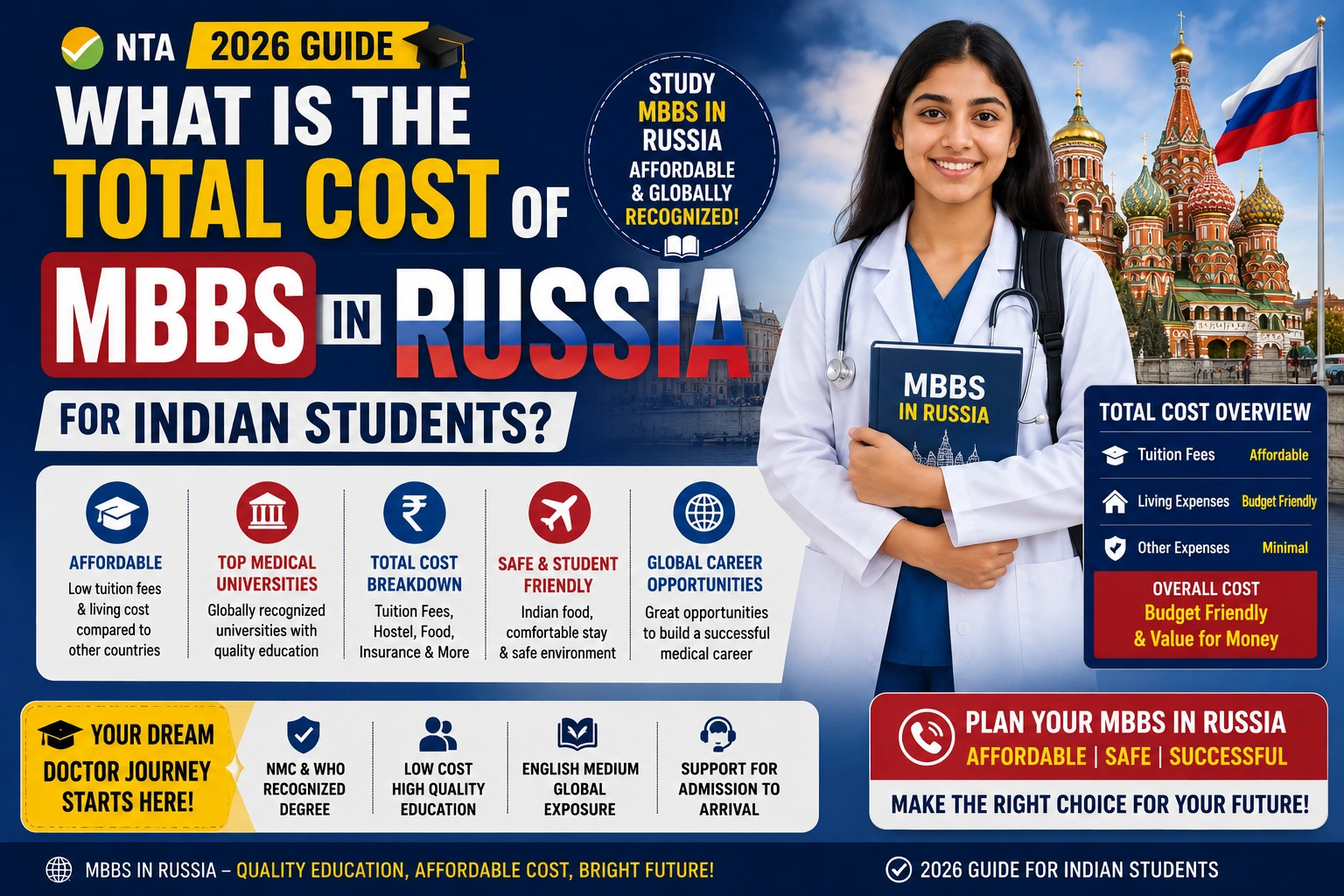
For many Indian students, medicine abroad begins with Russia as the cost for a course at a private medical college in India may exceed what it would cost at an MBBS program in Russia. Choosing a program in Russia is more convincing after accounting for things beyond published tuition costs, such as hostel, healthcare, food, travel, insurance, study, and other costs.
For 2026, it is expected to cost Indian students anywhere between ₹20 lakh and ₹40 lakh to complete an MBBS in Russia. This price range accounts for the university, the city, currency exchange rate, and the student's lifestyle. At the current rate of conversion, tuition for the majority of the medical universities in Russia is between ₹2.5 lakh and ₹6 lakh. However, there are workarounds for this price range.
The following guide outlines the major components of the cost of an MBBS in Russia for Indian Students to help the students and their parents plan their finances in advance.
Quick Overview of the Cost of MBBS in Russia for Indian Students
Prices vary at different universities. Hence, answering the question of how much an MBBS in Russia costs requires a range rather than a single answer.
|
Expense |
Approximate Annual Cost |
Approximate Cost for 6 Years |
|
Tuition |
₹2.5 lakh to ₹6 lakh |
₹15 lakh to ₹36 lakh |
|
Hostel |
₹40,000 to ₹1 lakh |
₹2.4 lakh to ₹6 lakh |
|
Food & Living |
₹1 lakh to ₹1.5 lakh |
₹6 lakh to ₹9 lakh |
|
Medical Insurance |
₹10,000 to ₹20,000 |
₹60,000 to ₹1.2 lakh |
|
Visa, Travel & Personal Expenses |
Variable |
Variable |
These are planning ranges, not fixed university fees. The actual amount can be higher or lower depending on the institution and student's spending habits. Published estimates for 2026 put tuition in the range of ₹2.5 lakh to ₹6 lakh, and hostel costs in the range of ₹40,000 to ₹1 lakh.
Tuition Fees for MBBS in Russia
Tuition tends to be the bulk of MBBS fees in Russia. For 2026, most medical universities in Russia fall broadly in the range of ₹2.5 lakh to ₹6 lakh. More central and prestigious universities may charge more than this.
For example, published estimates show annual tuition fees as ₹3 lakh to ₹4 lakh for Bashkir State Medical University, ₹4 lakh to ₹5 lakh for Orenburg State Medical University, and ₹5 lakh to ₹6 lakh for some of the higher cost universities. These figures should be treated as an estimate only, as the figures and currency converted values can change.
Therefore, tuition costs for six Years can be in the range of ₹15 lakh to ₹36 lakh. Students are advised to contact their selected university for the most recent fees before paying the admission fees.
Hostel and Accommodation Expenses
Accommodation cost is one of the considerable components of Russian MBBS fees for Indian students. Many universities have hostels for international students and hostels are generally less expensive than rented apartments.
One can expect to spend around ₹40,000 to ₹1 lakh per year on hostel accommodation, depending on the university, type of room, and facilities.
Students must ask the amenities included in the hostel package and if the utilities are included. While deciding on accommodation, students should always consider the winters of Russia where heating costs can be significantly high.
Food and Living Expenses
The cost of living depends on the lifestyle of students. Regular cooking students can save money by using university facilities while students who eat outside may incur more expenses.
A conservative estimate of expenses per month for food and other necessities in 2026 can be around ₹15,000–₹30,000, depending on lifestyle and location. A similar broad range estimate is available online.
The budget for a month can include the following.
- Food
- Groceries
- Local transportation
- Mobile and Internet
- Personal hygiene
- Clothing
- Study materials
- Entertainment
- Miscellaneous
Students must have an extra budget for emergency savings.
Medical Insurance
Informing the need for medical insurance, international students have to expect a cost of around ₹10,000–₹20,000 annually for insurance, depending on the insurance policy.
Students should ensure they understand what the university requires, what travel insurance covers and if the policy is annual and needs to be renewed.
Visa, Travel, and Other Expenses
Students need to keep these other costs in mind in addition to the cost of medical study in Russia.
These could be the costs of the visa, the medical report, the translations, travel, the airport transfers, and the flights for the return journey at the breaks. Flights can be expensive and can vary a lot, depending on the season and the booking date.
A student cannot think that the total cost for Study MBBS in Russia will be the cost of the tuition for 6 years, multiplied by 6. There are many other categories that need to be added to the total cost.
How Much is the Cost of MBBS in Russia for 6 Years?
Because there are costs for tuition, boarding, living, insurance, and miscellaneous costs, many students plan to spend around ₹20 lakh to ₹40 lakh for the 6-year program. Based on 2026 estimations from MBBS-in-Russia, this range reflects the total cost. Another estimate places it more in the range of ₹20 lakh to ₹35 lakh, also depending on the university and the lifestyle. The total cost will depend on:
The university, the city selected, the lifestyle, the rupee to ruble exchange rates, the hostel, and the university accommodation.
Example of Six-Year MBBS Cost
For the purpose of illustration, if a student takes admission to a university where the cost of education is about Indian Rupees 4 Lakh per year as well as the hostel cost is about INR 60,000.
The computation of the estimated cost would be like:
|
Expense |
Approximate 6-Year cost |
|
Tuition |
₹24 lakh |
|
Hostel |
₹3.6 lakh |
|
Food & living |
₹7.2 lakh |
|
Insurance |
₹90,000 |
|
Travel, visa & miscellaneous |
₹1.5–₹2.5 lakh |
|
Estimated total |
₹37.2–₹38.2 lakh |
This calculation is illustrative only and should not be taken as a cost quoted or approved by any varsity.
Low-cost MBBS in Russia: is it even possible?
Students looking for low cost MBBS in Russia will find that universities have various fee structures. Selecting a university with the lowest fee can be hazardous to the student.
A better comparison considers tuition, clinical training, university infrastructure, accommodation, program structure, location, and what requirements are imposed on foreign medical graduates.
Some fee comparison lists for 2026 state that tuition at the Bashkir State Medical University, Orenburg State Medical University, Mari State University, Altai State Medical University, and Kazan State Medical University is different from each other.
Potential students need to check directly with these universities for the current fee and program structure.
Is MBBS in Russia Cheaper Than Private Medical Colleges in India?
Cost is probably the most important factor when students consider MBBS in Russia for Indian students. Some private medical colleges in India report total foreign study expenditures that are higher than what other universities in Russia charge.
However, cost comparison should not be restricted to tuition. One should also consider accommodation, food, transport, and other expenses to determine the total cost of the six-year study.
In some cases, the university may charge a modest tuition fee when compared to other institutions, and have excellent facilities and a clear and transparent fee structure; this may be a better choice than an institution that charges unusually low tuition but has lots of additional fees.
Is NEET Mandatory for MBBS in Russia?
Yes. Indian students who wish to obtain a primary medical qualification abroad are required to clear NEET as per the NMC’s regulations. The cost of education does not affect the requirement.
Students should also know that obtaining an MBBS degree in Russia does not give them the right to practice medicine in India. They need to follow the applicable regulations for practicing medicine in India for foreign medical graduates.
Before admission, students should confirm from the official NMC and NEET websites the latest requirements.
How to Decrease the Total MBBS in Russia Cost?
Students can bring down the cost of study greatly by managing expenditures before departure.
Affordable hostel accommodation and tuition that is clearly detailed on a university’s website can help counterbalance high tuition. Living in university provided accommodation can contribute to cost savings as well as preparing meals in a hostel. Using public transport and avoiding unnecessary excursions helps to contain monthly expenditures.
Before committing to any university, students should also request the university to provide the details of all costs associated with the university in a breakdown. This includes tuition, hostel, registration, insurance and other mandatory costs.
The most important of all this information is that families should always have an emergency fund instead of exhausting their budget on tuition.
What Must Indian Students Verify Before Payment for MBBS in Russia?
Prior to making any payment for admission to an MBBS course in Russia, students must confirm the institution’s current data regarding courses, structure, fees, accommodation, and clinical training.
About individual medical schools, students can check information provided in the WDOMS. Students must verify the latest NMC requirements rather than relying on statements such as “WHO approved” or “NMC approved” without verifying the regulatory frameworks.
The WHO site can provide some health and medical data, however, students must know that WHO recognition should never be considered a substitute for verifying the latest foreign medical graduate requirements in India.
What Niche Budget Can Indian Students Expect for MBBS in Russia in 2026?
Indian students must keep in mind that the tuition, accommodation, living, insurance, travel cost and the ruble to rupee exchange rate can be expected to vary between approximately ₹ 20 lakh to ₹ 40 lakh for the complete MBBS course in Russia 2026. Based on current published data for 2026 this budget range is expected.
Students should not trust an advertised number when searching for Russian MBBS fees for Indian students. Instead, the total cost from admission to graduation should be analyzed.
The amalgamation of cost, quality, clinical exposure, verification, and regulation ensures a financially reasonable decision on studying medicine in Russia.
What is the expected cost of an MBBS Degree in Russia for Indian students in 2026?
The approximate cost of an MBBS degree in the range of ₹20 lakh to ₹40 lakh for six years. Cost will, of course, vary depending on the selected university, student lifestyle, and other miscellaneous costs.
What is the approximate cost of an academic year in MBBS university in Russia?
Many universities charge around ₹2.5–₹6 lakh per year, but some will charge even more.
How much does a hostel in Russia cost?
A hostel room at a university in Russia can vary in price from ₹40,000 to ₹1 lakh per year. Cost will depend on the selected university and type of hostel.
How much would I have to budget for my living expenses and food in Russia?
Food costs, as well as all living expenses, will depend on lifestyle and the city, but a safe budget to prepare for food and other expenses would be in the range of ₹15,000–₹30,000 per month.
Does the total cost include travel costs?
No, you have to add the university's tuition costs and accommodations to the travel costs, such as airline tickets, visa costs, and personal travel.
Can I study MBBS in Russia for less than 25 lakh?
It is likely possible with a less expensive university and minimal cost of living. However, it’s necessary to have the full information of the 6 year course fee to ensure that the cost of the course will not exceed 25 lakh.
Is MBBS in Russia cheaper than private medical education in India
In most cases, the overall cost is significantly lower than many private medical institutions in India. However, the actual cost of 6 years of study must be considered.
Which other factor should I consider?
Other than the cost, the structure of the course, the on-site clinical training, the accommodation, the status and accreditation of the institution and compliance with the requirements for the medical graduates of foreign medical institutions must also be checked. Cost must not be the only concern.