
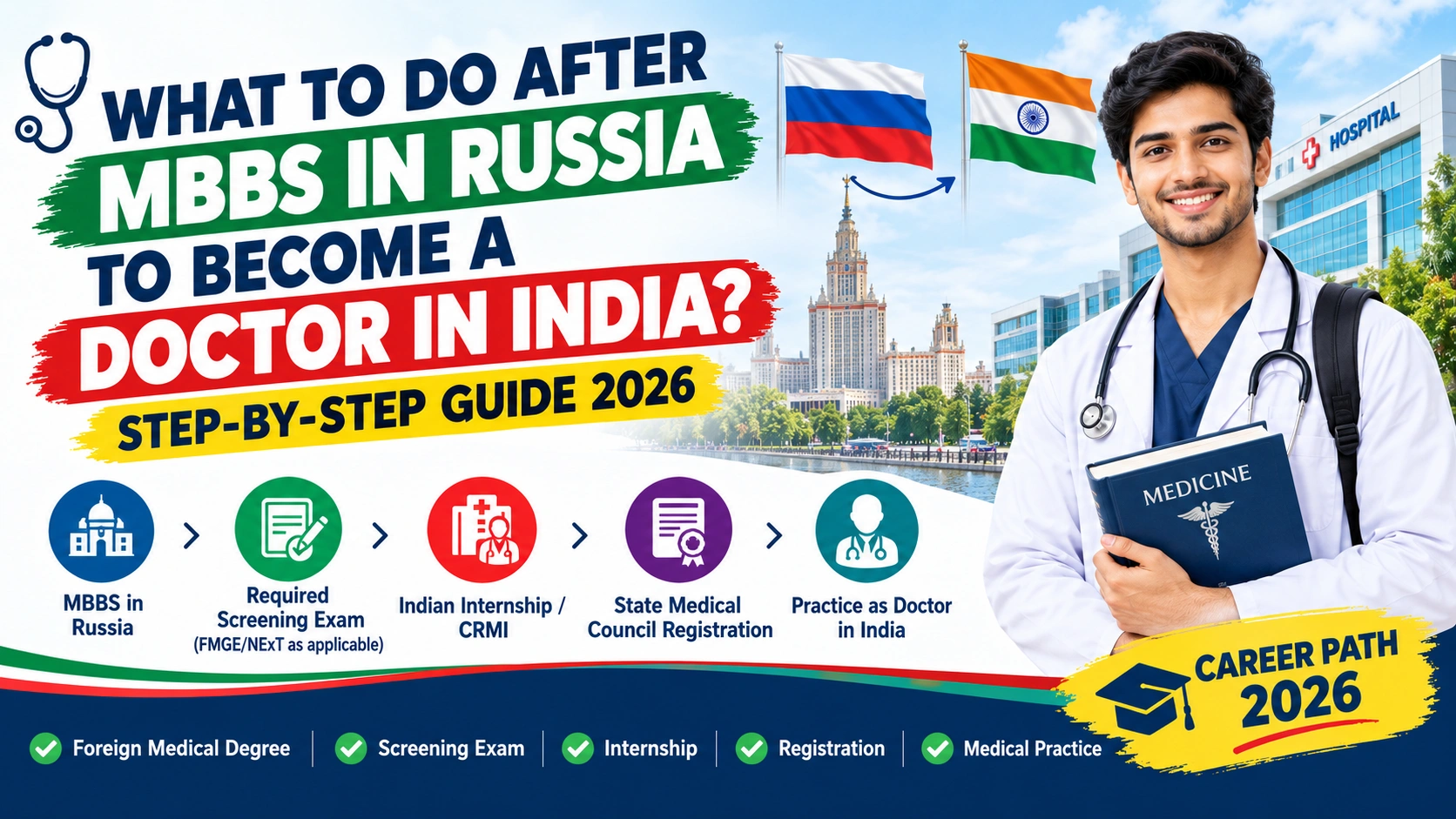
Finishing MBBS in Russia feels like the end of a very long journey. Six years of lectures, practical classes, hospital postings, exams, Russian winters, hostel life — finally done. Then you return to India and realise something quickly: having the degree and being legally allowed to practise independently in India are two different things. There are still a few formal steps left. For most Indian graduates returning from Russia, the route involves checking whether the foreign qualification satisfies the applicable National Medical Commission rules, clearing the licensing/screening requirement in force at that time, completing the required internship in India, and obtaining medical registration. The process isn't impossible. But yes, paperwork and regulatory compliance matter a lot. Students planning to study or already pursuing National Medical Commission (NMC) lists the Foreign Medical Graduate Licentiate Regulations, 2021 and Compulsory Rotating Medical Internship Regulations, 2021 among the key regulations governing this area.This is why choosing the university correctly before leaving India matters just as much as passing university examinations later. A cheap university isn't automatically a good choice if its course structure, internship arrangement or other conditions create problems under Indian rules.
The Basic Route from Russia to Medical Practice in India
So, what happens after graduation? For a student covered by the present FMGL framework, the pathway can broadly be understood like this:Complete qualifying medical education in Russia → obtain degree and required documents → meet the applicable FMG eligibility conditions → qualify the licensing/screening examination applicable in India → obtain the registration required for internship → complete compulsory internship in India → apply for permanent medical registration → start practising or pursue PG training.
Looks straightforward on paper. In reality, every stage has its own documentation and eligibility checks.One major detail deserves attention here. In its March 2026 clarification, NMC stated that students admitted to their foreign medical course after 18 November 2021 are governed by the CRMI Regulations, 2021 and are required to undergo one year of mandatory internship in India. Students admitted earlier can fall under different provisions depending on their circumstances.So don't blindly follow the process used by a senior who entered medical school several years before you. His or her regulatory route may genuinely be different from yours.
Step 1: Make Sure Your Foreign Medical Qualification Meets NMC Conditions
Here's where students need to be careful. Under the FMGL Regulations framework, NMC specifies conditions relating to the foreign medical programme itself. Its published FAQ states, among other requirements, that the course leading to the foreign medical degree must have a minimum duration of 54 months and that the medium of instruction must be English. It also requires theory, practical and clinical training equivalent to the Indian MBBS curriculum.For students evaluating MBBS in Russia, this means you shouldn't judge a programme only by tuition fee, city or university ranking. Check the actual medical programme offered to international students. Ask about clinical training. Ask where the internship is completed. Check the qualification awarded at graduation and whether that qualification meets the conditions for registration/licensure in the country where it is awarded.Honestly, this part doesn't get enough attention during admission counselling. Students spend weeks comparing whether one hostel costs ₹80,000 or ₹1.2 lakh per year, but sometimes barely investigate the structure of the medical programme that will decide their professional eligibility six years later.
Step 2: Keep Your NEET Record and Admission Documents Safe
Remember your NEET documents from the year you took admission? Don't lose them.World Directory of Medical Schools (WDOMS) is useful for checking information about medical schools, but WDOMS itself clearly states that inclusion in the directory does not by itself mean recognition, accreditation or endorsement by WDOMS, WFME or FAIMER.That's an important distinction because phrases such as "WHO approved" or "WDOMS approved" are often used loosely in overseas education marketing. WDOMS specifically cautions students that organizations such as WDOMS and the
Junior Resident/Medical Officer
Work in hospitals and build practical clinical experience
Compete for MD/MS and other eligible PG pathways
Join private, charitable or eligible public healthcare institutions
Apply for posts where eligibility criteria are satisfied
Practise subject to registration and other applicable legal requirements
Research, healthcare management, public health, medical writing and related fields
How Long Does the Whole Process Take After Graduation?
Common Mistakes Russian MBBS Graduates Should Avoid
- Assuming that graduating abroad automatically permits medical practice in India.
- Treating WDOMS listing as automatic NMC approval.
- Ignoring the specific FMGL rules applicable to the student's admission year.
- Starting licensing-exam preparation only after completing the entire course.
- Losing old NEET, passport, visa or university documents.
- Returning from Russia without complete academic and clinical records.
- Depending entirely on consultants or social-media groups for regulatory updates.
- Choosing a foreign university primarily because the tuition fee is low.
- Ignoring the language barrier during clinical years.
- Taking advice from seniors admitted under a different regulatory framework without checking whether the same rules apply.