
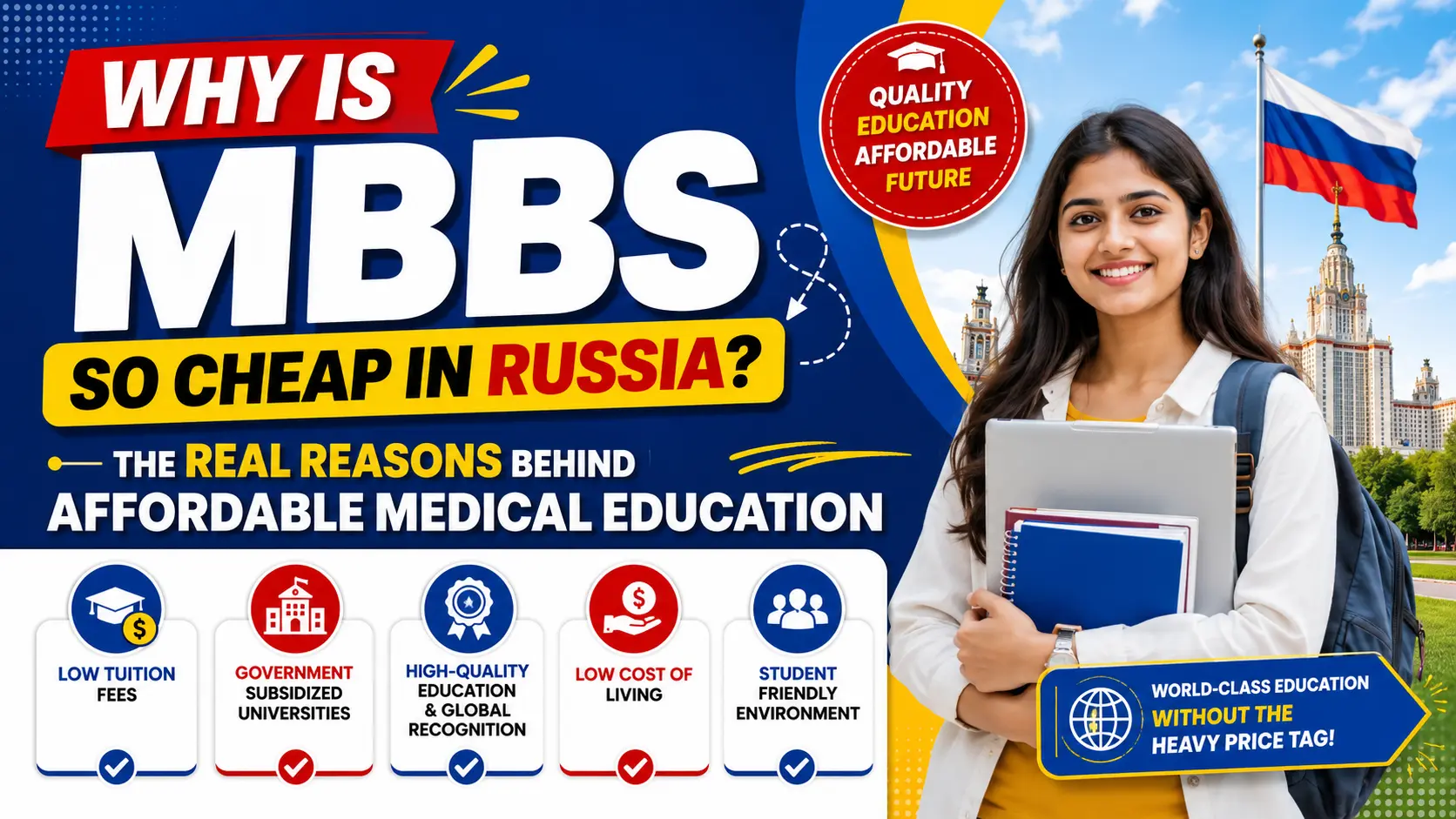
Tens of thousands of Indian students find it practical to pursue an MBBS degree abroad instead of studying in India where there is highest competition with the least number of government medical seats. When it comes to medical education abroad, students find it hard to overlook Russia.
It’s easy to understand why. Russia boasts considerable advantages, including high-quality education and recognized universities, in addition to reasonable tuition fees. Some parents and students ask, “Why is MBBS in Russia?” and “Does it come with a sacrifice in quality?” The answer is a resolute no. Russia is able to provide affordable medical education due to government support, subsidized university infrastructure, low living costs, and the longstanding tradition of prioritizing accessible higher education. As such, it’s easy to see why “MBBS in Russia" is attracting Indian students.
Russian universities possess modern laboratories, knowledgeable instructors, good clinical exposure, and international recognition. The purpose of this article is justifying affordable medical education in Russia and elaborating on the eligibility criteria, admission procedures, fee structures, benefits, and challenges, the best universities and the post-graduation career options.
Why Is MBBS in Russia Affordable?
There are many reasons that Russian medical education is affordable for international students.
1. Medical Education Subsidization
The Russian government puts a lot of money into public education. For this reason, many universities are state-funded, meaning they charge much lower tuition compared to private medical colleges in India. This subsidization means students are not as financially burdened while still meeting international standards.
2. Developed Educational Infrastructure
Most of the medical universities in Russia were established decades ago and already built laboratories, hospitals, libraries, and teaching facilities. Since they built their own facilities, other colleges do not need to pay for infrastructure, meaning there is lower tuition.
3. Non-Profit University Model
Russian universities, unlike many private medical institutions in other nations, focus on teaching as opposed to making profits. This helps retain modest, but good education fees.
4. Affordable Living
Generally, accommodation, transportation, food, and daily needs are cheaper in many Russian cities in comparison to Western countries. Students going to Russia for MBBS often incur much less in living costs compared to going to the USA, UK, or Australia.
5. Strong Government Regulation
Russian educational authorities control university fees and set strict academic standards. This stops tuition from increasing. International students can expect payments to stay stable and affordable.
MBBS Fees in Russia: A Comparison
|
University Type |
Annual Tuition Fees |
Hostel Fees |
Total Annual Cost |
|
Government Medical Universities |
₹2.5–6 Lakhs |
₹50,000–₹1 Lakh |
₹3–7 Lakhs |
|
Private Medical Colleges in India |
₹10–25 Lakhs |
Extra |
₹12–30 Lakhs |
|
Medical Universities in Western Countries |
₹25–50 Lakhs |
Extra |
₹30–60 Lakhs |
Students target Russian options for why they are among the most affordable MBBS in Russia 2026.
Is Cheap MBBS in Russia Good Quality?
Affordability of Medical Education in Russia
Thanks to government regulation, who you pay for medical education does not dictate the quality of instruction.
Many Russian medical universities are recognized by:
Students studying mbbs russia get a globally accepted degree, modern clinical experience, and opportunities to practice and conduct research.
Eligibility Criteria for MBBS in Russia
Indian students have additional requirements to meet.
Academic Requirements
The criteria for admission are:
- General Category: 50% in Physics, Chemistry, and Biology.
- For reserved categories: 40%.
- Class 12 from a recognized Board.
NEET Qualification
The NEET makes it mandatory for Indian students to clear NEET to pursue their medical studies abroad and practice medicine in India.
Those opting for russia for mbbs have to fulfill this requirement.
Age Requirements
The applicant must be:
- Minimum 17 years of age
- Maximum Age as per current NMC Norms
MBBS Admission Process in Russia
The procedure is simpler compared to other countries.
Step 1: Choose a University
Select a russia mbbs university of your choice based on use rankings, fee structure, facilities and clinical exposure.
Step 2: Submit Documents
The following are to be submitted:
- Mark sheets of Class 10 & 12
- Passport
- NEET Score Card
- Passport size Photos
- Medical Certificate
Step 3: Admission Letter
Universities will inform you of their decision after Document verification.
Step 4: Invitation Letter
Students will be invited by the Russian authorities to proceed with the Visa.
Step 5: Student Visa
The participants will be permitted to travel to Russia for the commencement of Medical Education after the Visa is approved.
The students preferring to pursue MBBS abroad in Russia appreciate the uncomplicated and clear admission process.
Average MBBS Fees in Russia for Indian Students
The most appealing factor is the fee structure.
|
Expense Category |
Approximate Annual Cost |
|
Tuition Fees |
₹2.5–6 Lakhs |
|
Hostel Accommodation |
₹50,000–₹1 Lakh |
|
Food Expenses |
₹60,000–₹1 Lakh |
|
Medical Insurance |
₹10,000–₹20,000 |
|
Miscellaneous Expenses |
₹30,000–₹50,000 |
Students interested in MBBS in Russia can typically finish their course at just about the price of our private colleges.
Benefits of Studying MBBS in Russia
Affordable Education
Lower Tuition fees is the primary advantage for pursuing russia mbbs.
International Recognition
Russian medical degrees have international recognition through WHO and WDOMS.
Modern Infrastructure
All the modern teaching hospitals and advanced instructional laboratories are provided by the universities.
English-Medium Programs
Complete MBBS programs in English are offered in many of the universities for international students.
No Donation System
Unlike many private colleges, donating or capitation funds are not asked by Russian universities.
Diverse Student Community
Russian medical schools have students from countries all over the world which helps make the learning environment diverse.
Disadvantages of MBBS in Russia
Although very desirable, there are some challenges associated with studying there.
Climate Adaptation
Russian winters may be initially challenging for most Indian students.
Language Barriers
It is necessary to learn some Russian for both daily and hospital communications.
FMGE/NExT Preparation
Those returning to India need to fulfill the NMC guidelines and prepare for the licensing exam.
Cultural Differences
Flexible adjustment to new cultures is a requirement.
Those considering MBBS abroad in Russia should go through all the challenges and advantages before making any decisions.
Top Medical Universities in Russia
Here is the table for the best medical institutions in Russia along with their respective annual tuitions:
|
University |
City |
Approximate Annual Fees |
|
Kazan |
₹5–6 Lakhs |
|
|
Ufa |
₹3–4 Lakhs |
|
|
Simferopol |
₹3–4 Lakhs |
|
|
Orenburg |
₹4–5 Lakhs |
|
|
Perm |
₹4–5 Lakhs |
Students searching for MBBS in Russia fees 2026 for Indian students rank these universities based on their fees and how reputed the universities are.
Career Opportunities After MBBS in Russia
There are many options available for graduates after they finish their course.
Practice in India
Students can come back to India after completing NMC and start practicing in India.
Further Education
A lot of students pursue MD, MS, and other courses after they finish their MBBS.
Practice Abroad
Due to WDOMS and WHO recognition, there are many countries where students are allowed to practice medicine.
Research
Since there is a strong emphasis on research, students can also pursue their research careers. After they study MBBSin Russia, students are given the chance to see and engage with global health care practices, and other fields ensuring comprehensive career prospects.
Frequently Asked Questions (FAQs)
Why is MBBS in Russia cheaper than in India?
In Russia, most of the universities are government-funded. They are also non-profit. Lastly, Russia has a low cost of living.
Is MBBS in Russia recognized in India?
Yes, students who graduate from NMC listed universities and complete the licensing course are eligible to practice in India.
Is NEET compulsory for MBBS in Russia?
Yes, compliance with the NMC stipulations has made it compulsory for Indian students to clear the NEET.
Is MBBS in Russia in English?
Yes, there are many universities that offer English medium courses in MBBS accessible to international students.
Is studying in Russia safe?
Most medical universities in Russia offer a safe campus, hostel facilities, and special assistance for international students.
How much does studying MBBS in Russia cost?
Those pursuing MBBS for Russia can expect to spend ₹20–35 lakhs for the whole course with accommodation and all living expenses included.
Conclusion
Affordable medical education does not come at the cost of quality in Russia. Strong government support, an established infrastructure, and low living costs with the regulation of tuition fees, are additional factors contributing to making Russia an optimal choice for many international candidates aspiring to study medicine.
Globally recognized degrees, modern educational infrastructures, experienced faculty, and affordable fee structures are the advantages that students aspirings for MBBS from Russia can avail of. With proper preparation, linguistic flexibility, and awareness of licensing, students can adapt to the conditions of medical schools in Russia with great outcomes in their prospective careers.
There is no doubt that an MBBS course in Russia is an economically viable option for Indian students wanting world class education in medicine while being focused on their primary goal of education being to become qualified doctors, especially with the intense competition for seats in India.