
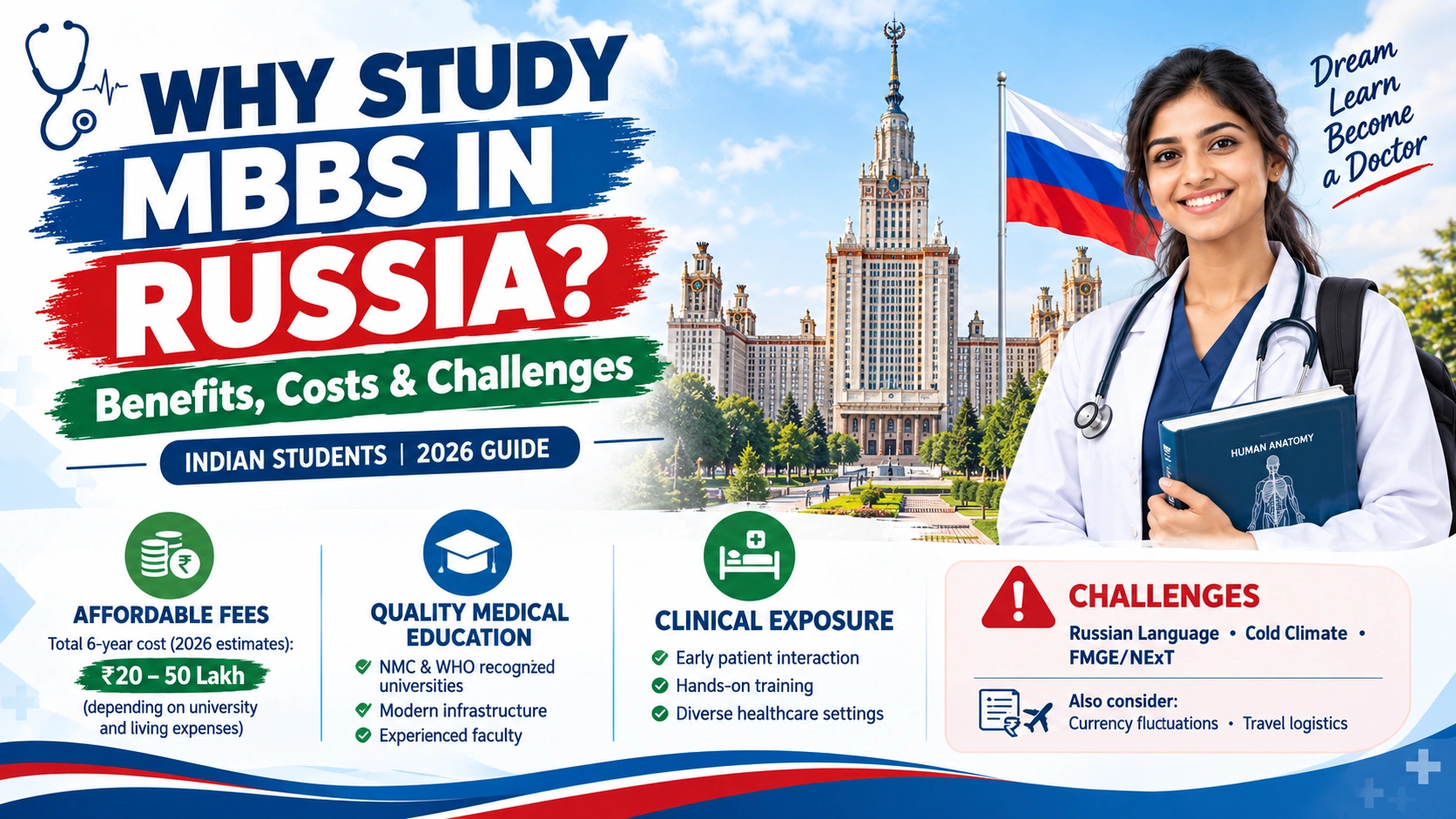
A private medical seat in India can put a family under serious financial pressure. That is usually where the Russia discussion begins.But cost alone shouldn't decide where you spend the next six years of your life.For Indian students, MBBS in Russia has remained a popular overseas medical education option because Russia has established medical universities, comparatively manageable tuition fees, international student intake, and several General Medicine programs available in English. At the same time, studying there isn't a shortcut to becoming a doctor in India. NEET qualification, NMC rules, the right university, clinical exposure, language skills, and the licensing pathway after graduation all matter.So, is Russia actually worth considering?For the right student, yes. But only after understanding both sides — the attractive fee figures as well as the practical challenges that don't always appear in admission brochures.
Why Do Indian Students Choose MBBS in Russia?
The biggest attraction is easy to understand: the difference between the cost of many Indian private medical colleges and Russian medical universities can be substantial.Russia also has medical institutions with decades of teaching history. Students can find universities in cities such as Kazan, Ufa, Volgograd, Orenburg, Kursk, Tomsk, and several other regions.Another reason is the admission structure. Students generally don't face the kind of extremely high NEET score competition associated with government MBBS seats in India. NEET still matters for Indian candidates planning to return and practise in India, but admission requirements at Russian universities are different.
There are other practical benefits too:
- General Medicine programs commonly run for around six years.
- Several universities offer programs or tracks with English instruction.
- Tuition at many universities is comparatively affordable.
- Hostel facilities are commonly available for international students.
- Indian student communities already exist at several established universities.
- Students get exposure to a different healthcare and education system.
Sounds attractive. It is. But university selection makes a huge difference.
How Long Does MBBS in Russia Take?
Six years is the figure students will see most often.Russian medical programs leading to a physician or General Medicine qualification commonly have a six-year curriculum. Individual medical-school entries in the World Directory of Medical Schools also show six-year programs at a number of Russian institutions.For an Indian student, however, simply seeing "6 years" on a university website isn't enough.The National Medical Commission Foreign Medical Graduate Licentiate Regulations require, among other conditions applicable to covered students, at least 54 months of medical education and a minimum 12-month internship in the same foreign medical institution. The regulations also specify English as the medium of instruction, required subjects and other conditions for permanent registration in India.This is where students need to be careful.Don't choose a university just because somebody says it is "NMC approved." Instead, verify whether the actual program you are joining satisfies the current NMC requirements applicable to your admission batch.
What Does MBBS in Russia Cost for Indian Students?
Here comes the part most families ask about first.For many universities, tuition can roughly fall between ₹2.5 lakh and ₹6.5 lakh per year, although some universities or programs may cost considerably more. Exchange rates also move, so INR figures should always be treated as estimates.
A practical six-year budget may look something like this:
|
Expense |
Approximate Range |
|
Tuition fees |
₹2.5–6.5 lakh per year |
|
Hostel |
₹30,000–₹1.2 lakh per year |
|
Food/personal expenses |
₹8,000–₹18,000 per month |
|
Medical insurance |
₹5,000–₹15,000 per year |
|
Visa/registration-related expenses |
Variable |
|
Air travel |
₹35,000–₹80,000+ per trip |
|
Winter clothing and setup |
₹20,000–₹50,000 initially |
|
Estimated overall six-year spending |
Roughly ₹20–45 lakh+ |
These aren't universal fees. Far from it.Moscow and other expensive cities can push the living budget higher, while universities in smaller cities may work out cheaper. Currency movements between the Russian ruble and Indian rupee can also change the final amount significantly.Honestly, this is one area where families should calculate the full six-year expense rather than comparing only first-year tuition.
University-Wise Cost Can Be Very Different
A cheap university isn't automatically a good university. And an expensive one isn't automatically better.Students researching MBBS in Russia often come across names such as Bashkir State Medical University, Kazan Federal University, Kursk State Medical University, Volgograd State Medical University, Siberian State Medical University, Samara State Medical University and several others. A number of these Russian institutions appear in WDOMS records.
For broad planning, students may encounter annual tuition bands such as:
|
Type of University/Location |
Approx. Annual Tuition |
|
Budget regional options |
₹2.5–3.5 lakh |
|
Mid-range universities |
₹3.5–5 lakh |
|
Higher-fee/popular options |
₹5–7 lakh+ |
|
Premium programs/cities |
Can exceed ₹7 lakh |
Don't treat this table as a current university fee sheet. Fees change by academic session, program, currency conversion and sometimes student category.
Before paying anything, get the latest official university fee structure.
NEET Is Still Part of the Equation
This surprises some students.Getting admission abroad doesn't mean NEET becomes irrelevant for an Indian student who wants to come back and obtain registration in India.Candidates should check the latest eligibility and examination requirements through the official NEET website and current NMC regulations before taking admission.The qualifying threshold in NEET is percentile-based and can vary each year. Historically, the general category qualifying criterion has typically been the 50th percentile, with different qualifying criteria for applicable reserved categories. The actual marks corresponding to those percentiles change from one examination year to another.So don't rely on an old YouTube video saying, "You need exactly X marks for Russia."That's not how the qualifying cutoff works.
Eligibility for Indian Students
The eligibility side is usually straightforward on paper. The details underneath it aren't.student generally needs to have completed Class 12 with Physics, Chemistry, Biology/Biotechnology and English, while satisfying the applicable eligibility requirements for medical education. NEET qualification is a key consideration for Indian students intending to pursue a foreign medical qualification and later seek registration in India.
A typical applicant should expect to need:
- Class 10 certificate and marksheet
- Class 12 certificate and marksheet
- Valid passport
- NEET scorecard/result
- Passport-size photographs
- University admission/invitation documents
- Medical fitness documents
- HIV test report where required
- Visa documents
- Other documents requested by the university or Russian authorities
Document requirements can change. Always check them again for the specific admission session.
The Biggest Benefit: Lower Cost Than Many Private Indian Options
Here is the obvious advantage.If an Indian private MBBS program is financially out of reach, Russia can offer a considerably lower-cost route at selected universities. A family working with a ₹25–35 lakh overall education budget may find options that would simply not exist in the higher-fee segment of Indian private medical education.But cheaper doesn't mean easy.You are still studying medicine. Anatomy won't become simpler because tuition is lower. Pharmacology won't care that you're abroad. Clinical skills need actual work.That reality gets ignored sometimes.
No Donation-Based Admission Structure at Many Universities
Another attraction is predictability.Students generally apply on the basis of academic eligibility, documents and the university's admission requirements rather than paying the kind of large capitation-style amount families may associate with certain private admission routes elsewhere.That can make budgeting more transparent.Still, check every payment carefully. Tuition, hostel, insurance, visa extension, document translation and consultant/service charges should be shown separately.Never transfer a large amount merely because someone says, "Seat will disappear tomorrow."
English-Medium Education Helps — But Verify the Entire Program
Here's where one line in a brochure can cause six years of confusion."English medium" should mean what you think it means.NMC's regulations specify English as the medium of instruction among the conditions for foreign medical graduates covered by the regulations. Russian medical schools can differ in the languages offered; WDOMS records, for example, show some programs with Russian and English while others may list Russian only.
Ask the university directly:
- Is the complete medical program taught in English?
- What language is used during clinical training?
- Are examinations conducted in English?
- Does the English-medium track continue through the clinical years?
- Get written confirmation where possible.
Russian Language Still Matters in Hospitals
Now the practical side.Even if classroom teaching is in English, patients in Russian hospitals aren't going to switch languages just because you are an international medical student.You need Russian.Not necessarily literary-level Russian, but enough to take history, understand complaints, communicate during ward postings and interact comfortably with patients and hospital staff.Honestly, students who take the language seriously from the first year usually put themselves in a much better position once clinical rotations begin.Ignoring Russian because "my course is English medium" is a bad plan.
Recognition: Don't Fall for the Wrong Terminology
This topic gets messy very quickly.You'll regularly see phrases such as "WHO approved university," "WDOMS approved college," or "NMC approved Russian university." Students should understand what these claims actually mean rather than accepting marketing labels.The World Health Organization is an important global public-health body, but university eligibility for Indian graduates needs to be assessed against India's applicable regulatory requirements.Likewise, WDOMS itself explicitly states that a school's appearance in its directory does not by itself mean recognition, accreditation or endorsement.That sentence matters.Use WDOMS to verify a medical school's directory information. Then separately check the program against NMC requirements.
NMC Rules Deserve More Attention Than University Rankings
A university can look impressive online and still be the wrong choice for an Indian student.The current NMC framework requires covered foreign medical graduates to meet conditions involving course duration, internship, medium of instruction, subjects, clinical training and eligibility for registration/licensure in the country where the degree is awarded. NMC has also warned students that deviations involving course duration, curriculum, clinical training or internship arrangements can affect eligibility for registration in India.
Here — well, this is exactly where students need to slow down.
Before admission, verify:
- Total program duration.
- Internship duration and location.
- Complete medium of instruction.
- Mandatory subjects.
- Clinical training arrangements.
- Whether training is completed at the required institution/location.
- Whether the qualification meets the local licensure condition specified under NMC rules.
- Current Indian licensing requirements applicable to your batch.
One verification today can prevent a massive problem six years later.
FMGE and the Licensing Pathway After Graduation
This is probably the biggest academic challenge waiting at the other end.A foreign medical degree doesn't automatically provide the right to practise medicine in India. Foreign graduates must satisfy the licensing and registration requirements applicable to them.NMC's FMGL framework provides for the prescribed licensing examination requirement as well as supervised internship requirements in India for covered foreign medical graduates. NMC's 2026 clarification also states that students admitted on or after 18 November 2021 who fall under the relevant regulations are required to undergo one year of compulsory rotating medical internship in India after qualifying FMGE, in accordance with the applicable rules.Rules and examination arrangements can evolve during a six-year course.That's why students joining now shouldn't build their entire plan around an old assumption about whether they will face FMGE, NExT, or another mandated examination years later. Follow current NMC notifications throughout your course.
Clinical Exposure Can Make or Break the Experience
Imagine studying medicine for years but struggling to speak properly with patients.Not ideal.Clinical exposure depends on the university, affiliated hospitals, patient flow, teaching system and — again — your Russian-language ability. A university with a famous name doesn't automatically guarantee that every international student gets the same hands-on learning experience.Ask current students specific questions.Not "Is your university good?"Ask: How frequently do you attend hospitals? From which year? Can international students interact with patients? What language do doctors use during rounds? How many students are assigned to one clinical group?Specific questions produce useful answers.
What Are the Main Challenges of Studying in Russia?
Russia isn't for everybody. Simple.The first challenge is climate. Students from India may need time to adjust to long winters and temperatures that can fall well below freezing in many regions.The second is language. Russian becomes particularly important outside classrooms and during clinical interactions.Then comes food. Indian mess facilities or restaurants may be available around universities with larger Indian communities, but quality, cost and availability vary.Homesickness is real too. Six years is a long time.Other concerns can include currency fluctuations, international travel costs, changing visa rules, geopolitical developments, banking/payment arrangements and changes in Indian medical regulations during the course.None of these automatically makes Russia a poor choice. They simply belong in the decision.
Hidden Costs Families Often Forget
Tuition is only one number.Suppose a university advertises tuition of ₹3.5 lakh annually. A family may mentally calculate ₹21 lakh for six years and stop there.Actual spending won't stop there.You may also pay for hostel accommodation, food, health insurance, visa extensions, migration/registration procedures, document translation, medical tests, local transport, winter clothing, SIM/internet, textbooks or study resources, flights to India and personal expenses.Add exchange-rate variation as well.A realistic financial plan should ideally keep a contingency fund instead of budgeting to the last rupee.
Admission Process: What Usually Happens?
The process is less complicated than many students expect.Applications for Russian medical universities commonly start months before the main academic intake, with activity often increasing after Class 12 and NEET results. Timelines differ by institution, so students targeting a particular university should check its official admission calendar rather than assuming every university follows one deadline.
The usual journey looks roughly like this:
- Shortlist suitable medical universities.
- Check the program against current NMC requirements.
- Submit academic documents and passport details.
- Receive the admission/offer confirmation, subject to university procedure.
- Complete university and invitation-related formalities.
- Apply for the student visa.
- Pay fees according to the official schedule.
- Arrange travel and accommodation.
- Complete registration after arriving in Russia.
Don't rush step two. Seriously.
Benefits vs Challenges at a Glance
|
Benefits |
Challenges |
|
Comparatively affordable tuition |
Russian language needed clinically |
|
Several established public universities |
Very cold winters in many cities |
|
Six-year medical programs are widely available |
FMGE/licensing preparation required |
|
English tracks available at selected institutions |
English-medium claims need verification |
|
International student communities |
Long distance from home |
|
Potentially lower overall cost |
Currency and travel expenses can fluctuate |
|
Hospital-based clinical education |
Clinical experience varies by institution |
The choice becomes much clearer once you stop asking, "Is Russia good?" and start asking, "Is this specific university and program right for me?"
Is MBBS in Russia Worth It for Indian Students?
For some students, absolutely.A student with a realistic budget, willingness to learn Russian, disciplined study habits and a clear plan for the Indian licensing examination can find MBBS in Russia financially and academically practical.For somebody expecting an easy degree because admission is comparatively accessible?Probably not.Medical education abroad requires more independence. Nobody will chase you every evening to prepare for an Indian licensing exam. You'll need to study the university curriculum while keeping your long-term India preparation alive.That takes consistency.
How to Choose the Right Russian Medical University
Forget rankings for five minutes.Start with eligibility.Check the university and exact program through official sources, including the National Medical Commission and World Directory of Medical Schools. Remember that WDOMS listing alone isn't an endorsement.Then compare the things that affect your actual six years: tuition, hostel, city expenses, English instruction, Russian-language training, hospital exposure, internship structure, Indian student population and academic support.Talk to current students too. Preferably students from different years, not just one person introduced by an admission representative.
That gives you a much cleaner picture.
FAQs About MBBS in Russia
Is MBBS in Russia a good option for Indian students?
It can be. Russia offers comparatively affordable medical education at several established universities, but students need to select the institution carefully and ensure the program satisfies current NMC requirements applicable to foreign medical graduates.
Is NEET compulsory for studying medicine in Russia?
Indian students who intend to pursue foreign medical education and later seek the relevant pathway for medical practice in India should follow the applicable NEET and NMC eligibility requirements. Check the latest rules on the official NEET portal before admission rather than relying on older cutoff information.
How much does MBBS in Russia cost?
Tuition at many universities may roughly range from ₹2.5 lakh to ₹6.5 lakh annually, though higher-cost options exist. Depending on university, city, hostel, lifestyle, travel and exchange rates, a broad six-year budget could be around ₹20–45 lakh or more. Always verify current fees directly.
Is Russian language compulsory?
For everyday life and clinical communication, learning Russian is extremely useful and often practically necessary. Even students enrolled in an English-medium program will interact with Russian-speaking patients during clinical years.
Can I practise in India after completing MBBS from Russia?
A Russian degree alone doesn't automatically grant registration in India. You must satisfy the NMC regulations and licensing requirements applicable to your admission batch, including the prescribed examination and internship conditions. Current NMC regulations should be checked before admission and again before graduation.
Is every Russian university listed in WDOMS safe for Indian students?
No. WDOMS clearly states that directory listing does not itself constitute recognition, accreditation or endorsement. Students should verify the individual medical program and its compliance with applicable NMC requirements separately.
Conclusion
Choosing MBBS in Russia shouldn't be an emotional decision made because an admission advertisement says "low fees" or "100% English medium."Look deeper.Russia can offer Indian students an affordable medical education route, established universities, international exposure and a realistic alternative to expensive private medical education. But the challenges are equally real — language, climate, licensing examinations, clinical adaptation, regulatory compliance and six years away from home.The best approach is fairly simple: compare universities rather than countries alone, calculate the complete six-year budget, verify NMC compliance yourself and understand exactly what happens after graduation.If those pieces fit your career plan, Russia can make sense. Quite a lot of sense.Before selecting a university, review updated university options, fees and admission information through MBBS in Russia and cross-check every regulatory point with official NMC, NEET and WDOMS sources.