
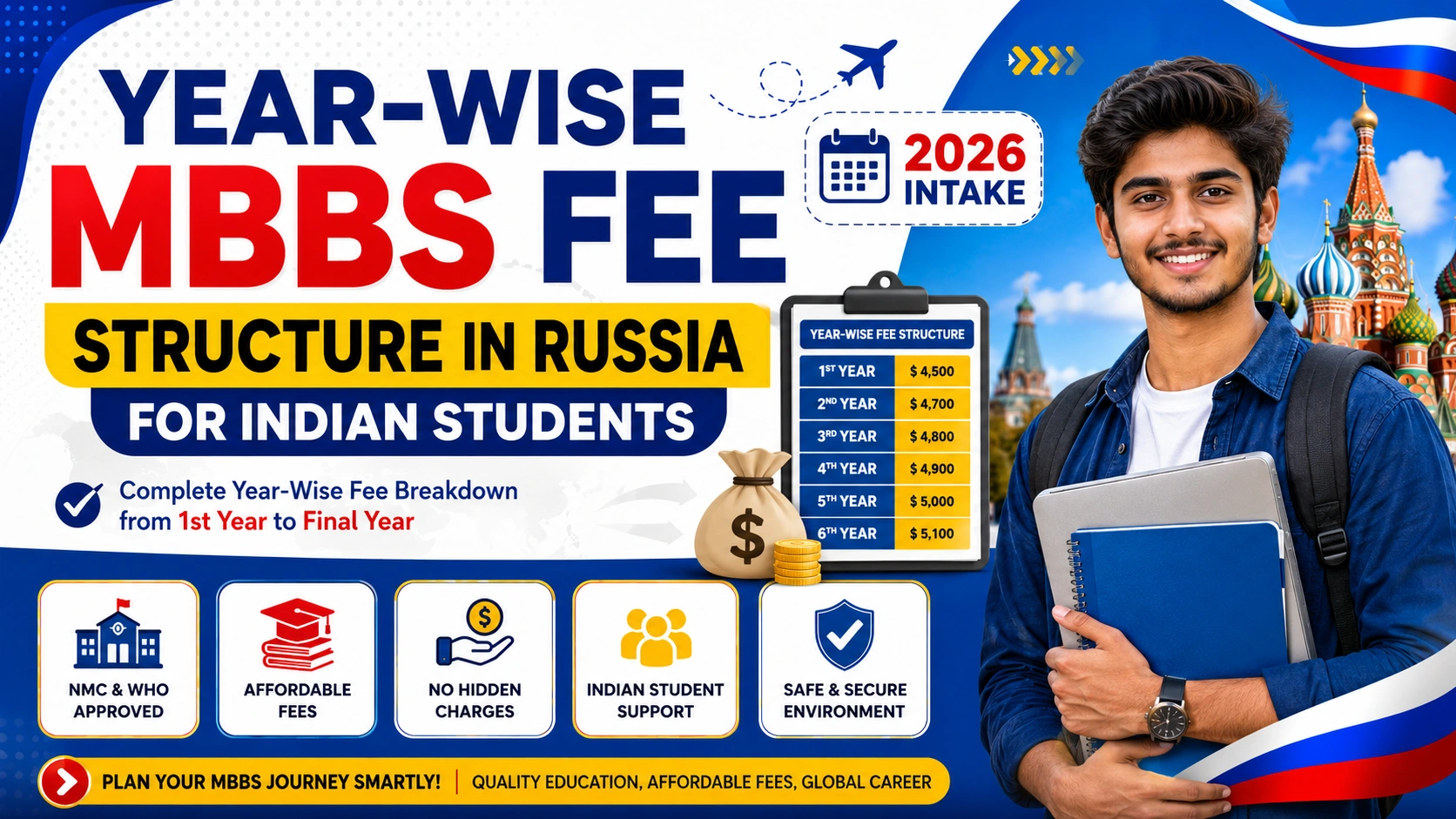
For Indian students wanting an inexpensive alternative for medical education, Russia has a favorable option as several of their medical universities offer strong medical programs with modern teaching facilities and with clinical exposure and more affordable tuition fees.
Looking at the first year tuition fee alone may be misleading. Students who want to study mbbs in russia should look at the total tuition, the cost of the hostel, food, medical insurance, visa, travel, and personal expenses.
This total can vary by a large amount depending on the university and city as well. For that reason, knowing the year wise MBBS fee structure is important when preparing a financial plan for six years.
This document covers projected yearly costs, eligibility and admission requirements, benefits and drawbacks, leading universities, and career prospects for students of the year 2026 admissions.
Year Wise MBBS Fee Structure in Russia
For students who want to mbbs in russia for indian students first year tuition fees can be estimated at between ₹3 lakh and ₹7 lakh. To estimate the total budget in the range of ₹5 lakh to ₹9 lakh per year, add costs for the hostel and food, insurance and visa, travel and personal costs. The total for six year medical education may be in the range of ₹30 lakh to ₹50 lakh or more, based on which university, the exchange rate, lifestyle and other expenses.
Important: This is a range for you to plan and is not a quote from the university. Students must verify the fee directly from the university before making any payments.
MBBS In Russia Fee Structure: Year-Wise Breakdown
Expense estimations, when organized on an annual basis, help you identify several types of hidden costs.
|
Academic Year |
Tuition Fee |
Hostel & Living |
Other Expenses |
Approx. Annual Budget |
|
1st Year |
₹3–7 lakh |
₹1–2 lakh |
₹0.75–1.5 lakh |
₹5–10.5 lakh |
|
2nd Year |
₹3–7 lakh |
₹1–2 lakh |
₹0.5–1 lakh |
₹4.5–10 lakh |
|
3rd Year |
₹3–7 lakh |
₹1–2 lakh |
₹0.5–1 lakh |
₹4.5–10 lakh |
|
4th Year |
₹3–7 lakh |
₹1–2 lakh |
₹0.5–1 lakh |
₹4.5–10 lakh |
|
5th Year |
₹3–7 lakh |
₹1–2 lakh |
₹0.5–1 lakh |
₹4.5–10 lakh |
|
6th Year |
₹3–7 lakh |
₹1–2 lakh |
₹0.75–1.5 lakh |
₹5–10.5 lakh |
These are approximate ranges. Actual costs depend on the university, the city, the rate of exchange, accommodation, and personal spending.
What Does the MBBS Fee Include?
The instruction fee for MBBS typically covers teaching and learning activities and other educational services of the university. It would be imprudent for students to assume that all costs would be covered.
Other costs commonly include:
- Staying in a hostel
- Food
- Medical insurance
- Visa
- Plane tickets
- Transportation
- Study supplies
- Winter clothes
- Personal expenses
- Exchange fees
This is why only looking at tuition can make one come up with unrealistic budgets.
Russian Medical Universities
There are many medical universities in Russia. Each needs to be assessed on its own rather than choose one based on the perception that its tuition is low.
Kazan State Medical University
Kazan State Medical University is a popular choice for foreign students. On its website, Kazan provides tuition information and details for International students and for the student intakes of 2026 and beyond.
Sechenov University
Another popular choice is Sechenov University in Moscow. Moscow's higher cost of living when compared to other Russian cities must be factored into your budget along with the tuition costs when looking at the overall cost.
Volgograd State Medical University
Another option for many foreign medical students is Volgograd. Prospective students are advised to compare the tuition, cost of living, clinical placements, and admission requirements when considering an application to this university.
Other Medical Universities
When considering other Russian universities, the following may be factors:
- University Recognition and Accreditation
- Availability of Clinical Training
- Means of Instruction
- Structure of Internship
- Accommodation Availability
- Location/Cost of Living
- Acceptable Compliance to NMC Requirements
Eligibility for MBBS In Russia
For Indians, eligibility is subject to both university requirements and Indian policy.
Academic Qualification
The usual expectation is for students to have completed Class 12 or equivalent, having studied and passed Physics, Chemistry and Biology/Biotechnology, and English.
NEET Qualification
For Indian students, the NEET requirement is especially critical. NEET-UG updates and information can be found on the official NTA portal.
Age Requirement
There is a minimum age requirement for the relevant admission year.
Medical Fitness
Medical fitness and health-related certificates may be required at admission by some Universities.
Admission Process for MBBS In Russia
The admission process is considered to have several stages.
Step 1: Research Universities
Consider tuition, hostel fees, curriculum, clinical exposure, the location and regulatory requirements.
Step 2: Check Eligibility
Confirm academic qualifications, NEET, and any other requirements for admission.
Step 3: Submit Documents
Common documents may include:
- Passport
- Class 10 certificate
- Class 12 certificate
- NEET scorecard
- Passport-size photographs
- Medical documents
- University-specific documents
Step 4: Receive Admission Confirmation
After verifying your documents, the university may grant admission or send you an invitation, depending on their internal processes.
Step 5: Apply for Visa
Admit notification allows students to start the student-visa process.
Step 6: Travel and Complete Registration
After arriving in Russia, students usually complete university registration, housing, and other required procedures.
Benefits of Studying Medicine in Russia
Affordable Compared With Many Private Options
For some students, Russian medical universities may provide a better value than some of the expensive private medical education options around the world.
Established Medical Education System
With an extensive history of medical education, several Russian universities offer mature medical programs.
International Student Communities
With so many universities with international students, Russian universities create opportunities for Indian students to connect with students from diverse backgrounds.
Clinical Learning
According to the university and course design, several students may gain access to clinics and hospitals for practical exposures.
Disadvantages Students Should Consider
MBBS in Russia may not be a good fit for everyone.
Expected difficulties may consist of the following:
- Some areas may have cold climates.
- Language differences, affecting the way of communication.
- Long-term separation from family members.
- Unpredictable currency values.
- Variability in health care and education systems.
- Increased costs of travel.
- Increased requirements to maintain compliance with laws and regulations.
Foreign medical students especially need to consider the rules and regulations of the Indian Government's NMC policy for foreign medical graduates.
Cut Down on MBBS Cost in Russia
Controllable cost factors include the following:
- Don't just look at the Tuition Fees, look at the Total Cost of the University.
- Choose Housing Based on Location and Amenities.
- Set a Monthly Food Cost.
- Avoid Unnecessary International Travel.
- Watch the Currency Exchange Before Making Large Transfers.
- Request the Latest Official Fee List from the University.
- Make Sure You Have a Safety Net.
The total cost of six years of study should be the main point of comparison as a lower Tuition Fee does not mean a lower Overall Cost.
Future of Studying MBBS in Russia
Indian students must follow the registration process to be allowed to practice in India after finishing their medical studies abroad.
If they meet the eligibility and licensing criteria, they may choose to pursue:
- Practice medicine
- Postgraduate studies (specialization)
- Research
- Consultancy (practice in related fields)
- Clinical medicine in areas that are permitted by law
Students should verify university training, the regulatory requirements in India and the curriculum prior to choosing a university based on claims regarding FMGE or future licensing.
Frequently Asked Questions
Are MBBS programs in Russia considered affordable for Indian students?
They can be, but it is entirely subjective depending on the university, city, exchange rate, hostel costs, and personal expenditure. Students should consider the total expenditure for all six years rather than just the tuition.
What is the average yearly MBBS tuition fee in Russia?
As a rule of thumb, consider tuition fees to be in the range of ₹3–7 lakhs yearly, but fees can be more or less than this. Be sure to check the official fee notification for the most accurate information.
What is the total cost of pursuing an MBBS in Russia for six years?
Considering tuition, accommodation, food, and incidental expenses, the total cost can be estimated to be in the range of ₹30-50 lakhs or more. The cost is highly variable based on the university and personal expenses.
Is the NEET exam mandatory for Indian students?
Prospective Indian students should check the current NEET requirements for students of medicine abroad and check the most recent information on the official NTA website.
Are food and hostel charges included in the tuition fees?
Not necessarily. Tuition, accommodation, food, and personal expenses are typically separate, and students should request the complete fee structure from the university.
Is an Indian student entitled to practice medicine with a degree from Russia?
A foreign medical degree does not automatically entitle you to practice medicine in India. Students will need to complete the NMC requirements along with the registration and licensing process.
Conclusion
For the 2026 intake, seeing the year-wise MBBS fee structure in Russia for Indian students means combining tuition with other costs in your financial plan. Tuition covers the main cost, but the final budget can be impacted significantly by hostel costs, food, insurance, visas, travel, and exchange rate risks.
Students need to carefully select their universities, check the universities' fee structure in real time, evaluate the universities through authentic medical school databases, and check the latest NMC guidelines.
For students who are cautious with their choice, MBBS in Russia is a reasonable option for International medical studies. Students should target universities that are financially feasible and fulfill their academic, clinical, and future professional licensing needs, rather than focusing on the lowest cost option.