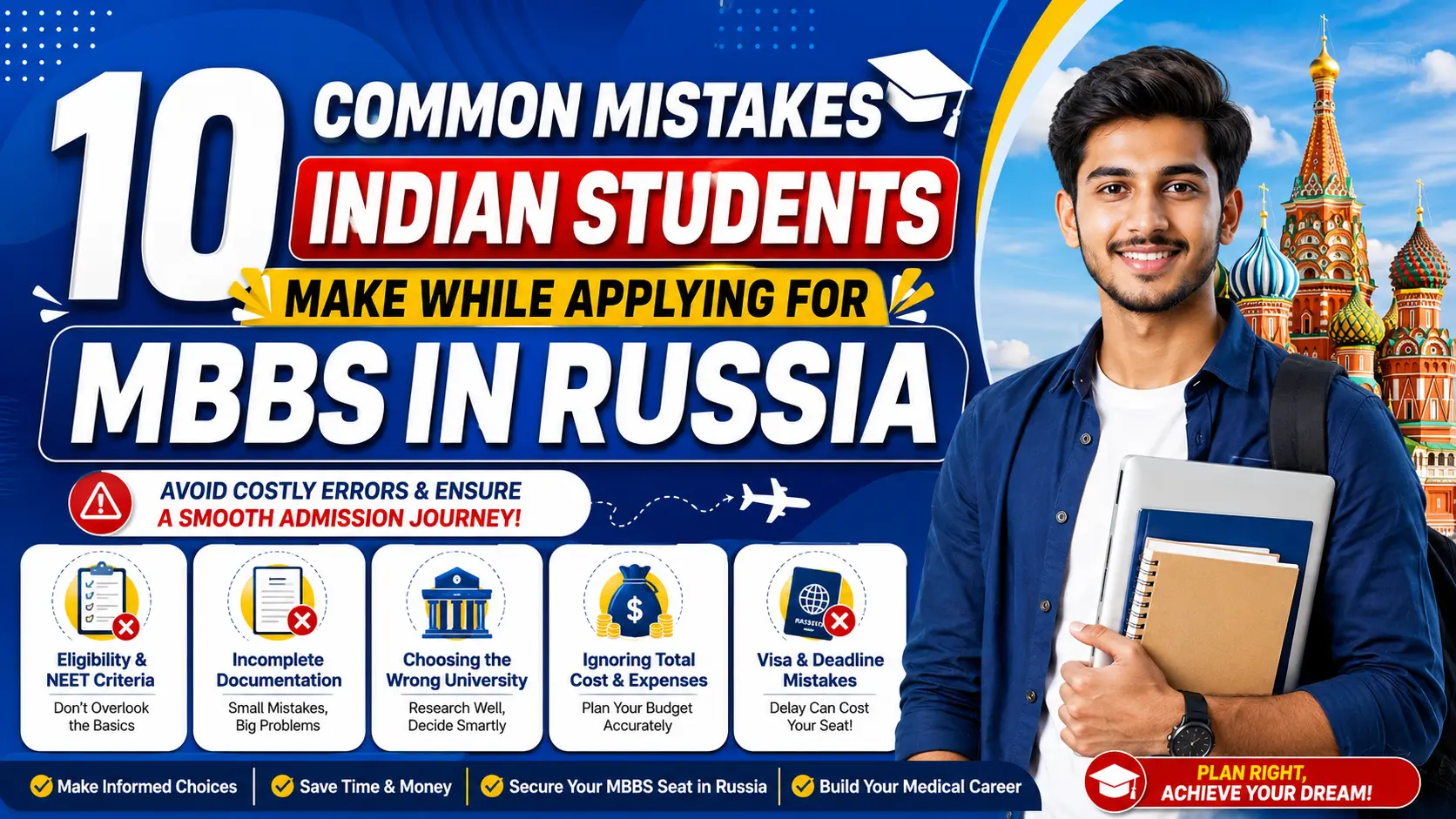
MBBS in Russia is a popular choice for Indian students seeking a combination of affordable medical education and modern, globally recognized medical universities. Despite the growing interest in medical education in Russia, many students still make easily avoidable mistakes that impact their medical education and career when applying to Russian universities.
If you are looking to pursue your dream of becoming a doctor right after the NEET exam or are seeking other international medical education options, being aware of these common application mistakes can limit the stress and resources you exert.
This guide details the most common mistakes Indian students make when applying for MBBS in Russia, including information on admission requirements, the application process, tuition costs, benefits and drawbacks, lists of top universities, potential career paths, and FAQs.
Featured Snippet
What are the common mistakes students make while applying for MBBS in Russia?
Some common mistakes are:
- Applying to non-NMC recognized universities
- FMGE/NExT eligibility is ignored
- Using unauthorized consultants
- Not calculating the total tuition costs
- Document deadlines are missed
- Living costs and accommodations are ignored
- Choosing universities based solely on low tuition
- Not checking if the program is English-medium
- Admission applications are submitted late
- Ignoring the university's ranking and clinical exposure
Making these mistakes can limit future career options.
Top 10 Mistakes When Applying to Russian Universities for MBBS for Indian Students
Finding a suitable place to study medicine abroad is only half the battle. Choosing the right university is just as important.
1. No NMC Recognition Check for University Choice
Several students only consider the tuition fee for the choice of university and ignore the university's compliance to the latest updates of the National Medical Commission.
Before application, check that the university is:
- Listed in the World Directory of Medical Schools
- Recognized by current NMC regulations
- Recognized for Indian licensing exams
Rather than choosing the cheapest option, use the MBBS in Russia to find a recognized university.
2. Eligibility Limitations Are Not Considered
Most students only consider passing the NEET for their eligibility, assuming that it's the only requirement. Some of the other basic requirements include:
|
Eligibility Criteria |
Requirement |
|
Age |
Minimum 17 years |
|
Education |
10+2 with Physics, Chemistry & Biology (PCB) |
|
PCB Marks |
50% for General category, 40% for Reserved |
|
NEET |
Yes — required for Indian students |
For the most recent NEET updates, check NEET.
Students interested in MBBS admission in Russia must ensure that they check all eligibility requirements before applying.
3. Use of Unregulated Agents
Just like several businesses that operate in India, several fake education consultants are operating in the space today.
Some of the red flags are:
- No authorization to the university
- Promises of very low tuition
- Hidden costs
- Fake admission letters
Always do checks on the consultant or apply directly to the university before making plans to MBBS in Russia 2026.
4. Selecting Universities Based on Tuition Fees Only
Cost of education is an important factor, but choosing a university based on tuition costs alone may prove costly in the longer term.
Consider:
- Clinical exposure
- Hospital training
- Faculty quality
- Research opportunities
- FMGE/NExT performance
- International recognition
When looking at MBBS programs in Russia, the quality of education should be prioritized over the cost.
SEO Table 1: Comparison Criteria for Russian Medical Universities
|
Factor |
Why It Matters |
|
NMC Recognition |
Enables licensure and practice in India after graduation |
|
WDOMS Listing |
Indicates global recognition and ease of verification |
|
English Medium |
Improves understanding, exam preparation, and communication |
|
Clinical Training |
Provides real-world patient care experience and skills |
|
Tuition Fees |
Determines affordability and financial planning |
|
Hostel Facilities |
Affects comfort, safety, and daily living conditions |
|
Student Support |
Helps with adaptation, paperwork, and academic guidance |
|
Internship Opportunities |
Offers hands-on experience and strengthens clinical competence |
5. Underestimating Total Costs
Students tend to only look at tuition while ignoring the total costs which includes:
- Hostel fees
- Medical insurance
- Visa extension
- Registration fees
- Meals
- Airfare
- Personal expenses
Check the total cost of MBBS in Russia for Indian students in 2026 for the complete picture.
6. Putting Off the Admission Process
Many students wait until NEET scores are out, results or apply at the last possible moment, leading to:
- Fewer selection options for universities
- More expensive flights
- Visa delays
- Starting education late
If you intend to pursue MBBS in Russia, start the admission process as early as possible.
7. Not Considering Language or Course Medium
Even when studying MBBS in English, some clinical training may be conducted in Russian.
Choose universities that offer:
- Medical MBBS in English only
- Russian Language
- Clinical training
- Communication courses
This is very important when considering studying MBBS in Russia.
8. University Ranking and General Reputation
University reputation will have a large impact on your educational experience.
Check and compare:
- International rankings
- Student feedback
- Research infrastructure
- Faculty
- Hospitals
Before deciding which university to pursue MBBS in Russia, do adequate research.
Top Medical Universities in Russia
|
University |
Approx. Annual Tuition (₹) |
Hostel Fees (₹/year) |
Medium |
FMGE Passing rate |
|---|---|---|---|---|
|
₹3.4–4.2 lakh |
₹40,000 |
English |
20% - 25% |
|
|
₹3.8–4.8 lakh |
₹45,000 |
English |
25% - 30% |
|
|
₹3.0–4.0 lakh |
₹35,000 |
English |
30% - 35% |
|
|
₹2.8–3.8 lakh |
₹40,000 |
English |
25% - 30% |
|
|
₹4.0–5.0 lakh |
₹50,000 |
English |
25% - 30% |
|
|
₹5.0–6.0 lakh |
₹55,000 |
English |
20% - 25% |
|
|
₹4.2–5.3 lakh |
₹45,000 |
English |
10% - 15% |
9. Ignoring Hostel and Living Conditions
Accommodation significantly impacts the overall studying experience.
Consider the following:
- Hostel Security
- Food Availability
- Internet Access
- Heating
- Laundry
- Presence of an Indian Mess
Those who wish to pursue MBBS in Russia must check the facilities available on campus.
10. Not Planning Career After Graduation
Some students are solely focused on the admission process, ignoring the post-studies licensing requirements.
Career options include:
- Practice in India
- Post-Graduation abroad
- USMLE
- PLAB
- Research
- Working in Hospitals
- Teaching Medicine
Those who are planning to pursue MBBS from Russia must start early for licensing exams.
Eligibility for MBBS In Russia
Most Indian students need to fulfill the following requirements:
- I am 17 years of age.
- 10+2 in Science.
- Necessary percentage in PCB.
- NEET qualification.
- Passport.
Those who plan to pursue MBBS in Russia during 2026 must prepare their documents on time as admissions will open in the near future.
Admission Process
The general admission process includes the following steps:
- Select a university that is recognized.
- Submit your educational qualifications.
- Receive an offer letter.
- Request for an invitation letter.
- Get the student visa.
- Book your travel.
- Register at the university.
Those who want to do MBBS from Russia must start the process several months prior to the official admission date.
Estimated MBBS Fee Structure
SEO Table 2: MBBS Cost Estimation in Russia
|
Expense |
Cost Estimation |
|
Tuition |
₹2.5–6.0 Lakhs / year |
|
Hostel |
₹40,000–1,00,000 / year |
|
Food |
₹8,000–15,000 / month |
|
Insurance |
₹10,000–20,000 / year |
|
Living Expenses |
₹12,000–20,000 / month |
Those who want to pursue MBBS in Russia must always check the latest fee structure from the universities.
Advantages of Studying Medicine in Russia
Studying in Russia has many attractive features, like:
- Low fees
- Recognition worldwide
- Education through English
- Advanced labs
- Skilled teachers
- International peers
- Strong clinical exposure
Many students pursue their MBBS in Russia as they receive a medical education that is recognized worldwide.
Disadvantages of Studying Medicine in Russia
Every country has its downsides, including Russia.
Some of the downsides are:
- Cold weather
- Learning a bit of Russian
- Culture shock
- Distance from India
- Licensing exam prep
A bit of foresight and planning can help students address the downsides of their MBBS in Russia.
What Can You Do After Studying MBBS in Russia?
There are many career options after studying MBBS in Russia.
You can:
- Meet National Medical Commission (NMC) requirements to practice in India
- Do post-graduation studies
- Work in global healthcare
- Do the US Medical Licensure Exam (USMLE) or the PLAB
- Do medical research
- Work in healthcare and hospitals
The MBBS course in Russia has many pathways to success.
Common Concerns
Is Studying MBBS in Russia Valid in India?
Yes. Studying in NMC approved and WDOMS recognized universities makes it valid. The student will need to follow the NMC guidelines and complete the medical licensing procedures in India.
Is NEET Mandatory?
Yes. NEET is required for Indians to be eligible to pursue MBBS in a foreign country, as well as for them to practice in India.
What is the Cost to Study MBBS in Russia?
It typically costs between ₹18–40 lakhs, based on the university and living cost.
Is Russia a Safe Country for Indian Students?
Yes, plenty of well-known universities in Russia have safe campuses, hostels, and special support for international students.
Can Indian Students Study MBBS in Russian Universities in English?
Yes. There are many leading universities providing complete English-medium MBBS programs in Russia for International students.
Conclusion
The decision to study MBBS in Russia will affect the rest of your life, so you need to be extra careful and plan everything in advance. Since most admission-related issues are because students don't care about the recognition of the university, the transparency of the fees, eligibility criteria, and future licensing, you need to do your research, choose legitimate places, and have full knowledge of the admission rules to plan the next few decades of your life. This will help avoid the mistakes of the past and help you with your journey of medical school abroad.
For the most advantageous outcome you need to check the recognition of the universities with the National Medical Commission (NMC), see if they appear in the World Directory of Medical Schools (WDOMS), keep in mind the updates of the NEET, and check the World Health Organization (WHO) guidelines where applicable. The choices you make today will build a strong base for the medical career you desire tomorrow.