
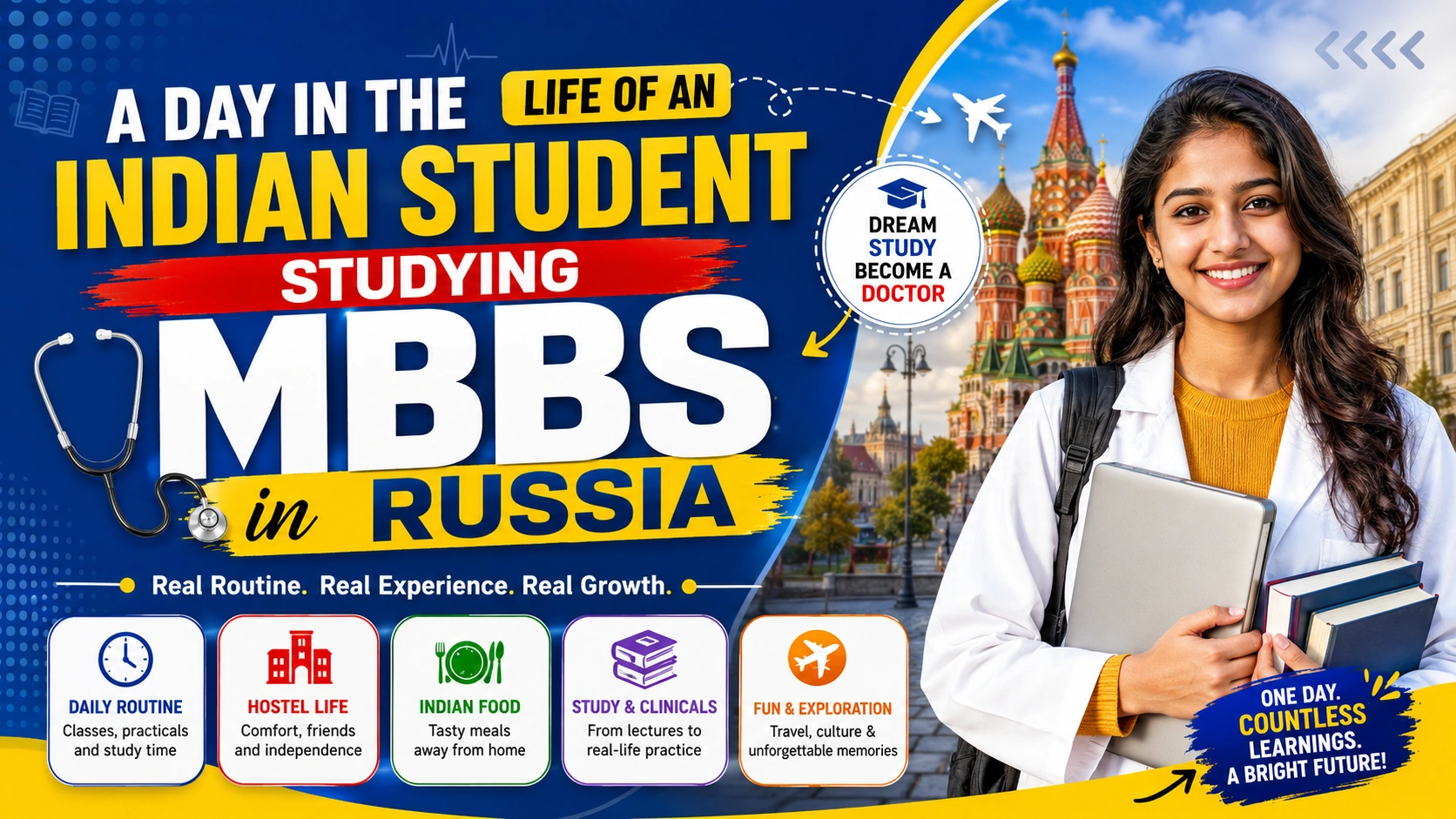
The choice of MBBS in Russia resonates beyond an economical medical degree. It symbolizes the initiation of a new global journey full of rigorous education, culture, and personal development. Thousands of Indian students opt to study medicine in Russia due to the modern and better-infrastructure universities, reasonable tuition fee structure, and better opportunities for clinical work.
A Day in the Life of an MBBS Student from India in Russia Offers a Look into Attending Classes, Practical sessions, and Research, as well as Cooking Indian Meals with Friends, Learning the Russian Language, and Studying for Exams.
This document is an attempt to provide prospective students with a better understanding of their daily life by explaining the eligibility and admissions criteria, as well as fees and other details related to the benefits and disadvantages of the top universities offering such courses, their career opportunities, and answering any other queries related to this profession.
Answering a Typical Finding
A Day in the Life of an Indian MBBS Student in Russia
The day of an Indian student undertaking an Study MBBS in Russia consists of attending morning lectures, practical lab sessions, clinical work in hospitals, and self study and engagement in a host of activities, plus a whole lot of socializing with peers coming from diverse parts of the globe. Students are also enrolled for the Russian language, enjoy very economical hostel accommodations, participate in a variety of events at the university, and find their medical education to be of high international standards and equivalently recognized, thus positioning them to practice medicine anywhere in the world.
Typical Daily Regimen of an Indian MBBS Student in Russia
Morning – Beginning the Day the Disciplined Way
Day usually commences around 6.30 to 7.00 AM.
Students residing in university hostels cook breakfast, organize lecture notes, and walk to their respective university campuses. When hostels are located a short distance to university campuses, it makes commuting hassle-free.
Most people’s morning routine includes the following:
- Eating a balanced meal
- Revising the previous day’s lectures
- Getting lab supplies
- Confirming class schedules
- Organizing tasks for the day
Having a well-structured routine fosters discipline, and such discipline is necessary for a successful career in medicine.
Attending Medical Lectures
Medical lectures typically start between 8:30 am and 9:00 am.
Students studying MBBS in Russia for Indian Students have the privilege of learning from well-trained lecturers who employ advanced tools in the teaching process such as:
- Smart classrooms
- Digital anatomy software
- Medical simulations
- Interactive discussions
- Case-based learning
This teaching methodology is applicable in the following subjects:
- Human Anatomy
- Physiology
- Biochemistry
- Histology
- Pathology
- Pharmacology
Most universities have MBBS programs for international students that are offered in English.
Practical Laboratory Sessions
A practical component is essential to the study of medicine.
Studying models, and participating in clinical activities solidify the theoretical component of the practice.
Practical lessons can be:
- Microscopy
- Dissections
- Biochemistry
- Clinical skills teaching
- Medical simulations
Learning by doing is the foundation of the study of medicine, and a key reason why education of medicine in Russia is sought after.
Lunch Break and Campus Life
At around 1 PM, students have lunch in university cafeterias.
Popular food options include:
- Rice
- Pasta
- Soups
- Salads
- Chicken
- Vegetarian meals
A number of Indian students cook food in hostels.
Campus life presents the chance to:
- Meet international students
- Join student clubs
- Participate in cultural activities
- Enhance communication
Clinical Training at Hospitals
Students start gaining exposure to hospitals during the third year.
Clinical rotations provide students with understanding of:
- Patient Interaction
- Diagnosis
- Medical Ethics
- Emergency Care
- Surgical Observation
Practical knowledge is given to medical students in Russia who learn under the supervision of skilled doctors.
Evening Self Study
In medicine, practice makes perfect.
The average medical student sets aside 3-5 hours after class to:
- Read textbooks
- Complete MCQ's
- Study for practical tests
- Engage in discussions
- Work on clinical cases
Effective practices for time management helps medical students find balance between study and leisure.
The Balance Between Study and Leisure
Students achieve leisure after study through attending:
- The gym
- Football
- Cricket
- University outings
- Watch movies
- Have video calls with family
Leisure helps students lower their stress and improve their mental state.
Why Russian MBBS is a Trending Option for Indian Students
Students move to Russia for MBBS for a number of reasons:
- Affordable fees
- Internationally recognized universities
- Course offered in English
- Modern labs
- Good clinical exposure
- Safe for students
- Recognition worldwide
- Quality of education
Eligibility
Students have to meet the following criteria.
|
Requirement |
Details |
|
Minimum Qualification |
10+2 (PCB) |
|
Minimum Marks |
50% for General and 40% for Reserved |
|
Age |
17 years or above |
|
Entrance Exam Qualified |
NEET (National Testing Agency) |
|
Passport |
Valid Passport |
MBBS Admission Procedure
The procedure to acquire MBBS Admission in Russia involves:
|
Step |
Process |
|
1 |
Select a recognized university |
|
2 |
Submit academic documents |
|
3 |
Receive admission letter |
|
4 |
Apply for invitation letter |
|
5 |
Obtain student visa |
|
6 |
Pay tuition fee |
|
7 |
Travel to Russia |
|
8 |
Complete university registration |
Check the university's recognition status in the World Directory of Medical Schools (WDOMS) and with the National Medical Commission (NMC) before applying for mbbs in russia.
MBBS Fees in Russia
Medical students enjoy Russia for the affordable educational costs.
|
Expense |
Approximate Cost |
|
Tuition Fee |
₹2.5-₹6 Lakhs/year |
|
Hostel |
₹30,000-₹80,000/year |
|
Food |
₹8,000-₹15,000/month |
|
Insurance |
₹10,000-₹20,000/year |
|
Living Expenses |
₹12,000-₹20,000/month |
Russian courses are much cheaper than private Indian medical colleges according to an enquiry about mbbs cost in russia for indian students. Indian students searching for mbbs in russia can also look into mbbs education loan in india.
Top Medical Universities
Best universities in russia for mbbs are:
|
University |
Approx. Annual Tuition (₹) |
Hostel Fees (₹/year) |
Medium |
Passing rate |
|---|---|---|---|---|
|
₹3.4–4.2 lakh |
₹40,000 |
English |
20% - 25% |
|
|
₹3.8–4.8 lakh |
₹45,000 |
English |
25% - 30% |
|
|
₹3.0–4.0 lakh |
₹35,000 |
English |
30% - 35% |
|
|
₹2.8–3.8 lakh |
₹40,000 |
English |
25% - 30% |
|
|
₹4.0–5.0 lakh |
₹50,000 |
English |
25% - 30% |
|
|
₹5.0–6.0 lakh |
₹55,000 |
English |
20% - 25% |
|
|
₹4.2–5.3 lakh |
₹45,000 |
English |
10% - 15% |
Make sure they are on the WHO list and WDOMS.
Duration of MBBS in Russia
mbbs in russia duration is 6 Years.
Related searches include:
- duration of mbbs in russia
- mbbs in russia how many years
Benefits of Studying MBBS in Russia
There are many benefits choosing study mbbs in russia for indian students.
Academic Benefits
- World recognized degree
- Degree taught in English
- Teaching staff are skilled
- State of the art labs
- Research is possible
Financial Benefits
- Low tuition costs
- Low cost of living
- Possible scholarships
Career Benefits
- Train and work globally
- Gain diverse experience
- Enhanced practical skills
- Clinical skills
Drawbacks to the Russia MBBS
Every place has some problems.
- Very cold
- Basic knowledge of the Russian language
- New culture
- Miss home
- Teaching style is different
- Exams to practice
Adaptation is possible.
Career Scope After MBBS in Russia
Many career options available after mbbs in russia.
Graduates are able to:
- Practice in India after completing the mandatory licensing examination according to the existing NMC regulations.
- Continue with their Post Graduation.
- Get jobs in international hospitals.
- Get involved in medical research.
- Get involved with various health care institutions.
- Start preparing for other countries' licensing exams.
Since the medical education provided in Russia is acknowledged worldwide, those students who wish to go to Russia for MBBS will have the same opportunity.
What Should You Know Before?
If you are an Indian student aspiring to do your MBBS in Russia, you must understand the following:
- Select only those universities for MBBS in Russia which are recognized by NMC and WDOMS.
- Look at the Russian MBBS fee structure for Indian students before you finalize.
- Check if the Russian university for your MBBS offers education in English.
- Select one of the options to study medicine in Russia which is in line with your requirements.
- Study the Indian student friendly options for medical education in Russia which offer quality clinical services and are less expensive.
FAQs
Is MBBS in Russia valid in India?
Yes, if they are listed by WDOMS and recognized by the NMC, and the requisite licensing regulations are complied with.
Is NEET required?
Yes, for an Indian student to pursue MBBS abroad and be eligible for Indian registration, it is mandatory to qualify in NEET.
Are students able to study in English?
Yes, in most universities the entire English MBBS program is offered.
Is Russia considered safe for Indian students?
Yes, as most universities have secured campuses which are under constant surveillance, including hostels for international students, and have support services for the international students.
Is it possible for students to work after doing their MBBS in Russia?
Yes, graduates are free to enter Post Graduation, Medical Licensing Exams, research, medical practice, or medical careers in various countries based on the country’s regulations.
Is hostel accommodation available?
Yes. Affordable hostel accommodation is available at almost every university, with various facilities catering to international students.
Conclusion
Life as an Indian student pursuing MBBS in Russia combines academic rigor with practical training and rich cultural experience, as well as opportunities for self-development. Students learn how to build relationships and friendships that last a lifetime and participate in various activities that help to develop their skills as a global professional, as well as prepare them to become competent doctors.
In addition to international recognition, affordable education, advanced medical infrastructure, and promising career opportunities, Russia remains among the most sought-after countries for aspiring Indian medical students. By selecting recognized universities, fulfilling the eligibility criteria, and managing their finances, medical students can reap the benefits of their medical education and have successful medical careers in the country.