
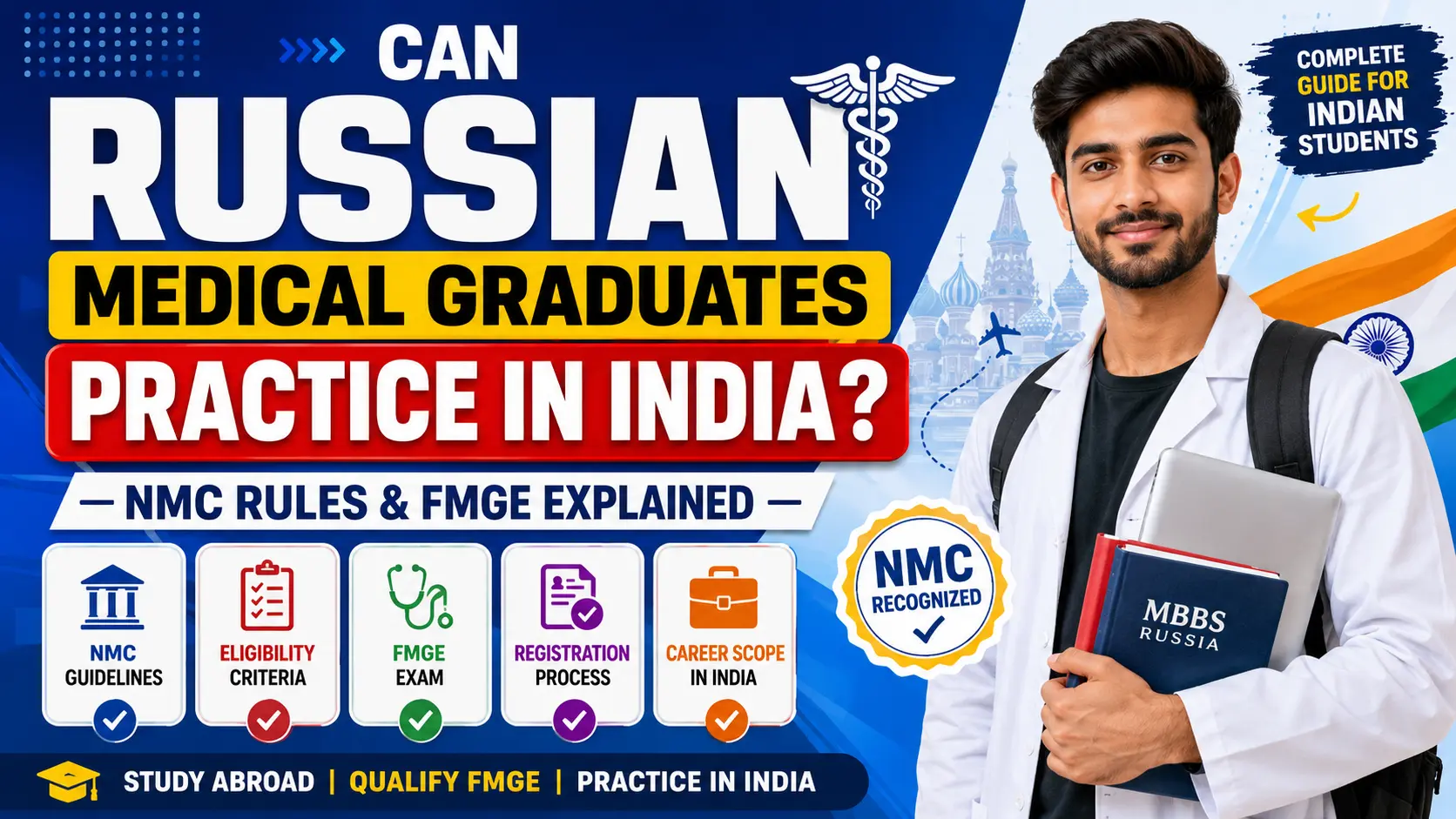
When it comes to pursuing an MBBS in Russia, Indian students have many concerns, and rightfully so. One key concern is what happens after they graduate. Once they graduate, can they become a doctor in India and practice there? How FMGE plays into this is also very important. What does the NMC stipulate for foreign medical graduates for them to be registered?
The simple answer is a Russian medical graduate can practice medicine in India, but just having a degree from the Russian medical school does not allow them to practice medicine in India. NMC regulations need to be fulfilled, and the required licensing/screening process, as well as an internship and registration, have to be completed.
As of now, the NMC has published the Foreign Medical Graduate Licentiate (FMGL) Regulations, 2021 on its official page and also some FAQs related to those Regulations. Therefore, before making a choice of university, students planning to study MBBS in Russia must have ample knowledge regarding the licensing regulations of India.
Can Russian Medical Graduates Practise in India?
Yes. Russian medical graduates can practise medicine in India provided they meet the National Medical Commission (NMC) requirements, qualify the necessary licensing/screening examination (FMGE), complete the requisite supervised internship in India, and gain registration from the concerned authority in India.
The NMC official website and its FMGL framework provide details on the foreign medical course and the accompanying foreign medical internship, medium of instruction, necessary subjects, and the country of medical registration.
What Is FMGE and Why Is It Relevant?
The Foreign Medical Graduate Examination (FMGE) is the eligibility screening examination for foreign medical graduates intending to register and practise in India.
The FMGE is conducted by the National Board of Examinations in Medical Sciences (NBEMS). Students should refer to the official NBEMS FMGE information for information bulletins, applications, notices, and examination results.
The examination has consisted of 300 multiple-choice questions, over the years, divided into two parts of 150 questions each.
According to the FMGE information bulletin, a candidate needs to score 150 marks out of 300 to be declared successful, with no negative marking and no limits on the attempts.
Students should not consider passing the FMGE as the sole criterion for eligibility. The requirements for foreign medical education, internship, and registration also have to be satisfied.
NMC Guidelines for Russian Medical Graduates
The NMC FMGL Regulations 2021 outline the basic requirements that foreign medical graduates must comply with to achieve permanent registration in India.
The requirements include:
- The minimum duration of the foreign medical course must be 54 months.
- A minimum of 12-month internship at the same foreign medical institution must be completed, subject to the regulations.
- The medium of instruction must be English.
- The International medical graduate must have completed the mandatory subjects as per the regulations.
- The medical graduate must be registered with the relevant professional regulatory body in the country in which the qualification was obtained, where applicable.
- The graduate must undergo the prescribed supervised internship in India as a prerequisite to permanent registration.
The NMC has provided these details in the advisory to support the medical aspirants going abroad to pursue medical education.
The Supreme Court has upheld the FMGL provisions of minimum course duration, foreign internship, and Indian internship provisions.
Importance of University Selection
The most common error is the selection of a university based solely on low cost. Although a medical degree may be a real one, that does not mean that every program satisfies the Indian licensing requirements.
Students must ensure the following before securing admission:
- Duration of the medical course and the curriculum.
- Medium of instruction.
- Structure of the clinical training.
- Internship provisions.
- Registration or licensing status in Russia.
- Authentic listing of the university in the international directories.
- Current provisions/guidelines of NMC.
The World Directory of Medical Schools (WDOMS) allows users to access various data points regarding medical schools. WHO evaluates WDOMS as a directory through which one can search and obtain data regarding medical schools providing undergraduate medical education across the globe. Students can also refer to the World Health Organization (WHO) for broader health and medical education resources.
MBBS in Russia Eligibility for Indian Students
For Indian students wishing to pursue MBBS in Russia, there are two primary admission standards that must be satisfied: the standards set by the Russian university as well as the standards prescribed by India for foreign medical education.
The general education prerequisites are as follows:
- Must complete the equivalent of Class 12.
- Must have Physics, Chemistry and Biology/Biotechnology.
- Must satisfy the relevant age stipulation.
- Must qualify NEET-UG – Indian students requiring foreign medical education.
- Must satisfy the relevant university admission stipulations.
- Must have all relevant educational and identification documents.
According to NMC, Indian citizens and OCI must qualify NEET-UG for the primary medical qualification. Officially, the NEET-UG 2026 portal states that NEET is mandatory for admission to medical colleges.
Students who want a broader overview of MBBS abroad can also compare the regulatory requirements before selecting a country.
MBBS Admission in Russia Process
The MBBS admission in Russia process consists of several stages.
Step 1: Eligibility Check
Ensure academic credentials, NEET qualification, and passport are all in accordance prior to lodging an application.
Students can also review the latest NEET information before proceeding with university applications.
Step 2: University Selection
While comparing universities, consider factors beyond tuition, such as curriculum, clinical exposure, teaching language, university’s recognition, internship structure, and costs.
Step 3: Submit Documents
Required documents typically include:
- Certificates for Class 10 and 12
- NEET scorecard
- Passport
- Birth certificate
- Passport photos
- Medical fitness certificate
- Any other documents requested by the university
Step 4: Admission Confirmation
The university notifies the applicant by sending an admission or invitation document after the completion of document verification.
Step 5: Student Visa Application
The student initiates the process of obtaining the student visa for Russia and gets ready to travel.
Step 6: Completion of the Medical Course
Complete clinical and academic records are maintained by the students throughout their medical education.
Step 7: Complete the Internship and Licensing Requirements
Post graduation from medical school, the Indian graduate must complete the required process for medical registration in India, including an FMGE, supervised internship, and registration.
Estimated MBBS in Russia Fees
The cost of an MBBS degree in Russia highly depends on the chosen university and the city of study. Tuition is only a small part of the overall expense.
|
Expense |
Approximate Range for Indian Students |
|
Tuition fees |
₹2.5–₹6 lakh per year |
|
Hostel |
₹30,000–₹1 lakh per year |
|
Food |
₹15,000–₹30,000 per month |
|
Insurance and medical expenses |
₹10,000–₹30,000 annually |
|
Travel and documentation |
Variable |
|
Total six-year academic/living budget |
Dependent on university and lifestyle |
These are indicative ranges for planning university costs. Students must check the university's official site for the most recent fee updates before making the payment.
Government vs. Private Medical Universities
|
Factor |
Government Medical Universities |
Private Medical Universities |
|
Tuition |
Often affordable |
More expensive |
|
Infrastructure |
Matured |
Varies greatly |
|
Clinical Exposure |
Varies with hospitals |
Varies with university |
|
Hostels |
Yes |
Yes |
|
Support for Indian Students |
Varies |
Varies |
|
Overall |
Varies with university rules and academics |
Varies with university rules and academics |
Sometimes the cheapest university is not the safest choice. While choosing Russia for MBBS, prioritizing regulatory compliance is recommended.
Top Russian Universities for International Students
Russia's medical universities have a well-established reputation. International students often consider:
|
University |
Approx. Annual Tuition (₹) |
Hostel Fees (₹/year) |
Medium |
FMGE Passing rate |
|---|---|---|---|---|
|
₹3.4–4.2 lakh |
₹40,000 |
English |
20% - 25% |
|
|
₹3.8–4.8 lakh |
₹45,000 |
English |
25% - 30% |
|
|
₹3.0–4.0 lakh |
₹35,000 |
English |
30% - 35% |
|
|
₹2.8–3.8 lakh |
₹40,000 |
English |
25% - 30% |
|
|
₹4.0–5.0 lakh |
₹50,000 |
English |
25% - 30% |
|
|
₹5.0–6.0 lakh |
₹55,000 |
English |
20% - 25% |
|
|
₹4.2–5.3 lakh |
₹45,000 |
English |
10% - 15% |
WDOMS records are a good starting point for students researching medical schools. However, a listing in WDOMS does not automatically mean Indian registration is guaranteed. Always refer to the latest NMC guidelines for program specifics.
Reasons for Choosing Russia for MBBS
Selecting a university that is compliant, MBBS in Russia for Indian Students provides several benefits.
1. Medical Education With a Strong Foundation
Russia has a good number of medical universities with a strong foundation in Medical Education and a few that have international recognition.
2. Relatively Manageable Costs
Private medical training in many other countries comes at a far higher total cost, although expenses still vary widely across Russian medical schools.
3. International Student Environment
Most Russian medical schools are accustomed to integrating international students in their programs.
4. Clinical Exposure
Affiliated hospitals provide practical and clinical exposure, but this depends on the university and specific program.
5. International Career Possibilities
Graduates can seek employment in countries other than India, after fulfilling those countries’ licensing requirements.
Disadvantages and Challenges
There are many challenges to studying medicine abroad.
Licensing Examination Pressure
Candidates must prepare very well for the FMGE or the licensing pathway that comes into effect. A foreign degree does not exempt one from evaluating their medical knowledge.
Language Barrier
Knowledge of Russian may be essential for communicating with patients and may be required in clinical training even if the medium of instruction is English.
Climate and Lifestyle Adjustment
Russia’s climate, food, cultural habits, and daily lifestyle will require a major adjustment for most students from India.
Changing Regulations
Medical licensing requirements may change. Students should be on the lookout for valid information as opposed to relying on obsolete brochures or posts on social media.
Internship Compliance
Serious issues may be created as a result of inadequate internship structuring. Students should confirm the internship structuring prior to enrollment.
Career Scope After MBBS in Russia
Russian medical schools invite you to apply for MBBS in Russia and, after meeting the requisite criteria in India, opens many career avenues.
Practice in India
Registered students may practice medicine in India following the completion of the requisite licensing and internship.
Postgraduate Medical Education
Graduates are able to pursue postgraduate medical education provided they fulfil the eligibility requirements set by the respective examination and the regulatory body.
Medical Practice Abroad
Graduates can look into the medical licensing processes for other countries. However, each country requires a separate licensing examination and registration.
Non-Clinical Careers
Graduates of medicine can also consider the following options:
- Clinical research
- Medical writing
- Health care management
- Public health
- Health care medical technology
- Pharmaceuticals
- Health care administration
Therefore, students who want to study MBBS in Russia for Indian students should plan their career before choosing a university.
Russia MBBS to India: Complete Roadmap
|
Stage |
What the Student Needs to Do |
|
1 |
Qualify NEET-UG as applicable |
|
2 |
Select a suitable Russian medical university |
|
3 |
Check programme and verify NMC requirements |
|
4 |
Complete the needed medical course |
|
5 |
Complete the needed foreign internship |
|
6 |
Obtain the necessary Russian registration/licensing status |
|
7 |
Apply for the Indian screening/licensing examination |
|
8 |
Pass FMGE where applicable |
|
9 |
Complete the prescribed supervised internship in India |
|
10 |
Apply for registration with the relevant authority |
The exact pathway is dependent on the date of admission, applicable rules, and the future implementation of India's medical licensing framework. For the most current updates and questions, you should visit the NMC regulations page.
Verifying Russian Medical Universities
Always verify a university before paying any admissions fee.
To begin, check the university on WDOMS. Next, check the current guidelines put forth by the NMC. The students should also check the WHO resource and use the official NEET portal for exam related information.
Don’t rely solely on the agent's words such as "100% FMGE approved" or "NMC direct approval." It is the student’s duty to check the exact university, course, duration, internship and the licensing requirements.
Students can also use a NEET Rank Predictor as an additional planning resource, but university eligibility and regulatory requirements should always be verified through official sources.
FAQs
Can I practise in India after MBBS in Russia?
Yes, Russian Medical Graduates may apply for medical registration in India, following the necessary NMC guidelines as well as meeting the requirements for a Medical Licensing and Internship as well as medical registration.
Is FMGE compulsory after MBBS in Russia?
As per the current stipulations, FMGE is the essential licensing examination for foreign medical graduates to be eligible to practice in India. It is advised to check the updated guidelines of NMC and NBEMS as per the year of admission and graduation.
What is the FMGE passing score?
As per the FMGE guidelines, a candidate must secure a minimum of 150 marks out of 300.
Is NEET required for MBBS in Russia?
In compliance with the NMC guidelines, qualifying NEET is mandatory for Indian citizens and OCI to pursue a primary medical qualification abroad. Students should verify the latest information through the official NEET portal.
Does WDOMS Listing Guarantee Indian Recognition?
No. Listing in the WDOMS directory does not guarantee eligibility for registration in India. Indian regulatory authorities will need to review the specific program.
Is MBBS from Russia Accepted in India?
If the medical program meets the NMC criteria, and the graduate fulfills the mandatory registration and licensing requirements, it affords the graduate the opportunity to medical practice in India.
Can Russian Medical Graduates Work in Other Countries?
Possibly. However, each country has specific medical licensing requirements, including examinations and registration. A Russian medical degree does not provide the right to practice medicine universally.
Conclusion
So, can Russian medical graduates practice in India? Yes—but this is only a small part of the entire process required to be eligible to practice in India.
For Indian students planning to pursue an MBBS in Russia, it is vital to choose a program that meets the NMC requirements from the beginning. This includes careful examination of course duration, teaching medium, curriculum and materials, clinical practice and training, internships, registration in Russia, and Indian licensing.
The FMGE will be a significant requirement for all eligible foreign medical graduates under the existing screening system. Consulting the official NMC and NBEMS websites will provide the most accurate information for foreign medical graduates, as relying solely on consultants and university advertisements will not be sufficient.
In the end, for Indian students, MBBS in Russia may be a possible option, depending on picking the best university, continued good academics, and planning the Indian licensing as of the first day.
For students comparing destinations and admission pathways, MBBS Abroad can also be used as a broader starting point for research.