Indian students aiming at cost-effective, internationally recognized medical training have massively favored MBBS in Russia for MBBS (bachelor of medicine and bachelor of surgery) courses. Private medical colleges in India charge exorbitantly, are poorly staffed, and provide outdated infrastructure and resources, whereas Russian medical schools provide much better and modern facilities and education while charging much less tuition for a degree that is internationally recognized.
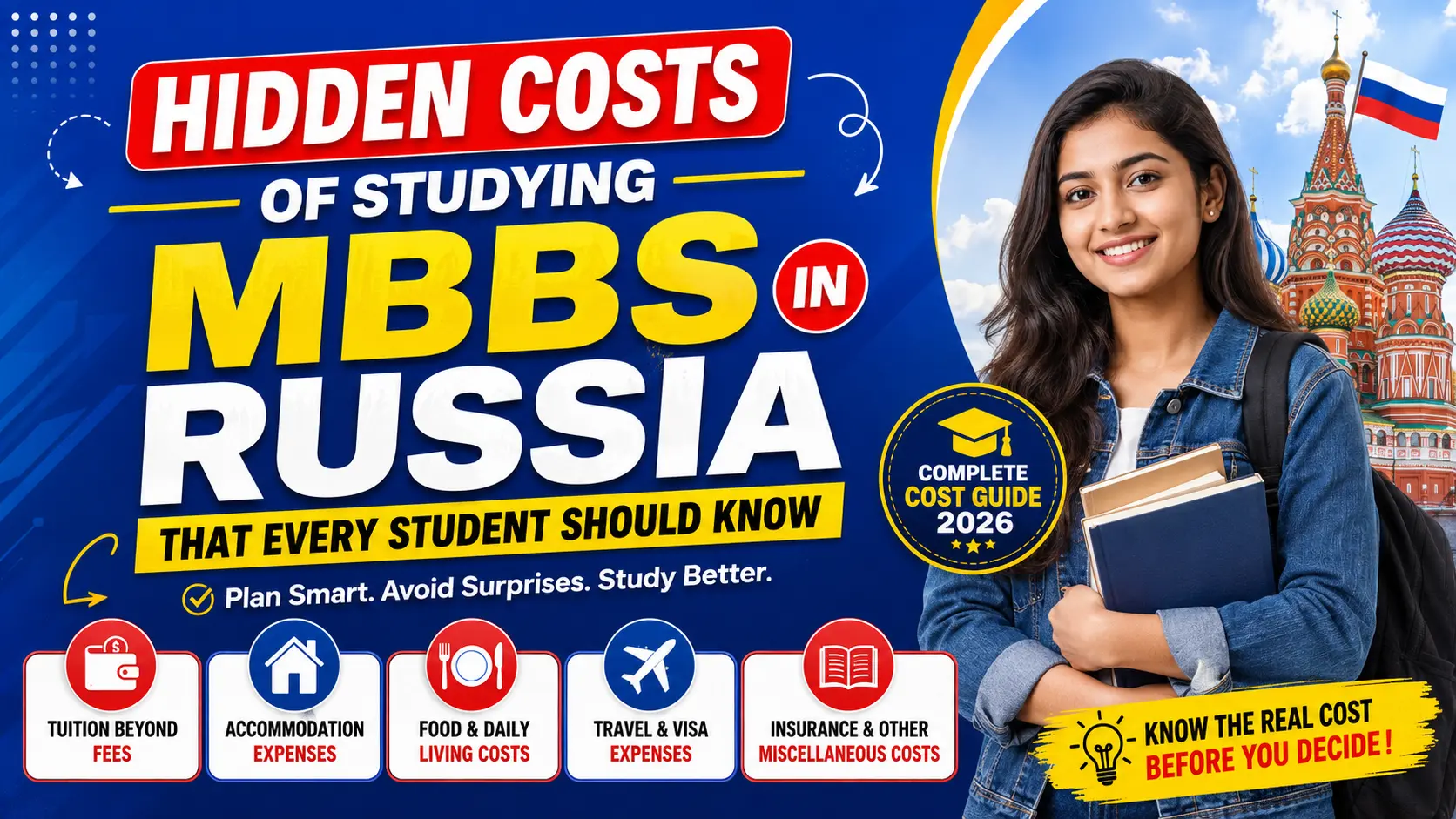
However, these schools do not go out of their way to advertise the hidden costs of the courses. The brochures focus heavily on the low tuition rates, and these hidden costs often outweigh the benefits of low tuition. Knowing these hidden costs before enrolling helps the students and parents budget accordingly for additional costs and avoid nasty surprises.
For those interested in studying MBBS in Russia, this guide covers hidden costs thoroughly, as well as eligibility, admission procedures, fees, benefits, drawbacks, top universities, career options, and more in the FAQs.
What Are the Hidden Costs of Studying MBBS in Russia?
Apart from tuition fees, students studying MBBS in Russia need to consider the costs for:
- Visa and other documentation
- Medical Insurance
- Hostel security deposits
- Registration and administrative fees at the school and university
- Airfare and travel (annual)
- Food and living costs
- Winter clothes
- Books and lab supplies
- Currency exchange costs
- FMGE/NExT coaching (post graduation)
- Costs surrounding an internship
- Other emergency medical costs
All of these need to be considered before total costs are budgeted for.
Why Knowing Hidden Costs Is Important
When students choose universities, most look only at tuition costs. They do not think about administrative fees or living costs that need to be paid on a recurring basis.
If you are interested in the mbbs cost in Russia for Indian students, do not focus solely on the annual tuition costs and assess your total educational budget. A complete financial plan for the family reduces stress and helps manage costs during the entire time the students are studying medicine.
Some Hidden Costs of MBBS In Russia
1. Visa and Documentation
Cost of visa processing, invitation letters, passport renewal, and costs of translating documents, notarizing or obtaining an apostille on the documents, and costs of extending a visa. These are not included in tuition packages.
2. Insurance
In Russia, universities purchase insurance for international students. Insurance may cover emergency care and hospital visits or other basic care. Students pursuing MBBS in Russia should account for the yearly renewal of insurance.
3. Hostel Deposits
In Russia, not all universities have the same accommodation fees. To stay in hostels, students may have to pay a hostel deposit which is usually refunded. Costs for other hostel services (like bedding, utensils, laundry, internet, or electricity) may also be incurred.
4. Travel
Students will have to pay for travel to Russia for admission, and then will also need to pay for airfare for the winter break, summer break, and emergencies.
5. Currency Exchange Costs
The exchange rate for Rubles fluctuates during the year, which can impact the amount required for travel. For MBBS in Russia, students should have a cash reserve.
6. Clothing
Russia has a very cold winter season, and students should purchase winter boots, thermal wear, snow boots and winter jackets. These costs are generally not factored in.
7. Food and Living Expenses
Hostel living is cost-friendly, but students pay for:
- Food
- Indian eateries
- Transport
- Mobile
- Leisure
Estimation of monthly living costs is essential for those looking to MBBS Russia.
8. Books and Study Materials
Not all universities offer digital alternatives. As a result, students pay for:
- Textbooks
- Lab coats
- Equipment
- Prints
- Supplies
9. FMGE/NExT Preparation
Indian students seeking to practice in India after completing their MBBS in Russia often spend on coaching.
This cost is important for the total cost of education.
10. Emergency Expenses
Some costs that fall in this category are:
- Unexpected health costs
- Replacement of electronics
- Extra stays
- Family issues
- More travel
It is wise to have an emergency fund.
Entry Criteria for MBBS In Russia
Students applying for MBBS in Russia usually have:
- 50% in Physics, Chemistry, and Biology for the General category. For the reserved categories, the requirement is 40% (as per NMC criteria)
- Pass the NEET
- Passport
- 17 years old
It is advisable that students verify eligibility with the NMC.
MBBS Admission Process
Students interested in Study MBBS in Russia generally do:
- Select an NMC approved medical school.
- Send academic papers.
- Get an offer.
- Request the invitation letter.
- Get a student visa.
- Buy flights.
- Register at the university on arrival.
Expected Cost Analysis
|
Expense Category |
Expected Cost (INR) |
|
Tuition fee |
₹2.5–6.0 Lakhs / year |
|
Hostel |
₹40,000–1,20,000 / year |
|
Food |
₹8,000–15,000 / month |
|
Medical insurance |
₹8,000–20,000 / year |
|
Visa & documentation |
₹20,000–50,000 |
|
Airfare |
₹30,000–80,000 / trip |
|
Winter clothing |
₹20,000–40,000 |
|
Miscellaneous |
₹40,000–80,000 / year |
Students aiming for MBBS in Russia education loan and are searching loan estimates should consider these additional expenses.
Leading Universities for MBBS In Russia
|
University |
Approx. Annual Tuition (₹) |
Hostel Fees (₹/year) |
Medium |
FMGE Passing rate |
|
₹3.4–4.2 lakh |
₹40,000 |
English |
20% - 25% |
|
|
₹3.8–4.8 lakh |
₹45,000 |
English |
25% - 30% |
|
|
₹3.0–4.0 lakh |
₹35,000 |
English |
30% - 35% |
|
|
₹2.8–3.8 lakh |
₹40,000 |
English |
25% - 30% |
|
|
₹4.0–5.0 lakh |
₹50,000 |
English |
25% - 30% |
|
|
₹5.0–6.0 lakh |
₹55,000 |
English |
20% - 25% |
|
|
₹4.2–5.3 lakh |
₹45,000 |
English |
10% - 15% |
Students should double check university listing on the World Directory of Medical Schools (WDOMS) before proceeding with admission.
Reasons to Study MBBS In Russia
Students focusing russia mbbs fees for indian students have clear advantages in terms of:
- Low tuition
- University recognition
- University taught in English
- Modern Labs
- International exposure
- High quality of clinical education
- Campus diversity
- Medical education recognized by WHO
For further information regarding international healthcare services, students may refer to the website of the World Health Organization (WHO).
Considerations for Student Decisions
Despite the benefits of MBBS In Russia, students should be made aware of the concerns.
Language
Basic clinical skills will be taught in the Russian language.
Extreme Weather
Students will have to adjust to the weather.
Licensing Exams
Graduates will have to comply with the Indian NMC licensing exam.
Other Living Expenses
Students focusing study mbbs in russia for Indian students must be prepared for miscellaneous expenses apart from tuition.
Time to Complete MBBS In Russia
The time to complete MBBS in Russia is on average six years. This includes the mandatory clinical internship.
Students frequently ask how long MBBS programs in Russia last. Most of the NMC-recognized Russian universities teach for six years.
Career Options After MBBS from Russia
There are several career options after MBBS from Russian universities.
Some of them are:
- Practice medicine in India after fulfilling NMC regulations
- Post Graduation
- Job in a Hospital
- Clinical Research
- Health Administration
- Public Health
- Teaching of Medicine
Medical students from Russia are Indian students; they should determine their career options before they graduate.
Key Considerations While Selecting the University
|
Selection Factor |
Importance |
|
NMC recognition |
Very important |
|
WDOMS listing |
Important |
|
Clinical exposure |
Very important |
|
Instruction language |
English preferred |
|
Availability of hostels |
Important |
|
Tuition fees |
To be determined |
|
Student support |
Helpful |
|
Availability of Indian food |
Desirable |
You should evaluate multiple universities for MBBS in Russia.
Medical Studies in Russia
Medical students from India prefer Russia for studies because of the structured curriculum and formal clinical exposure, and Russia offers medical degrees of international acceptance. Practical training and research make Russia a preferred place to study medicine. There is a modern infrastructure in Russia along with medical education.
FAQ
Is pursuing MBBS in Russia economical?
Yes, the tuition fees are less in comparison to the private medical colleges in India. However, students must plan the budget as there are hidden expenses as well.
What are some hidden expenses?
Costs for living, travel, insurance, and emergencies are frequently underestimated.
Is NEET mandatory?
Currently, it is mandatory for Indian students to qualify NEET as per the new NMC regulations.
Are Russian medical universities globally acknowledged?
A majority of the universities have NMC recognition and are listed in WDOMS and are accredited to the standards of medical education worldwide.
Can I avail an education loan?
Yes. Indian banks offer education loans to students who meet the eligibility criteria and want to study MBBS abroad.
How much beyond tuition fees do I need to budget?
Students are advised to budget an additional ₹3–6 lakhs for the entire course for living expenses, travel, insurance, documentation, and contingencies.
Conclusion
Studying MBBS in Russia is a good option for Indian students who want to study medicine abroad at a reasonable cost. However, smart financial planning must look beyond tuition costs. Costs for visa insurance, accommodation deposits, travel, winter wear, daily expenses, study materials, and costs for preparatory courses for licensing exams must be factored in.
Considering these hidden costs, choosing a university that is recognized, and setting a practical budget will help students avoid financial problems and focus on their studies. Adequate planning, the right choice of university, and following the NMC recommendations are key to a successful MBBS in Russia.