Indian students can pursue a medical degree that is internationally recognized by choosing to study MBBS In Russia, which is an economical option. The low tuition fees charged by Russian medical universities in comparison to other countries should be a significant factor in students’ decisions to study there.
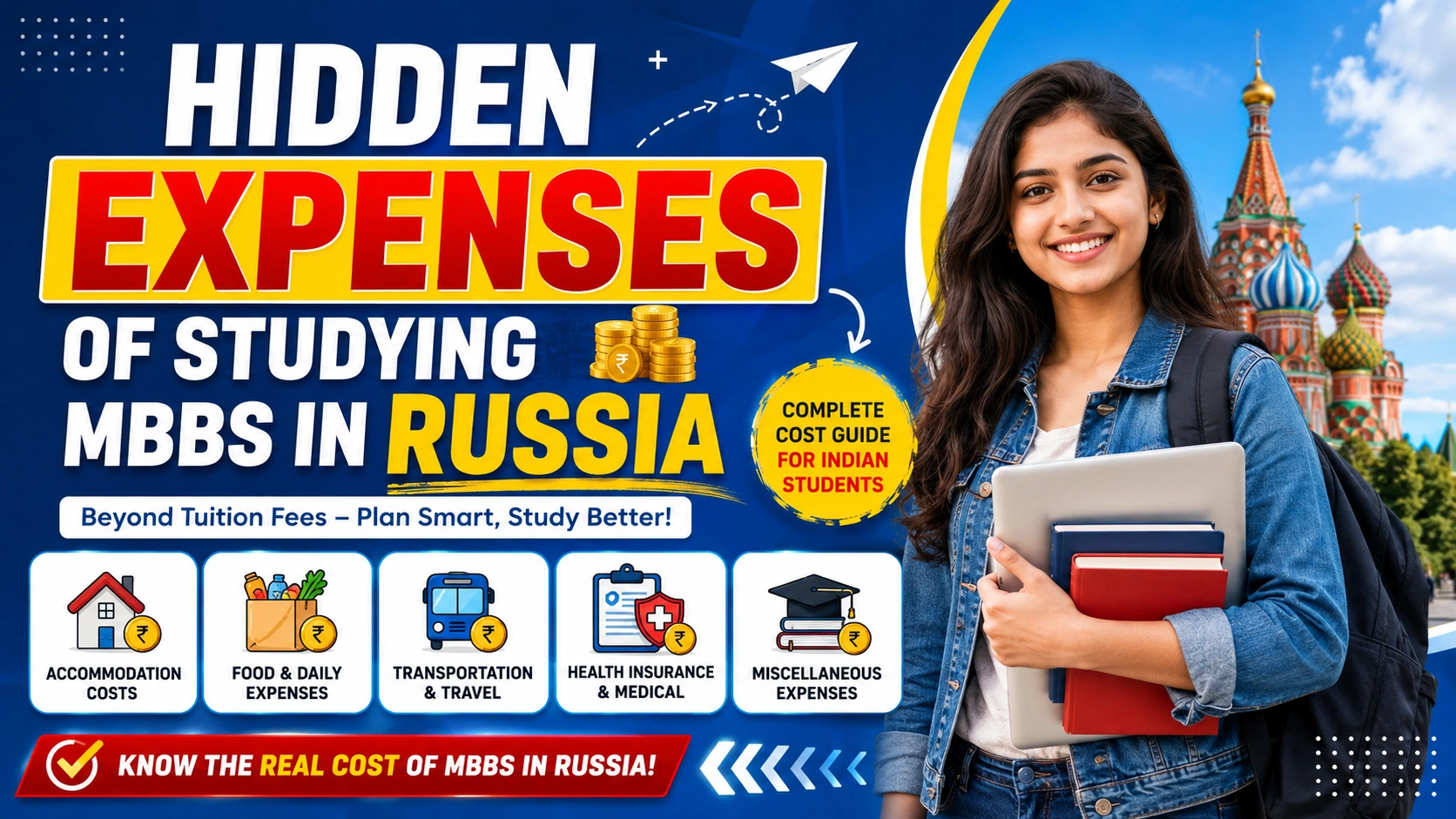
However, there are additional costs that students tend to ignore. In addition to tuition and hostel costs, there are renewal costs for visas and medical insurance, travel, food, winter clothing, and registration and exam fees. These costs can run into thousands of dollars. Knowing what these costs are allows students to budget and reduces stress.
We outline these costs, budget and compare costs, describe eligibility, the admission process, benefits and drawbacks, the leading universities, and career options after studying MBBS In Russia, and provide answers to the most common questions.
What are the hidden costs when studying MBBS In Russia?
There are many costs in addition to the tuition costs, which include:
- Visa processing and renewals
- Airfare
- Winter clothing
- Local travel
- Hostel security deposit
- Groceries and other food
- Medical insurance
- University registration
- Medical check ups
- Books and study materials
- Costs related to internships
- FMGE/NExT preparation
- Costs associated with exchanging currency
- Costs related to personal expenses
These costs can vary from USD 2,500 to 4,500 depending on the city and lifestyle.
Why Analyzing Hidden Costs is Important
Students typically only look at tuition costs when comparing universities. However, the costs associated with studying abroad are made up of many different expenses.
Budgeting helps to eliminate financial emergencies, create a realistic budget, and plan savings, and helps reduce the need for loans, and allows for more focus on academics.
Eligibility for MBBS in Russia
Minimum requirements to apply are:
- Attended 12th grade with a minimum of 50% in PCB with a passing NEET score (general category) (40% passing score for reserved categories)
- Minimum age of 17 years / Attained age of 17 years by the time of admission
- Possession of valid passport
- Required Admission Documentation
Please check the National Testing Agency (NEET) official site for the latest updates.
Admission Process
Those wondering how to apply for MBBS in Russia must:
- Choose a University listed in NMC
- Submit all required documents
- Receive admission letter
- Apply for invitation letter
- Obtain Student Visa
- Purchase flight tickets
- Register in the University upon arrival
Also check listings in:
- National Medical Commission (NMC)
- World Directory of Medical Schools (WDOMS)
- World Health Organization (WHO)
Tuition Fees vs. Hidden Expenses
Among students, scholarships are seen as just an opportunity to reduce tuition costs.
Tuition Fees vs Hidden Costs
|
Expense |
Estimated Cost |
|
Tuition Fees |
USD 3,000 – 7,000 |
|
Hostel Fees |
USD 500 – 1,200 |
|
Food |
USD 1,000 – 2,000 |
|
Medical Insurance |
USD 150 – 300 |
|
Visa Renewal Fees |
USD 100 – 250 |
|
Registration Fees |
USD 100 – 300 |
|
Books & Materials |
USD 150 – 400 |
|
Winter Clothing |
USD 250 – 600 |
|
Transportation |
USD 150 – 500 |
|
Miscellaneous |
USD 300 – 800 |
Major Hidden Expenses Students Ignore
1. Visa Processing & Renewal
Student visas must be renewed periodically and students must budget for the documentation & administrative costs incurred.
2. Airfare
Annual travel costs vary by season, but students typically spend between USD 400 – 900 per year.
3. Medical Insurance
Throughout an applicant's time as a student in a Russian university, valid Medical Insurance is a requirement. What this usually includes is as follows:
- Emergency Medical Treatment
- Hospitalization
- Medical Consultations
4. University Registration Fees
Almost all universities require a Registration/Documentation Fee upon arrival, which generally cannot be found in the tuition fee.
5. Hostel Security Deposit
Most universities require a refundable hostel security deposit. Students should check this prior to admission.
6. Food Expenses
Students wanting to study MBBS in Russia usually spend about USD 100 - 200 on groceries, Indian food, eating out, fast food, and snacks. These costs are significantly lower if you cook your meals.
7. Winter Clothing
Due to the harsh winters in Russia, students are required to buy winter clothing. Students typically buy snow boots, winter jackets, thermal clothes, and woolen gloves. The average expenditure in the first year is around USD 300 to 600.
8. Local Transportation
Although public transport is cheap, students should plan a monthly transport budget.
9. Study Materials
Consistent costs for study materials include books, lab manuals, printing, and stationery. Using digital resources can help lower costs.
10. Currency Exchange Charges
When students send money to their account abroad, they often ignore the costs for currency exchange rates, money transfers, and international transactions.
11. Personal Expenses
Students should account for leisure, shopping, internet and phone plans, and travel when considering yearly expenses.
The Total of Average Annual Hidden Costs
|
Expense Categories |
Average Annual Cost |
|
Visa & Registration |
USD 250–500 |
|
Medical Insurance |
USD 150–300 |
|
Food |
USD 1,200–2,000 |
|
Clothing |
USD 300–600 |
|
Local Transport |
USD 200–500 |
|
Books |
USD 150–400 |
|
Miscellaneous |
USD 500–900 |
|
Total |
USD 2,750–5,200 |
Benefits of Pursuing MBBS in Russia
Students pursuing MBBS in Russia for Indian students have the following advantages:
- Affordable tuition fees
- World-recognized degrees
- Programs offered in English
- Access to modern hospitals
- Opportunity for international exposure
- Access to advanced laboratories
- Well trained faculty
- Well developed clinical programs
Disadvantages
While pursuing Russia MBBS has multiple benefits, students should take into account:
- Cold climate
- Language barrier during clinical rotations
- Extra expenses
- Cultural adjustments
- FMGE/NExT preparation after pursuing MBBS in Russia
With proper planning, the above challenges can be minimized.
Top Medical Universities in Russia
Students looking for Russia MBBS University options can consider:
|
University |
Approx. Annual Tuition (₹) |
Hostel Fees (₹/year) |
Medium |
FMGE Passing rate |
|---|---|---|---|---|
|
₹3.4–4.2 lakh |
₹40,000 |
English |
20% - 25% |
|
|
₹3.8–4.8 lakh |
₹45,000 |
English |
25% - 30% |
|
|
₹3.0–4.0 lakh |
₹35,000 |
English |
30% - 35% |
|
|
₹2.8–3.8 lakh |
₹40,000 |
English |
25% - 30% |
|
|
₹4.0–5.0 lakh |
₹50,000 |
English |
25% - 30% |
|
|
₹5.0–6.0 lakh |
₹55,000 |
English |
20% - 25% |
|
|
₹4.2–5.3 lakh |
₹45,000 |
English |
10% - 15% |
Always verify recognition through WDOMS and NMC.
Duration of MBBS in Russia
Pursuing MBBS in Russia is of 6 years duration with clinical training included in the duration.
Many students also search Russia MBBS for how many years when selecting the university.
Fee Structure
Students looking for MBBS in Russia for Indian students fee structure should consider:
- Tuition
- Hostel
- Insurance
- Visa
- Food
- Books
- Personal expenses
Actual Russian MBBS fees will vary depending on the university and city.
Career Opportunities After MBBS
Studying MBBS in Russia grants access to varied careers, including:
- Practicing medicine in India after NMC completion
- Postgraduate studies
- Working in a hospital
- Pursuing a career in research
- Practicing abroad
- Working in public health
- Teaching medicine
- Healthcare management
Those who complete MBBS in Russia may also take international licensing exams, depending on the local laws.
Useful Information
Medical students in Russia should monitor the following:
- WHO – Global health information
- NMC – Indian medical regulations
- WDOMS – University recognition
- NEET – Eligibility requirements
Other Student Resources
Before selecting Russia for MBBS, research the following:
- Medical education in Russia for Indian students
- Medical study in Russia for Indian students
- Study medical in Russia
- Study medicine in Russia
- Study MBBS in Russia for Indian students
- MBBS Russia
- Russia MBBS
- MBBS duration in Russia for Indian students
- NEET scores for MBBS in Russia
Common Questions
Are MBBS programs in Russia cost effective?
Yes, MBBS programs in Russia offer far more competitive pricing in comparison to private medical colleges, especially when factoring the cost of living.
What other costs should students anticipate?
Students can expect costs for food, insurance, visa renewals, airfare, clothing, books, registration, transportation, and other personal costs.
What should students budget for other expenses?
Most students budget approximately $2,750 to $5,200 for other expenses each year.
Do Russian medical schools hold international recognition?
A number of them are NMC and WDOMS recognized, but always check before admission.
Can Indian students work in Russia after MBBS?
Yes. Graduates may take licensing exams, begin postgraduate studies, or engage in research or clinical work. This is dependent on the country’s regulations where the work will take place.
Conclusion
MBBS in Russia continues to be a wise decision for Indian medical students considering the low cost and the presence of good quality to world class universities, and the good clinical exposure the programs offer. However, the costs of MBBS Programs in Russia are a fraction of the total costs. Other costs to consider in the total costs of the program include food, travel, insurance, visa renewals, clothing for winter, books, and personal expenses.
Considering and including these costs eliminates the surprise of extra costs. The total costs of the programs do not outweigh the benefits with appropriate planning, attendance to an NMC, WDOMS, WHO, NEET, and other recognized universities.