
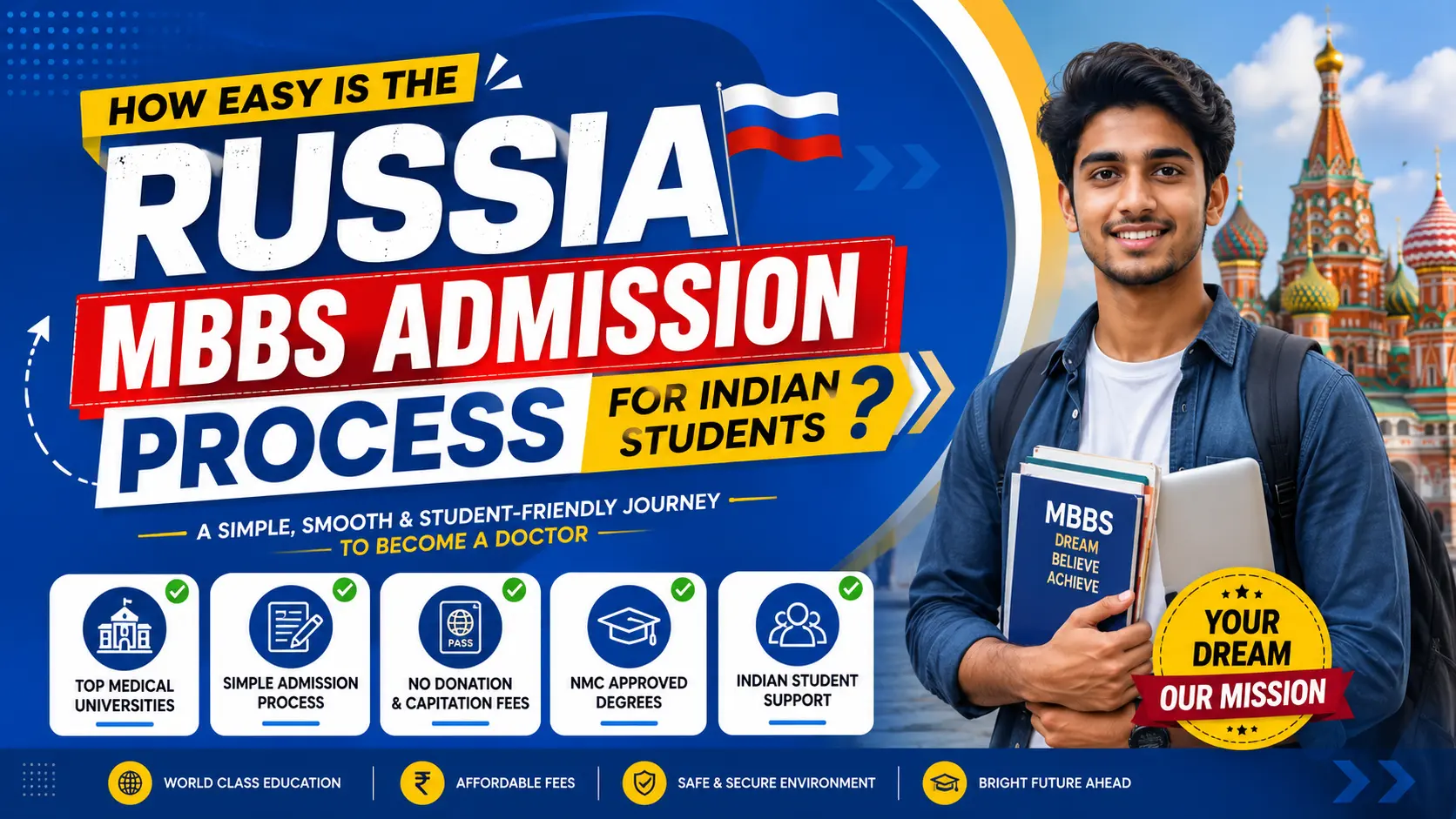
For Indian students seeking MBBS programs abroad, Russia is popular because of its relatively inexpensive tuition, recognized programs, its well built campuses, and easy to navigate acceptance processes. In contrast to private medical schools in India that charge outrageous fees and have cut-throat competition for seats, medical colleges in Russia have built systems that are much more accessible and easy to comprehend.
MBBS in Russia programs have built systems that readily accept students who have passed the NEET and are within the demographic of the described eligibility standards. Russian medical colleges do not charge capitation fees, do not conduct entrance tests for admission, and do not employ elaborate counseling for the admission process.
The admission process to Russian medical colleges is an important aspect for students who are planning to go abroad to study and also for students who are still considering their options. This process describes all the steps to apply for medical college in Russia along with the eligibility standards, fees, benefits, risks, and the employment options after getting an MBBS degree in Russia.
Featured Snippet
How Easy is the Russian MBBS Admission Process for Indian Students?
With few requirements compared to other countries, getting accepted to an MBBS program in Russia is one of the easiest in the world. Indian students must take and pass the NEET, have a General category score of at least 50% in the PCB, prepare the necessary documentation (that includes an acceptance letter) to apply for a student visa, and travel to Russia. There are no entrance exams for admission into most medical colleges in Russia, and there are no capitation fees.
Why is MBBS in Russia Popular Amongst Indian Students?
Continuing MBBS in Russia trends popularity because of the affordable costs of internationally recognized medical education.
The costs of education in Russia are:
- Low tuition costs
- No donation or capitation costs
- English MBBS programs
- WHO and NMC approved universities
- Modern hospitals for clinical education
- High standard education
- Easy admission process
- Globally accepted degrees
There are far fewer hassles for students who wish to get MBBS admission in Russia in comparison to getting admission in medical colleges of many other countries.
Eligibility Criteria for MBBS in Russia
Indian students are required to meet the following.
Academic Qualifications
|
Requirement |
Criteria |
|
Qualification |
10+2 |
|
Subjects |
Physics, Chemistry, Biology |
|
Minimum Marks |
50% (General), 40% (Reserved) |
|
Age |
Minimum 17 years |
|
NEET |
Mandatory for Indian students |
Students who wish to pursue MBBS in Russia 2026 should check for the latest eligibility regulations from the National Medical Commission (NMC).
Step By Step Process for MBBS in Russia
The process is easy and usually completed in a couple of weeks.
Step 1: Select the Appropriate University
Based on the:
- Recognition
- Ranking
- Tuition costs
- Hostel facilities
- Clinical exposure
- English curriculum
Always check the university recognition in the World Directory of Medical Schools (WDOMS).
Step 2: Check Eligibility
Confirm the:
- NEET qualification
- Age and academic criteria
Step 3: Submit Application
Submit:
- Passport
- Class 10 and 12 mark sheets
- Passport-size pictures
- NEET score card
- Medical certificate
Step 4: Admission Letter
The university issues an official Admission Letter after the verification of your documents. MBBS in Russia usually get their confirmation within days.
Step 5: Invitation Letter
The institution will ask Russian officials for your official Invitation Letter.
Step 6: Student Visa
You can apply for your Russian student visa once you have your Invitation Letter.
Step 7: Travel to Russia
Flights can be booked, accommodation can be arranged, and registration can be completed after arrival. Delegates from MBBS universities in Russia usually provide airport welcome assistance.
Documents Required
- Passport
- Class 10 Certificate
- Class 12 Certificate
- NEET Scorecard
- Passport-size Photograph
- Medical Fitness Certificate
- Report of HIV Test
- Birth Certificate (as applicable)
- Visa Documents
Admission Timeline
|
Activity |
Approximate Duration |
|
University Selection |
1 Week |
|
Application Submission |
2–5 Days |
|
Admission Letter |
5–10 Days |
|
Invitation Letter |
2–4 Weeks |
|
Visa Processing |
1–2 Weeks |
|
Departure |
September–October |
MBBS in Russia should start the application process several months before the academic year.
MBBS in Russia Fee Structure
Medical education in Russia is less expensive than in many other countries.
|
Cost Component |
Average (INR) |
|
Tuition |
₹2.5–6 Lakhs / year |
|
Hostel |
₹40,000–80,000 / year |
|
Food |
₹8,000–15,000 / month |
|
Insurance |
₹10,000–20,000 / year |
|
Total |
₹18–35 Lakhs |
MBBS in Russia applicants often have a lower total cost of education compared to Private Medical Colleges in India.
Top Medical Colleges in Russia
These universities are among the prestigious ones:
|
University |
Approx. Annual Tuition (₹) |
Hostel Fees (₹/year) |
Medium |
|
₹3.4–4.2 lakh |
₹40,000 |
English |
|
|
₹3.8–4.8 lakh |
₹45,000 |
English |
|
|
₹3.0–4.0 lakh |
₹35,000 |
English |
|
|
₹2.8–3.8 lakh |
₹40,000 |
English |
|
|
₹4.0–5.0 lakh |
₹50,000 |
English |
|
|
₹5.0–6.0 lakh |
₹55,000 |
English |
|
|
₹4.2–5.3 lakh |
₹45,000 |
English |
Always check the listings by WHO, NMC, and WDOMS for recognition before applying. When considering studying MBBS in Russia, students shouldn't focus on tuition costs alone. They should also look at the quality of education offered at each university.
Benefits of Studying MBBS in Russia
There are lots of pros to studying MBBS in Russia.
Cheap Education
Students doing MBBS in Russia can save money as compared to studying MBBS in India.
Affordable education should not come at the cost of quality, and Russian education is of great quality.
Internationally Recognized Degrees
Most degrees are recognized internationally. Admission would depend on local licensing's.
The recognition can be checked in the:
No Donation
Generally, Russian universities are free from donation expenses as compared to many private universities.
English Medium
MBBS can be done entirely in the English medium by many of the Russian universities.
Modern Infrastructure
Learning is done in labs, simulation centers, and modern teaching hospitals.
Cons of Studying MBBS in Russia
Although education is great, there are some cons as well.
- Weather
- Russian winters can get very cold.
- Language
- Most students have to learn some amount of Russian as it is necessary for clinical practice.
- Licensing Exams
- For Indian students, the new NMC regulations and requirements are to be followed for the students who practice after graduating.
- Food and Cultural
- Living abroad means a huge difference in food and other cultural aspects.
If you are looking for MBBS in Russia fees in 2026, you should also look at living costs.
What Can You Do After Studying MBBS in Russia?
The options are endless.
You can:
- Practice MBBS in India after the licensing is done.
- You can pursue your PG in Russia.
- You can do your residency in Europe.
- Licensing exams USMLE or PLAB can also be done to work in those countries.
- Pursue your career in research and work in hospitals.
Those who do their MBBS in Russia get exposure to many different countries and their clinical practices.
Russia offers an easy application process, no university entrance exam, no donation requirement, affordable tuition, faster confirmation for admission, clear documentation, and a high visa approval rate for complete documentation.
Most of the students wanting to pursue MBBS in Russia are able to complete the admission process without any hassle if they are well planned.
Before applying, Indian students should:
- Prepare for NEET
- Enroll in universities recognized by the NMC
- Check the World Directory of Medical Schools
- Compare universities and tuition
- Check available accommodations
- Know the licensing process
- Prepare required documents in advance
- Stay informed of any changes to the NMC guidelines
Why Choose MBBS In Russia?
There are a myriad of reasons why international students are so attracted to Russian universities. These reasons include:
- Highly qualified teaching staff
- Affordable education
- Fame and recognition globally
- Wonderful labs
- Adequate clinical exposure
- A community of international students
- Abundant research opportunity and resources
The Russian MBBS course offers a unique blend of affordability and excellence.
MBBS In Russia Plans For 2026
While pursuing MBBS in Russia in 2026, students must keep in mind the importance of early preparation and monitoring admission windows, visa windows, and stay informed of the changing eligibility requirements.
For Indian students, pursuing MBBS in Russia continues to be one of the most reasonable and accessible options for obtaining a globally recognized medical degree.
Frequently Asked Questions (FAQs)
Is NEET compulsory for MBBS In Russia?
NEET is compulsory for MBBS in Russia because qualifying NEET is one of the requirements laid down by the NMC.
Is there any entrance exam in Russian universities?
Most Russian universities do not have any entrance examinations for international students.
How long for the admission process?
The admission process takes about 30–60 days.
Is it expensive to study MBBS in Russia?
The cost of studying MBBS in Russia is between ₹18–35 lakhs, depending on the university and other expenses.
Are Russian medical universities acknowledged?
Several Russian medical universities have recognition by the World Health Organization (WHO) and are listed in the World Directory of Medical Schools (WDOMS). Ensure that you comply with NMC.
Can Indian students do MBBS in Russia and practice in India?
Yes, it is possible, if the licensing and regulatory requirements by the NMC are met.
Conclusion
The simplest and most transparent choice for Indian students who wish to pursue MBBS abroad in Russia is to study MBBS in Russia. The easy eligibility criteria, low tuition fee, and recognized universities, combined with no donation and no entrance exams, are key factors.
Indian students must choose a recognized university, check accreditation with the WHO, WDOMS, and NMC, pass the NEET exam, and study the new licensing rules before applying to Russia. Following the correct admission process, and with the right preparations, Indian students can pursue this journey with confidence.