
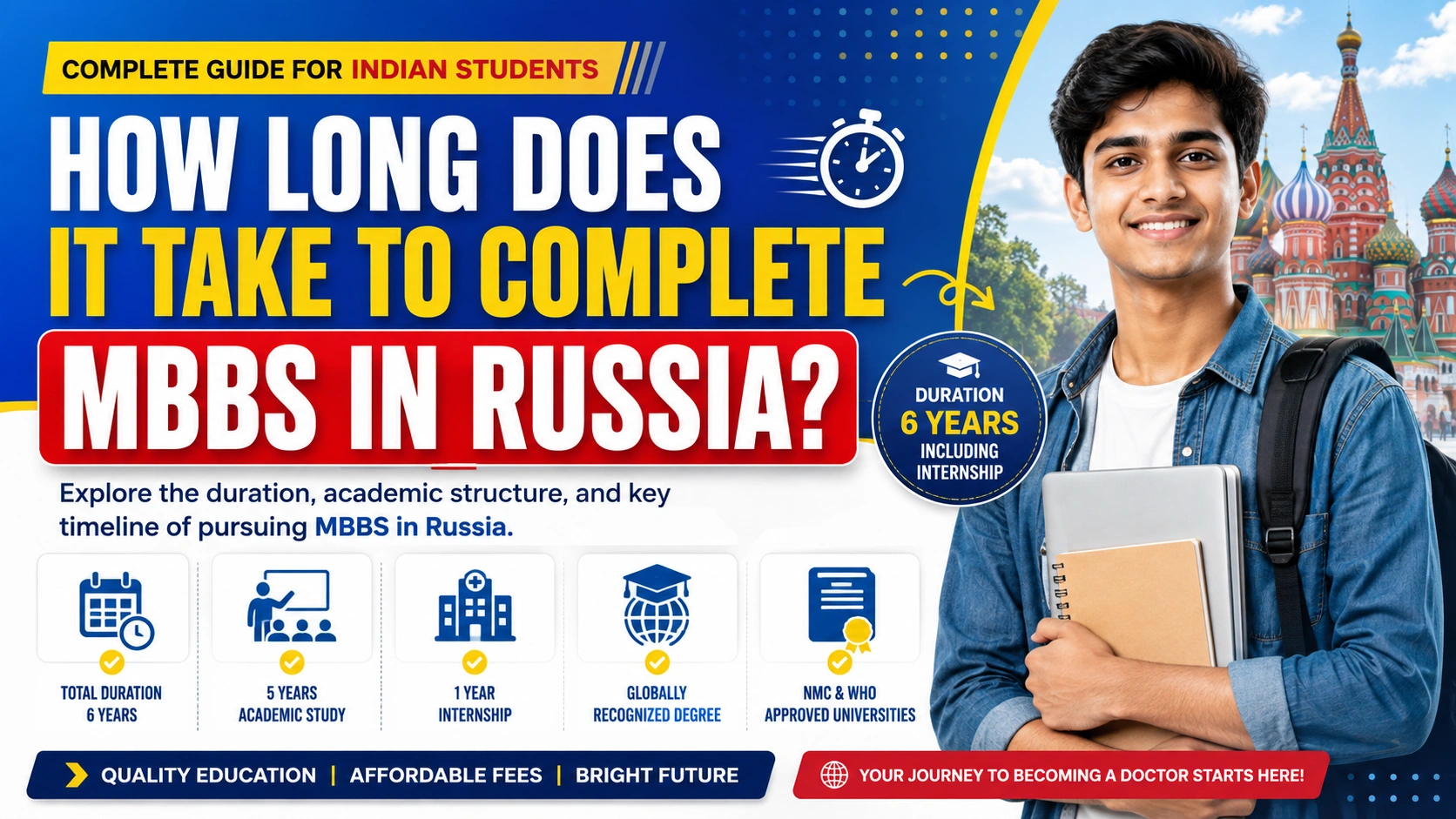
For Indian students seeking to study medicine outside India, the first question that arises is: How long does it take to complete MBBS in Russia? Students must analyze all the aspects of the academic program, internship, eligibility criteria, admission process, duration of the program, and the probable scope of the career after the program.
Typically, a medical degree in Russia will take 6 years. The usual duration of the medical degree includes theoretical and practical training in the clinical area. The National Medical Universities in Russia follow an academic structure that provides 6 years of medical education in English. During this period, students are trained in the clinic and research labs, and are exposed to all aspects of the medical profession
The duration of the medical program is one of the several important factors that aspirants looking to pursue MBBS in Russia must consider. Other factors include the quality of the medical program, cost of the program, clinical infrastructure, language requirements, medical licensure requirements of the country where the student will practice medicine after completing his Medical Degree in Russia, and recognition of the medical degree.
This article answers all questions in regard to the duration of ** MBBS In Russia** including a year-wise analysis of the program, admission criteria, fees, pros and cons of the program, the best medical institutions, and the career prospects of Indian students.
Standard preparatory or language program lengths differ from course to course but English-stream General Medicine degrees typically follow a 6-year academic format.
Length of the Russian Medical Education
General Medicine degrees offered by prestigious medical schools in Russia typically take 6 years to complete.
For those aiming to study MBBS in Russia, the medical education is completed over the span of 6 years covering topics through:
- Class room lectures
- Laboratory practicals
- Anatomy and physiology
- Clinical and specialized medicine
- Ward based education
- Interaction and exposure to patients
- Clinical training
Here, the first few years of the program focus on laying the foundation of medical sciences in detail. Later years focus more on clinical medicine and practicalities.
The Structure of the 6 Year MBBS Course
|
Year |
Focus Areas |
|
1st Year |
Anatomy, Histology, Physiology and Basic Sciences |
|
2nd Year |
Biochemistry, Microbiology, Basic Pathology |
|
3rd Year |
Pharmacology, Basic Pathology and Clinical Intro |
|
4th Year |
Internal Medicine and Surgery Clinical |
|
5th Year |
Advanced Clinical Specialty |
|
6th Year |
Clinical Practice |
The clinical activities and specialty medicine offered by different schools typically vary. Thus it is important to review curriculum information provided by universities or medical colleges.
Why 6 Years for MBBS in Russia?
The dedicated study of a subject combined with hands-on practice and training is the hallmark of a medical degree. A medical student must know the subject and also learn clinical medicine.
The length of time a student spends studying and practicing the subject must be gradual. When students enter graded medical universities in Russia, they begin studying in a classroom and practical training begins in the hospital.
The duration of 6 years covers all the syllabus required to study:
- Anatomy
- Physiology
- Biochemistry
- Microbiology
- Pathology
- Pharmacology
- Internal Medicine
- Pediatrics
- General Surgery
- Obstetrics and Gynecology
- Psychiatry
- Neurology
- Community Medicine
The medical profession has its own standards of ethics. Students need to conduct research on these standards through reputable organizations such as the World Health Organization (WHO).
Is a Preparatory Course a Part of 6 Years?
The 6-year medical program is mostly independent of any optional or mandatory preparatory course.
Some students require preparatory courses such as foundation programs or language courses based on the academic background, universities, and the language of instruction. This would mean more time spent to complete the main medical program.
The duration should be verified with the universities during the admission in Russia for MBBS.
Standard Duration vs Additional Preparation
|
Program Type |
Approximate Duration |
|
Standard General Medicine Program |
6 Years |
|
Preparatory/Language Course, if required |
Additional period |
|
Total Duration |
It depends on the university. |
Eligibility for MBBS In Russia
Indian students need to fulfill the requirements of a medical university of their choice and consider the requirements of their future practice.
General eligibility criteria may be as follows:
Academic Criteria
Students are expected to have passed Class 12 or an equivalent examination with the following subjects:
- Physics
- Chemistry
- Biology
- English
NEET Criteria
For those Indian students planning to retain their eligibility to practice medicine in India, it is essential to familiarize themselves with the latest requirements published by the National Medical Commission (NMC) and the official NEET page of NTA.
The NEET requirements and rules are subject to change, therefore students need to consult the latest official updates published by the universities rather than rely on outdated information.
Age
The applicants are required to meet the minimum age stipulated for medical admission. The latest age, as well as the other requirements, is advisable to check before application.
MBBS In Russia Admission Process
The process is fairly simple, but a lot of attention needs to be paid to document verification and selection of universities.
Most applicants for MBBS admission in Russia typically complete the following tasks in this order.
Step 1: Choose a University
Compare universities on the following points:
- Curriculum of the course
- Cost of tuition
- Availability and quality of clinical facilities
- Location
- Hostels
- Language of instruction
- Student support
- Recognition and eligibility
Step 2: Upload Documents
You will likely be asked for the following:
- Passport
- Certificate of Class 10
- Certificate of Class 12 and score sheet
- NEET score if applicable
- Passport photographs
- Medical documents, if needed
- University application form
Step 3: Invitation for Admission
An admission or invitation offer may be sent to the applicant after the evaluation of the documents by the university.
Step 4: Apply for Russian Visa
Comply with immigration requirements and apply for the Russian student visa.
Step 5: Education
Once the admission process and the visa is done, travel to Russia to study medicine.
Estimated Cost Structure
|
Expense Category |
Estimated Cost |
|
Tuition Fees |
University specific |
|
Accommodation Hostels |
University, room type |
|
Food, Personal Expenses |
City, lifestyle |
|
Medical Insurance |
As needed |
|
Visa, Documents |
Variable |
|
Travel |
As per travel |
Students seeking an MBBS degree in Russia must formulate a total cost of a six year budget as opposed to comparing universities on the basis of annual tuition fees.
Prospective students should request the universities to provide them with the official fee breakdown to understand if the quoted amount includes the tuition, hostel, insurance, registration, or other fees.
Top Universities for MBBS in Russia
Russia possesses a variety of reputable medical schools offering General Medicine programs. Students should independently cross-check the latest program details and recognize the respective medical schools.
Some of the reputed universities of Medicine in Russia are:
|
University |
Approx. Annual Tuition (₹) |
Hostel Fees (₹/year) |
Medium |
FMGE Passing rate |
|
₹3.4–4.2 lakh |
₹40,000 |
English |
20% - 25% |
|
|
₹3.8–4.8 lakh |
₹45,000 |
English |
25% - 30% |
|
|
₹3.0–4.0 lakh |
₹35,000 |
English |
30% - 35% |
|
|
₹2.8–3.8 lakh |
₹40,000 |
English |
25% - 30% |
|
|
₹4.0–5.0 lakh |
₹50,000 |
English |
25% - 30% |
|
|
₹5.0–6.0 lakh |
₹55,000 |
English |
20% - 25% |
|
|
₹4.2–5.3 lakh |
₹45,000 |
English |
10% - 15% |
Students can review the World Directory of Medical Schools (WDOMS) to check a specific medical school that is listed.
Being included in the WDOMS does not guarantee the right to practice medicine in all countries, and students must review the licensing and recognition criteria in the countries they wish to practice in.
Positive Aspects of Study MBBS in Russia
There are various advantages associated with choosing Russia for MBBS.
For starters, there are universities in Russia that have both a rich history in medical science education and an established curriculum.
Secondly, the program is structured in such a way that students are systematically introduced to basic medical sciences in the first part of the program, and transitioned to clinically-oriented learning in the subsequent years of the program.
In addition, many universities in Russia have international student populations, and as such, offer a well-established support infrastructure in place for students from India and other countries.
Furthermore, students have options of several universities that offer fully or partially English taught medical programs.
Challenges and Negative Aspects of Studying MBBS In Russia
While selecting a program to study MBBS in Russia, students need to consider the following drawbacks and challenges.
First, the enrollment intake for medical programs in Russian universities is higher than in most other universities in the world.
Second, even though the medium of instruction for medical programs in some Universities in Russia is English, the students are required to have an adequate understanding of the Russian language for covering day to day needs, social interactions, and especially for clinical practice.
Third, completing MBBS from a Medical University in Russia does not ensure the prospective students/ graduates the right to practice medicine in India or in any other country. They are required to satisfy the requirements of medical licensing practice in other countries.
Finally, students will need to allow some time for the culture shock to subside, and also for them to acclimatize to the new food, climate (especially the long and severe winters in Russia), education system, and lifestyle in Russia.
Students need to weigh both the pros and cons of studying MBBS in Russia for Indian students.
What Happens After 6 Years Study Of MBBS Program?
After completing a medical degree program, graduates can pursue several options based on their interest and the host country's regulation and licensing on medical practice.
Possible career paths include:
- Medicinal licensing practice pathway in India;
- Postgraduate medical education;
- Research;
- Healthcare administration;
- Public health;
- Clinical research;
- Medical writing;
- Other opportunities depend on host country regulations.
Graduates seeking employment in India must consider the requirements outlined by the NMC and affiliated institutions.
Career Possibilities After MBBS In Russia
Different alternatives are available after obtaining an MBBS degree which are primarily hinged on the aspirations of the candidate and regulations of the destination country.
Possible alternatives include::
- Licensure to practice in India;
- Residency in India;
- Clinical research;
- Healthcare administration;
- Pursuit of higher education in medicine;
- Public health;
- Research;
- Other alternatives which may depend on regulations of the destination country.
It is an important consideration to note that regulations under which a degree may be issued should also be an important consideration for a graduate of any profession.
Primary Things to Check Before Selecting A Russian Medical University
To confirm a choice for MBBS in Russia, numerous elements need to be cross checked by the prospective student. Especially, the following points should be checked:
- Confirmation of duration of the program
- The medium of instruction
- Total cost including the tuition and living costs
- Structure of clinical training
- Availability of hostel
- Presence of support services for students
- Details and ranking of a university
- Cost and regulations for licensing in India or any other destination country
- Whether the structure of the program meets the recent standards
- Policies regarding documents and fees
FAQs On The Duration Of MBBS In Russia
What is the typical length of time to complete the degree for the general medical program in Russia?
Typically it takes six years to complete a General Medicine degree program in Russia.
Is the internship included as part of the 6 year MBBS degree?
The practical and clinical training differs from university to university as well as the curriculum. Such aspects should be confirmed with both the university and the respective government agency.
Are Indian students allowed to apply for the MBBS programs in Russia?
Students from India as well as other countries are allowed to apply and can join Russian universities as long as they fulfill the requirements set by the university.
Do applicants have to appear for NEET in order to pursue MBBS in Russia?
Students should check the law on this especially for those who intend to come back to India for practice. This should be verified with the NMC and the NEET- NTA portal.
Is the MBBS from Russia valid in India?
Admission to medical practice in India is governed by regulations and licenses, and is assessed on a case-by-case basis. Prospective students should be aware of the most recent NMC rules and regulations.
Can I study MBBS in Russia in English?
There are several General Medicine programs in Russian medical universities that offer either full English-medium instruction or English-medium support. Students should, however, confirm the English-language instruction for instruction and clinical skills.
Which is better: a 5-year or 6-year medical program?
The superior program may depend on the curriculum, clinical exposure, regulatory compliance, and the student's potential career after the program. The program duration should not be the sole consideration for the program.
Conclusion
So, how long does it take to complete MBBS in Russia? The common answer is 6 years in the case of General Medicine. After 6 years, students learn to navigate through the advanced clinical subjects and the healthcare practice through clinical training.
For Indian students, many other factors need to be considered besides the duration of the program and fees. There are the university curriculum, clinical exposure, regulatory frameworks, Indian NMC licensing requirements, costs, accommodation, and provisions.
Students of the MBBS in Russia should base their decisions on authentic information published/provided by the universities and the regulatory bodies. Students who carefully evaluate each of the above factors can choose a medical program that meets their academic and future career requirements.