
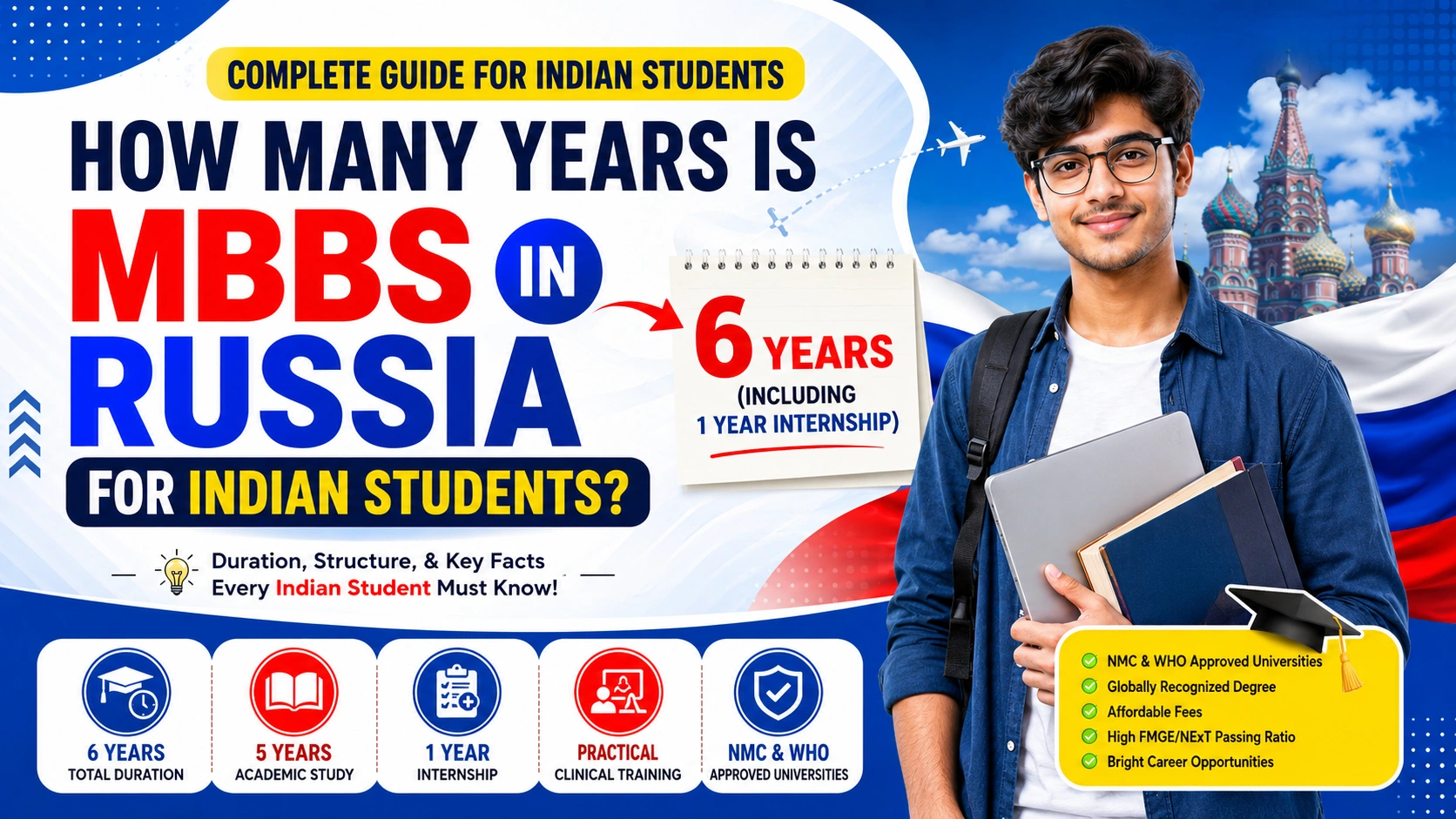
When applying to foreign medical schools, Indian students would like to know “how many years is MBBS in Russia? ” This is because studying medicine abroad involves students making long-term academic, financial, and professional commitments, and students would like to know how much time the commitment will take.
For most Indian students, MBBS in Russia is a 6-year medical programme. The medical programme combines classroom medical education, laboratory training, clinical subjects and teaching, and practical exposure. Students must also be aware that the programme’s structure, the language of instruction, clinical training and the internship, will be contingent on the particular university and the prevailing regulations.
Therefore, students intending to study mbbs in russia must take several factors into account in addition to the duration of the medical programme, including university recognition and ranking, clinical training, eligibility requirements, the rules governing the practice of medicine in India post-graduation, and the course duration.
This guide covers the duration of MBBS in Russia for Indian students along with the eligibility and admission requirements, MBBS Russia fees, pros and cons of studying MBBS in Russia, the leading universities, and career prospects.
How Many Years Is MBBS in Russia?
For Indian students, MBBS in Russia usually takes 6 years to complete. The programme typically consists of preclinical and clinical medical education, practical laboratory work, hospital training, and clinical subjects. Students should ensure that they are well-informed of the curriculum and the training requirements before gaining admission to the university.
|
Course Detail |
Information |
|
Course duration |
Normally 6 years |
|
Degree awarded |
Medical degree, depending on the university program structure |
|
Medium of instruction |
Variable; English, Russian, or both - as per the university |
|
NEET relevance |
Of prime importance for Indian students intending to do medical studies and later medical practice in India, as per the rules |
|
Practical training |
Yes, as per the university curriculum |
|
Admission level |
Undergraduate medical program |
When looking to study mbbs in russia, students should not select a university based on its location or on its low fees alone. They should also compare the curriculum.
Why Is MBBS in Russia Usually 6 Years?
Most Russian universities have a medical education system where the integration of theory and clinical practice is a key focus. The early years of medical training cover the core medical sciences. The later years are directed toward the clinical sciences, the care of patients, diagnostics and learning in a hospital.
A typical medical curriculum includes the following subjects:
- Anatomy
- Histology
- Physiology
- Biochemistry
- Pathology
- Pharmacology
- Microbiology
- Internal Medicine
- General Surgery
- Pediatrics
- Obstetrics and Gynaecology
- Neurology
- Psychiatry
- Clinical Medicine
The order and the period of each of the subjects varies from one university to another. Therefore, all students considering mbbs in russia for indian students must ask for the official curriculum before getting enrolled into the university.
Year-by-Year Arrangement of MBBS in Russia
First Two Years: Pre-Clinical Foundation
The initial two years of the medical program aim to provide a knowledge base in medical sciences and help students further understand the human body.
The subjects that are usually taught may include:
- Anatomy
- Biochemistry
- Histology
- Biology
- Medical Chemistry
- Biophysics
- Physiology
Students also develop practical lab skills during the first two years of the program.
Years Three and Four: Introduction to Clinical Subjects
During the third and fourth years of the program, students are introduced to more advanced medical subjects. This may include a variety of subjects related to internal medicine and surgery as well as the study of pathology, pharmacology and microbiology.
Students planning to get an admission in russia for mbbs should keep in mind that they may need to learn the local language in order to acquire medical and clinical communication skills, as the medical program may not cover that specific area, even though it is taught in English.
Years Five and Six: Clinical Subjects and Hospital Training
The last two years are aimed more at teaching clinical skills and practical medical education. Students learn highly specialized areas of medicine and may receive hospital-based training as per the approved curriculum of the university.
Students should ensure that the other required areas for practical training are verified and that the mbbs degree in russia fulfills the needed requirements in order for students to pursue their future planned careers.
MBBS in Russia Duration Compared With Other Countries
|
Country |
Typical Duration of Medical Course* |
Main Features |
|
Russia |
About 6 years |
Different university, different modules, different clinical training |
|
India |
5.5 years |
Training includes compulsory rotating internship |
|
Kazakhstan |
5 to 6 years |
Depends on the university and programme |
|
Uzbekistan |
6 years |
Depends on the university |
|
Nepal |
5.5 years |
Includes internship |
*Duration of course can change depending on the university. Structure of the program, regulations of the country concerning education matters, can also affect course duration. It is advised that students check with the university and the appropriate authorities for the most accurate and timely information.
When considering MBBS in Russia, you should look beyond the course duration and consider factors such as academic quality, affordability, clinical exposure, recognition, and your career goals.
Eligibility for MBBS in Russia for Indian Students
Though eligibility requirements are not the same for all the medical universities in Russia, the Indian applicants will have to meet the following requirements in most of the cases:
Academic Qualification
It is generally required that students should have completed Class 12 with Phy, Chem and Bio from a recognized board.
Minimum Marks
Required minimum marks are generally different for different universities. Applicants must check the admissions criteria on the official website of the universities.
Age Requirement
Students must fall in the age group as per the requirements for admissions of the respective universities and the Indian regulations.
NEET Qualification
NEET is important for Indian students who want to go back to India to complete their medical registration or licensing. Before completing their foreign medical qualification, students should look at the recent updates published by the National Medical Commission (NMC) and the official NEET information provided by the NTA as this may affect their eligibility.
Students who are interested in MBBS admission in Russia should not trust unreliable sources for eligibility that may be out of date.
Admission Process for MBBS in Russia
The admission process becomes simple if the documents are prepared correctly.
Step 1: Choose a Medical University
To compare and choose the best university, students should look at:
- The course curriculum
- The tuition fees
- Clinical training
- Hostel facilities
- Living expenses and the expense of the city
- Recognition and listing information
- Available student support
A listing on the World Directory of Medical Schools (WDOMS) is important, but does not guarantee the practice of medicine is allowed in that country.
Step 2: Check Eligibility
Make sure that your academic qualifications match what the university requires.
Step 3: Submit Documents
There are common documents that are required when applying that include:
- Class 10 certificate
- Class 12 marksheet
- NEET scorecard, if needed
- A passport
- Passport-sized photographs
- Any required medical documents
- Application form for the university
Step 4: Receive the Admission Letter
The admission or offer letter will be issued by the university, based on their process, after they complete the verification of the documents.
Step 5: Complete Visa Formalities
Students should refer to the Russian government’s instructions to apply for a student visa and submit the required documents.
Step 6: Travel and Start Classes
Completion of the admission and visa requirements allows students to travel to Russia to attend their scheduled classes.
Students wishing to study MBBS in Russia for Indian students must carry copies of their academic and financial documents as well as admission and travel documents.
MBBS in Russia Fees for Indian Students
The prices for medical universities in Russia are not fixed and fluctuate based on a number of factors including the specific medical school, the specific city in Russia, the exchange rate, accommodations, and your personal preferences.
Estimated Cost Structure
|
Expense Category |
Estimated Range |
Notes |
|
Tuition fee |
Varies significantly by university |
Confirm directly from the official university website |
|
Hostel |
Varies by university and room type |
May be charged separately |
|
Food and personal expenses |
Depends on city and lifestyle |
Major cities may be more expensive |
|
Medical insurance |
Variable |
May be compulsory |
|
Visa and travel |
Variable |
Depends on travel period and official fees |
For the families of prospective students, it is important to consider the potential impact of the fluctuating currency over the duration of the program, including the estimated total cost of six years of study as opposed to just the first year.
Reasons for Pursuing an MBBS Degree in Russia
1. Integrated 6-Year Medical Degree
This program moves students through the basic to advanced clinical sciences in a single 6-Year integrated structure.
2. Globalized Educational System
Russian universities attract students from a variety of countries, creating a diverse classroom setting.
3. Mode of Instruction in English
Some universities run medical programs for international students in English. Students must confirm the language for the clinical teaching and communication.
4. Theoretical and Clinical Medical Education
Medical Education programs involve preparation for clinical practice and laboratory work.
5. Plenty of Options
With a large higher education system, students can compare a variety of universities, cities, and fee structures.
Greater information on global health and health systems can be found on the World Health Organization (WHO) website, however, students should check the medical education and career destination licensing requirements on their own.
Challenges and Disadvantages of Studying MBBS in Russia
Language Challenges
Students in English medium programs will still need to learn some Russian, as it will be vital for communication with patients throughout the clinical training.
Weather Changes
Students from India will especially find the Russian winter to be harsh, as it is much colder than India.
Medical Degree from Russia and Practicing in India
Studying medicine in a foreign country will not give the student the opportunity to practice in India, as there are rules and regulations that are set and need to be followed.
Differences in University Quality
University quality differs across infrastructure, clinical training, faculty, support services, and even services for international students. Hence, students must do their own research.
Exchange Rate Changes
Variances in ruble exchange value within the rupee may alter the cost of completing your education.
Best Medical Universities in Russia for Indian Students
Russia has a wealth of developed medical universities. Students should analyze the official course details instead of just seeing the rankings or looking at the adverts.
Here are some of the universities that international medical university seekers check out:
|
University |
Approx. Annual Tuition (₹) |
Hostel Fees (₹/year) |
Medium |
FMGE Passing rate |
|---|---|---|---|---|
|
₹3.4–4.2 lakh |
₹40,000 |
English |
20% - 25% |
|
|
₹3.8–4.8 lakh |
₹45,000 |
English |
25% - 30% |
|
|
₹3.0–4.0 lakh |
₹35,000 |
English |
30% - 35% |
|
|
₹2.8–3.8 lakh |
₹40,000 |
English |
25% - 30% |
|
|
₹4.0–5.0 lakh |
₹50,000 |
English |
25% - 30% |
|
|
₹5.0–6.0 lakh |
₹55,000 |
English |
20% - 25% |
|
|
₹4.2–5.3 lakh |
₹45,000 |
English |
10% - 15% |
University respondents may check out the official course details on the university sites of Sechenov University and Kazan Federal University.
Check the latest course details, the length of the course, and the language of instruction. Ensure there are clinical practice opportunities and that the university is recognized, and check what is required by the country in which you plan to practice.
Work Opportunities After Completing MBBS in Russia
Graduates of this six-year program have many options, depending on the degree held, the country where they are eligible to practice, and that country’s requirements.
Practicing in India
Graduates of Russian medical universities enforced by Indian regulations must keep themselves updated on the new rules and public notifications on the official site of the National Medical Commission (NMC), NMC's official website.
Postgraduate Medical Education
Graduates have the option to pursue postgraduate education depending on placement examinations, eligibility conditions, and regulations of particular countries.
Healthcare and Research
Depending on graduate qualifications and relevant licensing, the following options may be available to graduates:
- Medical Research
- Clinical Research
- Public Health
- Health Care Management
- Medical Teaching
- Industry (Pharmaceutical and Health Care)
Choosing the correct career path depends on an individual's interests, academic results, licenses, and future regulations.
How to Choose the Right University for MBBS in Russia
To help you in your selection process, make sure to check the universities for the following:
- Authenticity of the stated course duration.
- Availability of the complete six-year course.
- Stated medium of instruction.
- Local language (when needed) for clinical training.
- Review of costs (tuition, hostel, and living).
- Affiliated Hospitals (practical exposure).
- University recognition and listing.
- Review of the latest Indian policies for foreign medical graduates.
- Where possible, converse with students currently studying there.
- Do not choose a university just because of low fee structure.
Because medical education is a long-term investment, a decision based on thorough research is imperative.
FAQs
How many years is MBBS in Russia for Indian students?
Russian Universities have generally designed MBBS as a 6-year medical programme. It is suggested that the students confirm the required structure and the practical training with the respective universities.
Is MBBS in Russia shorter than MBBS in India?
On average, a typical MBBS program in India lasts for 5.5 years, whereas a typical medical program in Russia lasts for 6 years. This is largely due to a compulsory rotating internship in India. Nonetheless, students should examine the full program and licensing structures in addition to the duration.
Is NEET required for MBBS in Russia?
As of now, Indian students must check the latest NEET and NMC updates especially if they are interested in practicing in India after studying abroad.
Can Indian students study MBBS in Russia in English?
Many Russian universities have medical programs in English for international students. Students must check the actual language of instruction and the local language requirement for clinical interactions.
Is an MBBS degree from Russia valid in India?
Whether or not an Indian student can practice medicine in India after studying in Russia will depend on the local rules and regulations governing the practice of medicine. Students should check the latest updates through the NMC.
What is the total cost of MBBS in Russia?
The cost of medical school in Russia varies greatly depending on the school, city, housing, food, transportation, the exchange rate, and personal expenses. Students should plan to budget the full 6 years before applying.
Conclusion
For Indian students, MBBS in Russia generally takes 6 years to complete. Students spend Russian medical school gaining an understanding of the medical sciences and the skills required to practice medicine. However, duration should not be the only concern in choosing a medical program.
Before choosing a university, students should check the official university curriculum, medium of instruction, clinical exposure, total six-year cost, and the recent guidelines for foreign medical graduates.
An international medical degree does not guarantee success in a medical career. One has to choose a good medical college, be academically excellent, have good clinical skills, and be aware of the future medical licensing systems. With good planning and realistic expectations, studying medicine in Russia is one of the many options for Indian medical aspirants.