
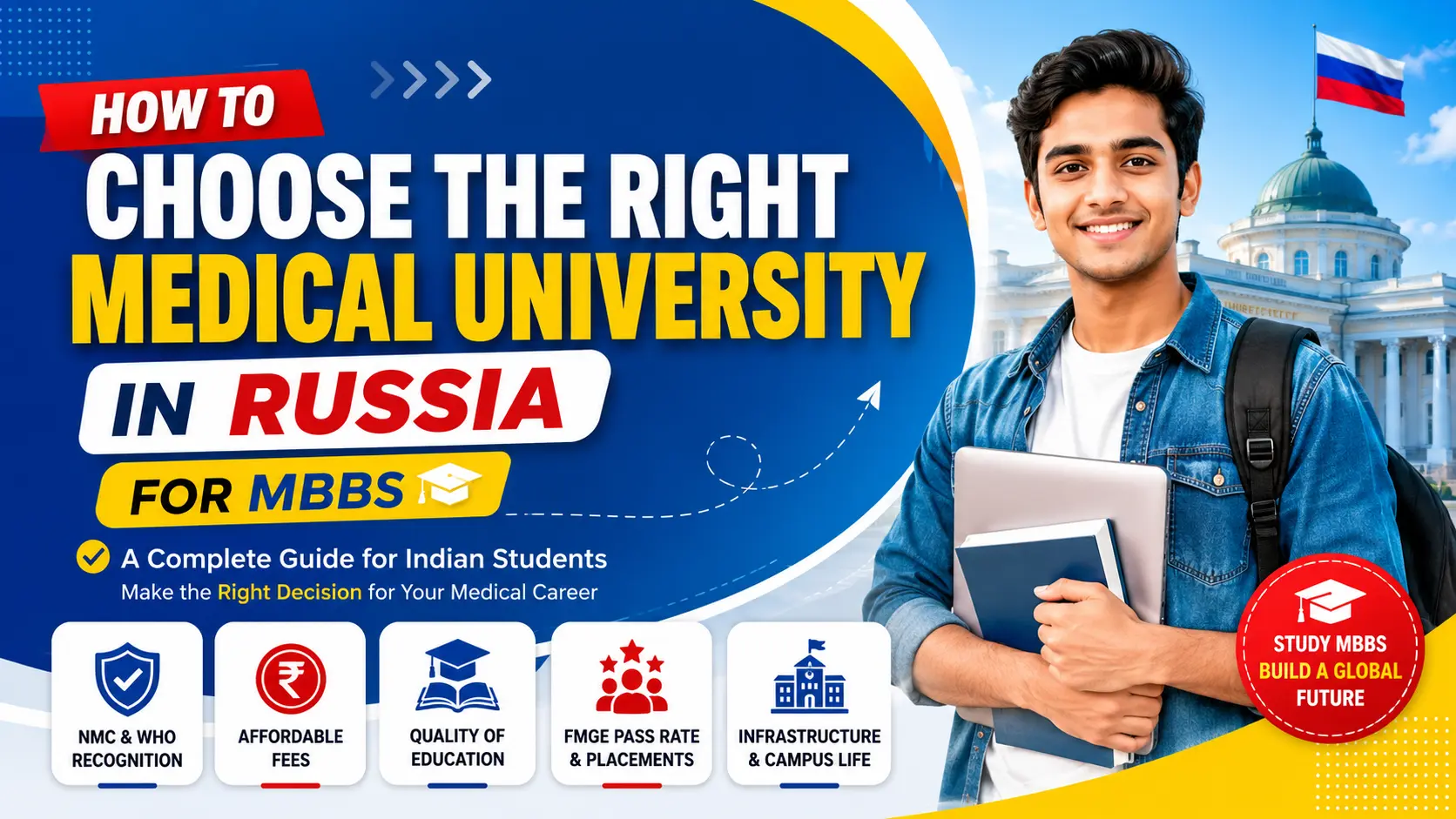
After 12th grade, selecting a medical university is one of the most significant decisions an Indian student has to make. When considering MBBS in Russia, students have to look into a number of options. These include tuition cost, overall rankings, availability of English medium, hostel facilities, and global recognition. The best option is not always the cheapest.
It is best to evaluate a medical university from the viewpoint of an Indian student. This includes university compliance, course content and structure, clinical availability, language of instruction, total cost of studying, student services, and licensing or registration pathways.
Students should always conduct independent research to verify the claims a university makes regarding their medical programs and always use official medical school verification sources to do so. The World Directory of Medical Schools (WDOMS) is one such source. Moreover, it is important for Indian students to look into the current National Medical Commission (NMC) guidelines. WDOMS explains that their aim is to provide accurate and up to date information on medical schools across the globe.
How to Select the Right Medical University in Russia
To select the right medical university in Russia, Indian students should verify NMC guidelines, WDOMS listing, duration of course, medium of instruction, availability of clinical training, tuition fees, hostel and living expenses, admission criteria, and university rank and international student support services. Moreover, all regulations should be verified prior to the student's admission. Indian students should also ensure that the total cost of the six-year program is actually taken into consideration as opposed to the tuition fees alone.
Why University Matters for MBBS in Russia
In Russia, there are multiple universities that offer General Medicine degrees, and all of them will differ in location, tuition cost, and their environment and services for international students.
For example, at Sechenov University, their General Medicine degree is a six-year full-time Specialist degree, and they offer it in both Russian and English. As for cost, their tuition is listed as ₽1.3 million for the year for 2026/27.
At Kazan Federal University, their English-taught General Medicine degree is also a six-year full-time Specialist degree, and their tuition for the same academic years is ₽653,400.
This is a small example of why students should look at individual universities instead of just using one broad estimate for “Russia MBBS fees”.
What Should You Look at When Choosing a University
1. Make Sure They Are Actually a University and Not a Diploma Mill
The most important thing to look at is if the university is listed and approved in WDOMS. For Indian Students, it will be important to look at the new NMC regulations pertaining to foreign medical graduates and read the new NMC updates as well as the Foreign Medical Graduate Licentiate Regulations, 2021 and related FAQs.
Pay attention to the medical school and what programs are being offered instead of relying on statements like “WHO approved” or “NMC approved”.
2. Make Sure the Language Medium Will Not be an Issue
Although studying in English helps for the first few years, Russian will likely be needed for communication during the clinical years.
For example, Pirogov Russian National Research Medical University offers General Medicine as a six-year program in Russian/English. However, the International admissions page of the university explains separate admission requirements for English medium study.
Similarly, Sechenov University provides General Medicine programs in both English and Russian and offers preparatory Russian-language programs for international students.
To that end, please ask:
- Is the whole program in English?
- When would I start Russian clinical training?
- Is medical Russian offered?
- Are lectures and exams conducted in the advertised language?
3. Compare Tuition and Total Cost
Tuition is only part of the budget.
Consider total estimated costs:
- Tuition
- Hostel
- Food
- Health insurance
- Visa and registration
- Flights
- Books and supplies
- Local transit
- Personal
- Currency-exchange fees
MBBS In Russia: Example University Fee Comparison
|
University |
Program |
Duration |
Tuition Reference |
|
Sechenov University |
General Medicine |
6 years |
₽1,300,000/year for 2026/27 |
|
Kazan Federal University |
General Medicine, English |
6 years |
₽653,400/year for 2026/27 |
|
Pirogov University |
General Medicine |
6 years |
See official fee schedule |
|
VolgSMU |
General Medicine |
Varies by program |
See official site for admission info |
The above are fee estimates published by each university. These are subject to change.
For those considering study mbbs in russia, total six-year costs are a key factor beyond first-year fee estimates.
Eligibility for Indian Students
Eligibility depends on the university and Indian regulations. In general, upper secondary school with the relevant science subjects, especially Biology and Chemistry, is required for admission to undergraduate medicine programs.
Indian students should also check the latest on NEET. The official NEET UG site states that NEET is India’s entrance exam to undergraduate programs in medicine, and the site has 2026 exam and result information.
Before applying, check if you meet the following requirements:
- Pass class 12 or equivalent.
- Completed prescribed Science courses.
- Met the minimum age requirement.
- Satisfy NEET requirement for Indian applicants.
- Hold a valid Passport and meet other document requirements.
- Meet other requirements for entrance tests, if any.
Steps Involved in Getting Admission to Russia for MBBS:
Step 1: Select Medical Colleges
Choose 3-5 Medical Colleges based on your own selection criteria (# of Indians, Tuition, Medium of Instruction, and College Location).
Step 2: Check the Recognition of the Medical College
Step 3: Apply to the Medical College
Make sure to include the following when you apply:
- Passport.
- 10th and 12th Grade Certificates.
- Mark Sheets.
- NEET qualification papers, if any.
- Other Medical Papers.
- Photographs.
Additional requirements to apply may be included in the medical college website.
Step 4: Meet the Admission Requirements
Medical Colleges in Russia may conduct their own entrance tests. For example, Sechenov University requires at least the entrance test score.
Step 5: Receive Admission and Visa
Once students are accepted, they normally complete the university contract and payment process, and then proceed to complete the Visa process.
Best Medical Colleges in Russia
There are many good Medical Colleges in Russia to pursue MBBS In Russia, and they have fully developed Medical Systems to accommodate International Students.
|
University |
Approx. Annual Tuition (₹) |
Hostel Fees (₹/year) |
Medium |
FMGE Passing rate |
|
₹3.4–4.2 lakh |
₹40,000 |
English |
20% - 25% |
|
|
₹3.8–4.8 lakh |
₹45,000 |
English |
25% - 30% |
|
|
₹3.0–4.0 lakh |
₹35,000 |
English |
30% - 35% |
|
|
₹2.8–3.8 lakh |
₹40,000 |
English |
25% - 30% |
|
|
₹4.0–5.0 lakh |
₹50,000 |
English |
25% - 30% |
|
|
₹5.0–6.0 lakh |
₹55,000 |
English |
20% - 25% |
|
|
₹4.2–5.3 lakh |
₹45,000 |
English |
10% - 15% |
Sechenov has 6,500 international students, with VolgSMU claiming over 3,000 foreign students from 61 countries for the 2024-25 academic year. Academic reputation is not the only factor, but the kind of support available to international students.
When it comes to MBBS in Russia for Indian students, the climate, food, and city also factor in, along with the distance from the main airport.
Benefits of Studying Medicine in Russia
Cost of Programs
Compared to private medical degrees in other countries, tuition at some Russian medical schools is more affordable.
Programs in English
Some Russian universities provide English medium General Medicine programs. However, the language instruction should be verified.
Developed Systems of Medical Education
Russia has a developed system of higher education and medical training that provides a continuum of undergraduate and postgraduate medical education.
Established International Student Communities
Large universities can offer a campus environment rich in multiple nationalities.
Students can refer to the WHO as a global health authority for international health information and terminology.
Disadvantages
Studying abroad comes with other challenges.
- Language ambiguity: Russian is important and becomes restrictive for clinical interaction.
- Weather: Winters in parts of India can be difficult for students from warmer regions of the country.
- Distance: Traveling back to the home country can prove to be time consuming and expensive.
- Cost: The ruble-to-rupee rate can affect the overall budget.
- Licensing: Graduation does not mean Indian students can work in India. Further, Indian students must complete the Indian regulations and Indian licensing.
The NMC’s published FMGL framework deals with Indian Medical Council NZ and Indian Medical Council registrations. For more details of the official published framework, prospective students must check the official website.
Career Scope After MBBS In Russia
There are multiple pathways and options for graduates upon completion of basic medical degree, depending on the country of practice.
Such pathways and options may include:
- Returning to India and fulfilling the Indian licensing.
- Pursuing Postgraduate training.
- Continuing medical education.
- Research and Academia.
- Medical practice within the limits of the law.
The medical school can provide a variety of pathways through clinical training, research and their postgraduate options. For example, Sechenov states General Medicine Graduates may go on to complete Residency, Masters and PhD studies.
How to Avoid Common Mistakes in Admission
Avoid choosing a university because an agent says it is “cheap” or “best.” Instead you should:
- Check the university yourself.
- Look at the official syllabus.
- Confirm the language of instruction.
- Ask for the complete fee structure.
- Check Hostel information.
- Know the arrangements for clinical training.
- Current NMC requirements.
- Retain copies of each document for admission.
Fees should only be paid to verified channels of the University.
FAQs
Is MBBS in Russia a good option for Indian students?
Yes, it is a good option if students choose a university with a compliance record, know the complete costs, and are ready for the Russian language and the additional clinical training.
Is it mandatory to qualify for NEET for Indian students?
They must adhere to the NEET requirement and the Indian regulations for overseas medical education. Please continue to check for updates in the regulations published by NTA and NMC.
What is the duration of MBBS in Russia?
Most of the programs in Russia for General Medicine are of six years duration and are Specialist programs. Universities like Sechenov and Kazan Federal University have six-year programs in General Medicine.
Is MBBS in Russia available in English medium?
Yes, MBBS in Russia is offered in English, but the medium of instruction may vary across different universities and is subject to change. Therefore, students must check the entire course structure prior to seeking admission.
What else do I check apart from fees?
You must check the recognition, curriculum, and clinical exposure, as well as the language, living expenses, and the university’s support in the medical registration process, and the admission regulations.
Conclusion
The right university choice is more important than the lowest fees. Combining affordability with regulatory, clinical, and linguistic factors also impacts your decision's quality.
Shortlist universities, compare the official program documents, and check the current NMC regulations, review the full cost of medical education, and then make the payment.
First verify, then compare, and finally pay. This is the best strategy. Students who choose their medical school in Russia carefully will find the process more comfortable and will get more from their education