
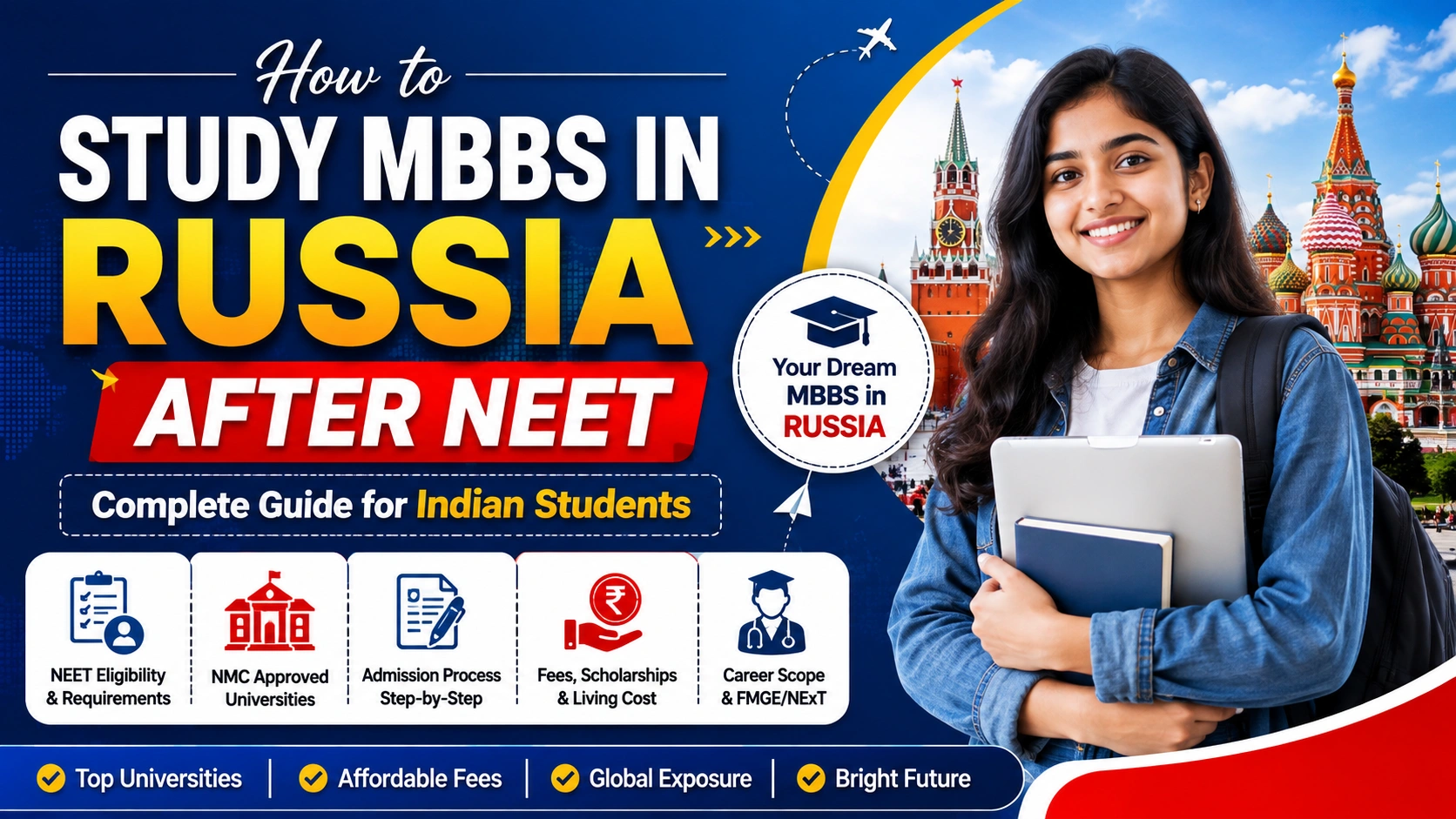
All aspiring Indian doctors must take the NEET. Nevertheless, the limited availability of seats in government medical colleges and the prohibitive cost of private medical colleges create an impetus to study medicine in another country. Of all the available countries to study medicine, MBBS in Russia undoubtedly offers the right combination of established medical universities, reasonable fees, an influx of international students, and an enduring history of support for medical education.
Indian students who have taken NEET have the choice of many medical programs of varying costs, preferred universities, durations, and languages of instruction, to name a few. Students must do thorough research on the overall picture of the university (as opposed to its low fee or impersonal advertising), including its course, duration, clinical training, requirements, eligibility, and the most recent of the laws of foreign medical graduates applicable.
This guide provides an assessment of the costs, the advantages and disadvantages, the universities, and the career pathways for students who have taken NEET and wish to study MBBS in Russia
How Can Indian Students Study MBBS in Russia After NEET?
Indian students desiring to study MBBS in Russia after NEET must first take and pass NEET, complete class 12 with the requisite subjects of Physics, Chemistry, and Biology and English, as well as the other academic requirements of the university to which they are applying.
The general steps for the process are as follows:
- Take and pass NEET
- Choose a medical university in Russia
- Ensure the university is recognized and check the eligibility of the course
- Submit academic and passport related documentation
- Receive letter of admission or invitation.
- Complete visa and travel requirements.
- Travel to Russia and register at the University.
Students should check the National Medical Commission (NMC) latest updates and check the listing of the respective University in the World Directory of Medical Schools (WDOMS) before selecting a University.
Why Consider MBBS In Russia After NEET?
For many years, Russia has been a popular place for global medical education. Students can pursue their MBBS in Russia, from large cities to small urban areas.
For Indian students, one of the biggest draws is the lower price for medical degrees abroad compared to Indian medical colleges. Many Russian schools have courses for international students, but students need to be clear about the language of instruction for both the classroom and the clinical training.
Students need to consider the full education and all aspects when looking at MBBS in Russia for Indian students, not just tuition costs.
Main Factors for Choosing Russia
- A well-established system for medical education.
- Many schools have courses for international students.
- Options for many schools in many cities.
- Possibly lower total costs than Indian medical colleges.
- International academic environment.
- Medical curriculum that includes clinical training.
- Many international students.
For more general public health and international health topics students can visit the World Health Organization (WHO).
MBBS In Russia Eligibility After NEET
When applying for MBBS in Russia, students should check the Indian regulations and the specific requirements for each university.
Basic Eligibility Requirements
Generally, these are the requirements for applicants:
|
Eligibility Factor |
General Requirement |
|
Academic Qualification |
Class 12 or equivalent |
|
Required Subjects |
Physics, Chemistry, Biology, English |
|
NEET |
Required for Indian students planning to follow the respective route for medical practice in India |
|
Minimum Marks |
As per University and respective regulations |
|
Age |
Students should be within the prescribed age limit |
|
Documents |
Passport along with all academic documents and requisite photographs |
Ensure to visit the NEET portal of the National Testing Agency for the revision before applying.
Admission Process
The general process for MBBS in Russia starts when students get their NEET results and after which they choose their university.
Step 1: Qualify NEET
For the Indian students wanting to follow the foreign medical pathway to later on establish a medical practice in India, qualifying NEET is a significant step. Students should retain their NEET scorecards for the following admission process.
Step 2: Research Universities
The next step is to choose a university for its:
- Academic Infra Structure
- Duration of course
- Fee structure
- Availability of hostel
- City and weather
- Language of instruction
- Clinical exposure
- Support for international students
- Recognition and eligibility considerations
Prospective students considering MBBS in Russia should contact universities for accurate information and rely less on official brochures and promotional materials.
Step 3: Submission of Documents
Although requirements differ by university, the documents below are the most commonly requested:
- Class 10 mark sheet and certificate.
- Class 12 mark sheet and certificate.
- NEET scorecard.
- Valid passport.
- Passport-size photographs.
- Medical documents (if any) required by the university.
- Application form (if any) duly completed.
Step 4: Admission Invitation
Documents related to admission will be sent to students (if any) as per the process defined by the university, after the university completes its review of the application and considers the student eligible.
Step 5: Visa Application and Process
Students are required to apply for and complete the process for the specific visa as mandated by the respective authorities.
Step 6: Travel and Registration
Students after completing visa formalities are required to travel to Russia and complete the registration formalities at the university and the accommodation booking and then start the program of study as per the planned course.
This is the most common procedure in Russia for MBBS, though each university may prescribe its specific processes.
MBBS In Russia Fees for Indian Students
The fees for MBBS in Russia depend on the university where you will study and the city where you will stay along with the exchange rate, accommodation, lifestyle, travel, insurance and personal expenses.
|
Expense Category |
Estimated Consideration |
|
Tuition Fees |
Varies depending on University |
|
Hostel |
University accommodation choice |
|
Food |
Dependent on city & lifestyle choice |
|
Medical Insurance |
Additional annual expense |
|
Visa and Documentation |
Dependent on charge |
|
Travel |
Dependent on departure city |
|
Personal Expenses |
Dependent on lifestyle |
Prospective students looking at mbbs admission in russia should consider all the explicit costs before making any financial commitments.
Important Financial Tip
Never judge the affordability of the first year of a university by only looking at the first-year tuition fee. Determine the total cost of the whole course including logistics and personal estimates on accommodation, food, insurance, travel, and currency fluctuation.
Top Medical Universities in Russia
There are many medical schools in Russia. Students are always encouraged to check the current developments, changes in the programs, and their eligibility on their own as they do research.
These are some medical schools that many students search.
|
University |
Approx. Annual Tuition (₹) |
Hostel Fees (₹/year) |
Medium |
FMGE Passing rate |
|---|---|---|---|---|
|
₹3.4–4.2 lakh |
₹40,000 |
English |
20% - 25% |
|
|
₹3.8–4.8 lakh |
₹45,000 |
English |
25% - 30% |
|
|
₹3.0–4.0 lakh |
₹35,000 |
English |
30% - 35% |
|
|
₹2.8–3.8 lakh |
₹40,000 |
English |
25% - 30% |
|
|
₹4.0–5.0 lakh |
₹50,000 |
English |
25% - 30% |
|
|
₹5.0–6.0 lakh |
₹55,000 |
English |
20% - 25% |
|
|
₹4.2–5.3 lakh |
₹45,000 |
English |
10% - 15% |
It is always advisable to check the updates and offers of the medical schools on the official medical school websites, and on their postings in WDOMS and their official admission posts.
Advantages of Pursuing MBBS in Russia
1. Abundant University Choices
Applicants have the flexibility to choose from a wide array of universities in various regions. Applicants are able to evaluate the different choices and compare university infrastructures and living expenses.
2. Global Education
As many universities have students from all over the world, it is an excellent opportunity for students for globalization.
3. Economical Education
In comparison with several private medical institutes, studying MBBS in Russia for Indian students can be an economical choice, depending on the university and city.
4. Medical Education Framework
Medical education consists of theory, lab work, and clinical education. Verify how clinics are provided and if interaction with patients is dependent on the knowledge of the language.
5. Exposure to New Cultures
Being in a new country is an opportunity for students to learn to be self-sufficient, be flexible, and learn to communicate in different ways.
Drawbacks to Weigh
While studying abroad has its benefits, weighing drawbacks is important.
Language
Even if some or all classes are provided in English, students may need to acquire the local language for services in everyday life and clinical education.
Weather
Russian weather has a tendency to be much colder than most parts of India. Students may need time to adjust to the winter.
Distance
Being in a new country means students will be away from their families for long periods of time.
Medical License
Studying MBBS abroad means students must fulfill other requirements to be legal practitioners in India.
Students must check for updates on the official site of NMC from time to time.
Career Scope After Completing MBBS In Russia
The career scope for students after obtaining a medical degree from abroad depends upon the country the graduate intends to work in and the respective country’s licensure needs.
Returning to India
The graduates intending to work in India should comply with the current norms set by the respective Indian authorities.
Postgraduate Medical Education
Students are free to pursue postgraduation based on their eligibility, entrance exams, and country licensure needs, along with applicable rules.
International Opportunities
While some graduates may consider international opportunities, each country has its own licensure needs, registration requirements, language needs, and immigration rules.
Thus, MBBS In Russia should be viewed as the first step of a long professional journey, as graduation does not guarantee the privilege to practice medicine in any country.
How to Choose the Best Fit Russian Medical University
Before you choose where to apply, check the universities against the following factors:
|
Selection Factor |
Why It Matters |
|
Official Recognition and Listing |
Helps students check university’s information |
|
Course Structure |
Helps to see the division between academic and clinical training |
|
Language of Instruction |
Determines the teaching and the learning of the students |
|
Total Course Cost |
Avoids unplanned costs and financial burden after enrollment |
|
Hostel Facilities |
Concerned with personal safety and comfort on a daily basis |
|
Location |
Affects the environment you live in and expenses |
|
Clinical Training |
Necessary for a rounded medical education |
|
Student Support |
Important to all, but especially beneficial to the international student |
Most importantly, one should not choose the cheapest option, this may not be the best option. Each student must choose the university based on their own financial, educational and career planning.
FAQs About MBBS In Russia After NEET
Is NEET required to study MBBS In Russia?
NEET is mandatory for the Indian students wanting to obtain a medical degree abroad and to be eligible to undertake the medical licensure process in India. Students are encouraged to research and review the most up-to-date official notification for the accurate information and the latest amendments.
How long is the MBBS course in Russia?
This varies with different universities. Students must check for each university individually.
Is MBBS In Russia affordable for Indian students?
Overall costs for MBBS vary from university to university. Prices also depend on the city, the type of accommodation and lifestyle. Some Russian universities even offer a lower cost option when compared to private medical colleges in India. However, students are advised to calculate the overall cost and not just tuition fees.
Are Russian medical universities listed in WDOMS?
Yes, there are medical universities in Russia listed in WDOMS. However, not all Russian medical schools are listed in WDOMS. Students should look up the official WDOMS directory to find out the specific listings.
Can Indian students practice in India after MBBS In Russia?
Yes, they can, but graduates must comply with Indian laws and the regulations in force when they seek to practice. This most of the time includes passing prescribed examinations and being registered. Students should look for NMC official notices.
What documents are required for admission?
Documents will vary from one university to another, however, passport, photographs, academic documents, NEET scorecard and any other documents mentioned on the university’s website and Visa’s website will almost always be required.
Conclusion
After NEET, Indian students wanting to pursue an international medical degree find MBBS In Russia an attractive choice. This, however, can only be the case when students make a choice based on well-informed research. The admission letter is not the end of the process. Students are required to check for medical universities in Russia extensively, verify all official sources, check for every cost, get to know the customs and culture, be aware of the most recent foreign medical graduate policies and most recent regulations, translate and prepare for differences in language and much more.
An ideal medical education sets the stage for a thriving medical career. It creates an understanding of both the journey to admission and the training needed to become a licensed medical professional with the ability to shape your future medical career. Prior to the final decision, confirm the facts about the university and avoid long-term commitments based on marketing or a low cost of attendance. Look to official sources and the latest regulations.