
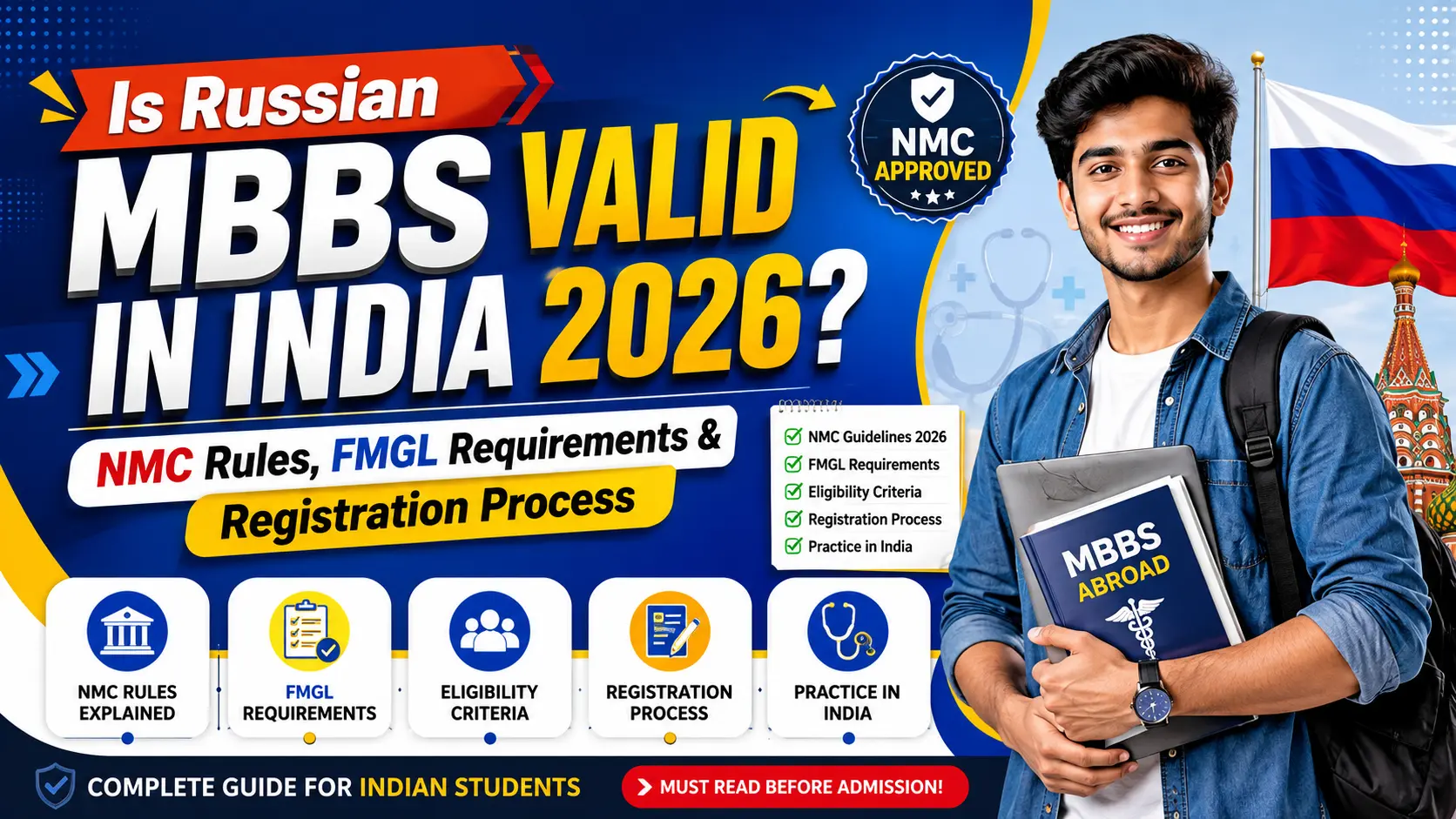
For Indian students planning to pursue MBBS in Russia, one of the most important questions is whether the degree will allow them to practise medicine in India after graduation.
The answer is yes, a Russian medical graduate can become eligible to practise in India, but simply holding a Russian medical degree is not enough. The graduate and the medical programme must satisfy the applicable requirements of the National Medical Commission (NMC), including the rules governing foreign medical education, licensing examinations, internship and registration.
In 2026, students should pay particular attention to the Foreign Medical Graduate Licentiate (FMGL) Regulations, 2021, relevant NMC FAQs and subsequent regulatory updates. Course duration, medium of instruction, curriculum, clinical training, internship and registration in the country of study can all affect eligibility.
Therefore, anyone planning to study MBBS in Russia should verify the exact university and programme before paying admission or tuition fees.
Is Russian MBBS Valid in India in 2026?
Yes, an MBBS or equivalent foreign medical qualification from Russia can lead to medical registration in India if the programme and graduate satisfy the applicable NMC requirements. These requirements include prescribed standards relating to course duration, English as the medium of instruction, theoretical and practical training, clinical exposure, internship and medical registration in the country of study.
Graduates must also complete the applicable Indian licensing pathway, which may include FMGE, supervised internship in India and registration with the relevant medical authority.
Importantly, being listed in WDOMS does not by itself guarantee NMC recognition, eligibility or registration in India.
What Makes an MBBS Degree from Russia Valid in India?
The validity of MBBS in Russia for an Indian student depends more on regulatory compliance than simply the country where the degree was obtained.
The applicable FMGL framework establishes requirements for foreign medical education. Students should carefully examine:
- University and programme status
- Duration of the medical course
- Medium of instruction
- Subjects and syllabus
- Practical and clinical training
- Internship structure
- Medical registration/licensing in Russia
- University documentation
- Current NMC requirements
The World Directory of Medical Schools (WDOMS) can be useful when researching a medical school. However, WDOMS listing should not be interpreted as recognition, accreditation or approval by WDOMS or the NMC.
This is why students considering MBBS in Russia for Indian students should verify the specific programme rather than relying on generic claims such as "NMC-approved university."
NMC FMGL Requirements for Medical Graduates from Russia
1. Minimum Course Duration
The FMGL Regulations, 2021 prescribe a minimum foreign medical course duration of 54 months. Students should be particularly cautious about shortened, accelerated, online or unconventional programmes that may not satisfy the applicable requirements. A standard six-year General Medicine programme is common among Russian medical universities, but students should still verify the exact programme they intend to join.
2. English as the Medium of Instruction
The applicable NMC framework requires the foreign medical course to be conducted in English.
This is especially important in Russia because universities may offer medical programmes in Russian as well as English. Students should obtain written confirmation of the actual language of instruction for their programme.
3. Clinical Training
Clinical education is a critical part of medical training. Students should verify where clinical teaching takes place, which hospitals are affiliated with the programme, how much practical exposure students receive and whether the clinical component satisfies the applicable NMC requirements. A university's general reputation does not automatically establish that a particular programme meets Indian registration requirements.
4. Internship
The applicable FMGL framework includes requirements concerning the foreign medical internship. For relevant students, the foreign internship must meet the prescribed conditions, including the required duration and institutional requirements.
After returning to India, eligible foreign medical graduates may also need to complete the applicable supervised internship/CRMI requirement before permanent registration.
Because regulations and implementation can change, students should verify the requirements applicable to their admission and graduation year.
FMGE and the Registration Process in India
For foreign medical graduates covered by the existing screening pathway, FMGE remains an important step toward medical registration in India.
The examination is conducted by the National Board of Examinations in Medical Sciences (NBEMS).
The broad pathway can be understood as follows:
Step 1: Complete a Compliant Medical Programme
Complete the prescribed medical course while maintaining academic, clinical and internship records.
Step 2: Obtain Your Medical Degree and Documents
Keep your original degree, transcripts, internship certificate, passport, identity documents and other records safely. These documents may be required during examination and registration procedures.
Step 3: Apply for FMGE When Applicable
Eligible foreign medical graduates covered by the FMGE pathway can apply through the applicable NBEMS process. Students should always refer to the latest examination bulletin because examination procedures and regulatory requirements can change.
Step 4: Complete the Required Internship in India
After satisfying the applicable examination requirements, foreign medical graduates may have to complete the prescribed supervised internship/CRMI in India. The internship is an important part of the route toward permanent registration.
Step 5: Apply for Medical Registration
After completing the applicable examination and internship requirements, the graduate can proceed with registration through the relevant medical regulatory authority.
Therefore, completing MBBS admission in Russia is only the beginning of the overall pathway for an Indian student who ultimately wants to practise in India.
MBBS Eligibility in Russia for Indian Students
Indian students need to satisfy both the admission requirements of the Russian university and the applicable Indian requirements for studying medicine abroad.
Generally, students should have:
- Completed Class 12 or equivalent education
- Studied Physics, Chemistry and Biology/Biotechnology
- Met applicable academic requirements
- Qualified NEET where required
- Obtained a valid passport
- Submitted the documents required by the university
Indian citizens and eligible OCI candidates should check the latest NEET requirements applicable to foreign medical education.
Students can verify current examination information through the official NEET portal.
Admission Process for MBBS in Russia
The typical admission process involves the following steps:
- Check eligibility: Confirm academic, NEET and passport requirements.
- Select a university: Compare programme structure, fees, location, language and clinical exposure.
- Verify NMC requirements: Check the exact course duration, curriculum, clinical training and internship.
- Prepare documents: Arrange academic certificates, passport, photographs, NEET documents and other required records.
- Submit the application: Follow the university's international admission procedure.
- Receive admission documents: Obtain the relevant offer, admission or invitation documents.
- Complete visa formalities: Apply for the student visa and prepare for travel.
- Begin the programme: Complete the medical course while maintaining proper academic and clinical documentation.
Before making any substantial payment, students should confirm all programme details directly with the university.
Fees for MBBS in Russia 2026
The cost of studying medicine in Russia varies considerably according to the university and city. Moscow-based universities can be significantly more expensive than universities in some regional cities.
|
Expense |
Indicative Planning Range |
|
Annual tuition |
₹3 lakh–₹8 lakh+ |
|
Annual hostel |
₹30,000–₹1.5 lakh+ |
|
Food |
₹10,000–₹25,000/month |
|
Medical insurance |
Variable |
|
Travel |
Variable |
|
Visa/documentation |
Variable |
|
Total six-year cost |
Depends on university and lifestyle |
These figures are indicative planning estimates, not fixed university fees. Students should obtain the latest official fee schedule before making a payment.
For example, Sechenov University has published a substantially higher tuition figure for its General Medicine programme for the 2026/27 academic year. This illustrates why students should compare university-specific fees rather than relying on a generic Russia MBBS fee estimate.
For students researching the MBBS degree in Russia, the overall budget should include tuition, hostel, food, insurance, travel, visa expenses and currency fluctuations.
Best Universities to Study Medicine in Russia
There is no single Russian university that is automatically the best choice for every Indian student.
Instead, compare universities according to their programme structure, clinical exposure, language, cost and regulatory suitability.
|
University |
Approx. Annual Tuition (₹) |
Hostel Fees (₹/year) |
Medium |
FMGE Passing rate |
|
₹3.4–4.2 lakh |
₹40,000 |
English |
20% - 25% |
|
|
₹3.8–4.8 lakh |
₹45,000 |
English |
25% - 30% |
|
|
₹3.0–4.0 lakh |
₹35,000 |
English |
30% - 35% |
|
|
₹2.8–3.8 lakh |
₹40,000 |
English |
25% - 30% |
|
|
₹4.0–5.0 lakh |
₹50,000 |
English |
25% - 30% |
|
|
₹5.0–6.0 lakh |
₹55,000 |
English |
20% - 25% |
|
|
₹4.2–5.3 lakh |
₹45,000 |
English |
10% - 15% |
Sechenov University, for example, offers a six-year General Medicine programme with an English-language option for international students.
However, students should verify the current programme directly with the university rather than relying on lists claiming that particular universities are simply "NMC approved."
Benefits of Studying MBBS in Russia
Established Medical Education Environment
Russia has numerous long-established medical universities offering medical education to domestic and international students.
International Exposure
International campuses can provide students with exposure to classmates and healthcare environments from different cultural backgrounds.
Clinical Experience
Medical programmes include theoretical and clinical components, although the quality and extent of clinical exposure can vary between universities and programmes.
Multiple University Options
Students can compare universities based on location, tuition, accommodation, teaching language, facilities and programme structure.
Further Education Opportunities
Graduates may pursue postgraduate education, residency, research or medical careers depending on the eligibility and licensing rules of the country where they intend to study or work.
Disadvantages and Risks
Although MBBS in Russia can be an option for Indian students, it also comes with challenges.
Extreme Weather
Many Russian cities experience very cold winters. Students from India may require time to adjust to the climate.
Language Barrier
Even when the medical programme is taught in English, Russian can be important for communicating with patients during clinical training.
Currency Fluctuation
Changes in the value of the Russian ruble against the Indian rupee can affect the overall cost of education.
Travel and Geopolitical Issues
International travel, banking, insurance and other arrangements may be affected by changing geopolitical circumstances.
Licensing Requirements
A foreign medical degree does not automatically provide the right to practise medicine in India.
Regulatory Changes
NMC regulations and implementation requirements can change. Students should therefore rely on current official information rather than old brochures or social media posts.
Career Scope After Russian MBBS
After satisfying the applicable licensing and registration requirements, graduates can explore several career paths.
Medical Practice in India
This is the most common goal for Indian students. Graduates must complete the applicable licensing and internship pathway before registration.
Postgraduate Medical Education
Eligible graduates can pursue postgraduate medical education after fulfilling the requirements of the relevant examination and regulatory authority.
Healthcare and Research
Medical graduates may also explore clinical research, public health, healthcare administration and related fields, depending on their qualifications and career objectives.
Medical Practice Outside India
A Russian medical degree may also provide a foundation for pursuing medical registration in another country. However, every country has its own examinations, registration rules, internship requirements and language expectations.
The WHO and WDOMS can provide useful international medical education information, but neither replaces India's NMC licensing requirements.
How to Choose the Right Russian Medical University
When planning MBBS in Russia, regulatory compliance should come before tuition fees or marketing claims.
Before admission, check:
- Programme duration
- English as the medium of instruction
- Complete syllabus and curriculum
- Practical and clinical training
- Internship structure
- University status in Russia
- Medical licensing/registration status in Russia
- WDOMS listing
- Current NMC requirements
- Written confirmation from the university
- Tuition and refund policies
- Hostel and hospital facilities
A student should never rely exclusively on an agent's statement that a university is "100% FMGE approved" or has "direct NMC approval."
Students considering MBBS admission in Russia should independently verify the exact programme before signing an agreement or transferring fees.
FAQs
Is Russian MBBS valid in India in 2026?
A Russian medical qualification can form the basis for registration in India if the programme and graduate satisfy the applicable NMC requirements and licensing pathway. A foreign degree alone does not grant the right to practise.
Is FMGE compulsory after MBBS in Russia?
For foreign medical graduates covered by the existing FMGE screening pathway, FMGE is an important licensing requirement. Students should check the latest NMC and NBEMS rules applicable to their admission and graduation cohort.
Is NEET mandatory for MBBS in Russia?
Indian students should qualify NEET when required under the applicable rules for pursuing a primary medical qualification abroad. Always verify the latest requirements for your admission year.
Does WDOMS listing guarantee NMC recognition?
No. WDOMS listing does not itself guarantee recognition, accreditation or eligibility for medical registration in India.
What is the duration of MBBS in Russia?
Many Russian universities offer six-year General Medicine programmes. However, students should verify the exact programme and its compliance with applicable NMC requirements.
Do Russian medical graduates require an internship in India?
Foreign medical graduates may be required to complete the applicable supervised internship/CRMI requirement in India before permanent registration. The exact requirements should be verified against current NMC regulations.
Are all Russian medical universities suitable for Indian students?
No. Students should assess each university and programme individually based on course duration, language, curriculum, clinical training, internship, Russian registration and current NMC requirements.
Conclusion
So, is Russian MBBS valid in India in 2026?
It can be, provided the foreign medical programme and the graduate satisfy the applicable NMC requirements and complete the required licensing and registration pathway.
The most important lesson for students is that university selection is only the first step. Course duration, English medium of instruction, curriculum, clinical training, internship, medical registration in Russia, FMGE or the applicable licensing examination, and Indian CRMI/registration requirements all matter.
Students planning MBBS in Russia for Indian students should verify the exact programme rather than relying on generic "NMC-approved" lists or consultancy advertisements.
Ultimately, choosing a university solely because it offers low fees or easy admission can prove costly later. The better approach is to select a programme that fits the applicable regulatory requirements and your long-term goal of obtaining medical registration in India.