
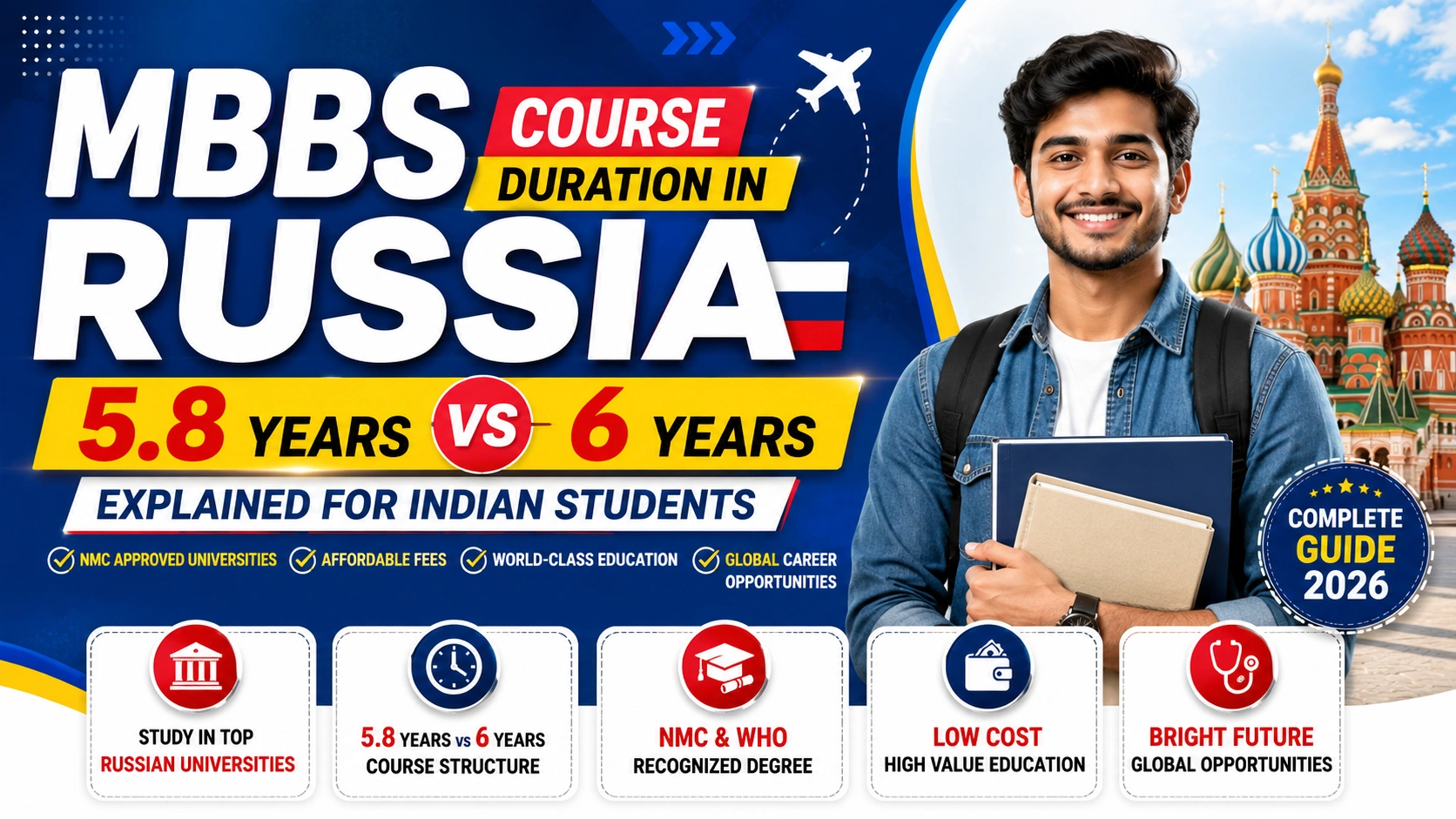
Russia has been a top study abroad destination for Indian students with an eye on affordable medical education for a long time now. Yet, one particular question remains a source of perennial confusion: Are the MBBS courses at the Russian universities 5.8 years or 6 years?
The variation in the length of the course is due to the academic calendar integration of the internship and clinical training. In Russian medical universities, the General Medicine course is written as 5 years and 10 months, which is equivalent to 5.8 years, by some. However, there are institutions that claim to provide a 6-year medical course.
In the context of the MBBS in Russia, the length of the course is obviously an essential consideration. The duration of the course, clinical practice, medium of instruction, eligibility of the universities, recognition within India, and adherence to the laws of India should all be evaluated before the application is sent.
Here, we have examined the distinctions between the lengths of the course being 5.8 years or 6 years. We also cover the costs, advantages and disadvantages, the top universities, and the career prospects that follow an MBBS degree obtained in Russia.
MBBS Course Duration in Russia
The duration of the MBBS course in Russia is 6 years. Some universities state the duration of the course as 5 years and 10 months. This is further explained as 5.8 years. The difference is usually caused by the academic calendar and how universities define total duration. Students should also consider the complete course structure, clinical training, and other requirements before applying.
Each University has its own course structure and students have to confirm the official information along with the regulations of the National Medical Commission (NMC) before confirming MBBS admission in Russia.
Why is MBBS in Russia sometimes stated as 5.8 Years?
The term 5.8 years does not signify that the duration of the course is less than a typical 6 years MBBS course. In fact, 5.8 stands for 5 years and 10 months. If we consider the academic and clinical education, it approximately equals 0.83 years and hence stated as 5.8 years.
When you are planning to study MBBS in Russia, then looking at the course structure in decimal form is not of much importance, rather you should be more concerned with the total years of education it offers.
5.8 Years vs 6 Years: What is the difference?
Most of the time, the difference is related to:
- How the academic calendar counts
- Start and end dates of the program
- Scheduling of the semesters
- Clinical rotations
- University program descriptions
- How the total duration is rounded
Before admission, students must request the official course curriculum and the academic calendar from the university.
MBBS Course Duration in Russia: 5.8 Years vs 6 Years
|
Feature |
5.8-Year Programme |
6-Year Programme |
|
Approximate duration |
5 years and 10 months |
6 academic years |
|
Common interpretation |
Same General Medicine programme described precisely |
Rounded programme duration |
|
Clinical training |
Included according to university curriculum |
Included according to university curriculum |
|
Programme structure |
May vary by university |
May vary by university |
|
Important verification |
Check official curriculum |
Check official curriculum |
|
Student consideration |
Total duration should meet applicable regulations |
Total duration should meet applicable regulations |
Students opting for MBBS in Russia for Indian students should not choose a university based on whether its program is labeled as 5.8 or 6 years. The quality of education, clinical exposure, university recognition and regulatory compliance are more important.
MBBS Course Structure in Russia
The General Medicine program in Russia integrates teaching and learning, lab work, and clinical practice.
First Phase: Basic Medical Sciences
The first years of teaching contain the following subjects:
- Anatomy
- Histology
- Physiology
- Biochemistry
- Microbiology
- Pathology
- Pharmacology
Medical Sciences provide complex preparation for learning Clinical subjects.
Second Phase: Clinical Education
The later years of teaching focus more on learning Clinical. Students study:
- Internal Medicine
- General Surgery
- Pediatrics
- Obstetrics and Gynecology
- Neurology
- Psychiatry
- Emergency Medicine
- Community Medicine
Candidates applying for MBBS admission in Russia need to check the facilities available at clinical teaching hospitals.
Eligibility for MBBS in Russia
Indian candidates applying for mbbs in russia must fulfill the following requirements:
|
Eligibility Factor |
General Requirement |
|
Academic qualification |
Class 12 or equivalent |
|
Required subjects |
Physics, Chemistry and Biology |
|
Minimum marks |
Depends on category |
|
Age |
17 years (minimum) |
|
NEET |
Applicable |
|
Passport |
Valid |
The admission procedure is easy as long as the documents are prepared well.
1. University Selection
You should review the tuition cost, length of program, teaching language, hostel availability, clinical practice and university reputation.
You should also review if the medical school is in the World Directory of Medical Schools (WDOMS) and understand that a directory listing does not mean a school fulfills the requirements of medical licensing in other countries.
2. Submission of the Application
The application dossier normally includes
- a. Mark sheets of class 10 and 12.
- b. Passport copy.
- c. NEET Score card if applicable.
- d. Passport Size Photographs.
- e. Medical Records.
- f. Other additional documents submitted by the University.
3. Admission Documents
According to their international student policy, the University will issue admission related documents post verification of the documents.
4. Student Visa
You should carry out the student visa procedure with the Russian authorities and submit the required documents.
5. Beginning of the Program
Once you finish the admission and visa procedure, you can travel to Russia and start your academic activities.
The process of MBBS-in-russia should always be based on official university documents instead of unofficial sources.
The Cost of Studying MBBS in Russia
The total cost of studying Medicine in Russia depends on the university, city, exchange rate and personal expenses.
Estimated Cost Structure
|
Expense Category |
Estimated Range |
|
Tuition Fee |
Variable |
|
Accommodation |
Variable |
|
Food and Daily |
Variable |
|
Medical Insurance |
Usually Required |
|
Visa and Docs |
Variable |
|
Travel |
Variable |
Students need to request for the written fee structure for all years before considering mbbs admission in russia.
One has to keep in mind that for Indian Students the exchange rate will have a direct bearing on the total amount.
Advantages of Studying MBBS in Russia
Moscow has a mature medical education system that offers General Medicine programs at its universities
2. Multinational Environments
Admissions at most universities encourage a multinational learning environment.
3. Clinical Learning Opportunities
Russian Universities have university teaching hospitals and clinical departments that provide clinical education.
4. Affordable Options
When compared to a few other select international countries, Russian universities have a low cost structure for medical education.
5. English medium programs
Russian universities offer English medium General Medicine programs.
If you plan to apply to any of the Russian universities, you should probably develop some conversational Russian.
Students should look at individual universities because the facilities and academic structures are distinct.
Disadvantages and Challenges
Studying medicine abroad has its own disadvantages and challenges students must consider.
Language Barrier
Though some programs may be in English, students should understand that the ability to speak Russian in this case may be helpful, and at times, even necessary, when students go for clinical practice.
Seasonal Climate Change
Students may take time to get used to living in a cold environment.
Cultural Distance
Students may be homesick and miss their families. They may have problems adjusting to a new culture.
Licensing Issues
Simply completing a foreign medical degree does not provide the right to practice medicine in India. Students should be aware of the existing laws and regulations.
Articles posted on the NMC official website should be consulted regularly for changes that may occur. Wider information on international health can be found on the World Health Organization website.
Top Universities for MBBS in Russia
There are lots of medical universities in Russia offering General Medicine. Students must compare universities based on official information, and not on ranking information, exclusively.
Some universities that attract international applicants are:
|
University |
Approx. Annual Tuition (₹) |
Hostel Fees (₹/year) |
Medium |
FMGE Passing rate |
|
₹3.4–4.2 lakh |
₹40,000 |
English |
20% - 25% |
|
|
₹3.8–4.8 lakh |
₹45,000 |
English |
25% - 30% |
|
|
₹3.0–4.0 lakh |
₹35,000 |
English |
30% - 35% |
|
|
₹2.8–3.8 lakh |
₹40,000 |
English |
25% - 30% |
|
|
₹4.0–5.0 lakh |
₹50,000 |
English |
25% - 30% |
|
|
₹5.0–6.0 lakh |
₹55,000 |
English |
20% - 25% |
|
|
₹4.2–5.3 lakh |
₹45,000 |
English |
10% - 15% |
Prior to applying, students should verify the official university websites for the current tuition fees and length of the program, and check the admission and teaching requirements.
Career Options After Finishing an MBBS Degree in Russia
After completing their MBBS degree, graduates have many options available to them based on the laws of the country where they wish to practice. These may include:
- Taking the medical licensing exam in India
- Taking up a position for postgraduate medical education
- Taking up a position for clinical research
- Taking up a position for healthcare administration
- Taking up a position for public health
- Taking up a position for medical writing
- Taking up a research or academic position
- Taking up any of the opportunities which graduate is eligible for in the country where they will fulfill the local licensing requirements.
For the Indian students it is important that they understand what the local requirements of practicing medicine in India are and then only decide to take the course. Official updates should be regularly monitored from the National Medical Commission.
How to Choose Between 5.8 Year and 6 Year MBBS Programs in Russia?
Going by just the number 5.8 or 6 will not help when deciding on a better option.
Before finalizing admission, ask the university for:
- Total days required in months and years
- Semester-wise curriculum
- Clinical training
- Internship or practical training
- Medium of instruction
- Teaching hospitals
- Cost of tuition and additional charges
- Official eligibility
You should also understand whether the program structure fulfills the requirements of your intended career.
FAQs
Is an MBBS degree in Russia 5.8 years or 6 years?
In some cases, degree programs may describe the duration of General Medicine programs as 5 years and 10 months. Other universities round off the duration to 6 years. Therefore, it is important to check the official degree curriculum.
Is 5.8 years the same as 6 years?
It depends on how a university defines its academic year. 5 years and 10 months (5.83 years) is perhaps written as 5.8 years.
Is NEET a necessary requirement for Indian students applying towards MBBS admission in Russia?
Indian students must check the revision and changes in the NMC norms and guidelines available in the official NEET portal before applying.
Which university offers the best duration for the MBBS program in Russia?
The best duration does not exist. Students must evaluate a university's clinical exposure and teaching methods along with regulatory compliance and fees. It is advisable to consider a duration of 5.8 or 6 years.
Can Indian students pursue their career in India after completing their MBBS in Russia?
Indian students must comply with the then prevailing rules and legislation of the country to acquire a license. Students must verify the applicable rules from the official sources of NMC before seeking admission.
Conclusion
Knowing the MBBS course duration in Russia: 5.8 years versus 6 years is crucial when considering universities. Most of the time, this 0.2 year disparity is based on how the academic years are calculated. A program that spans 5 years and 10 months could be described as 5.8 years at one university, while another may describe the same as 6 years.
Duration is not the only concern that you should have. You should also consider the entire curriculum, practical and clinical training, teaching hospitals, total and split fees, language training, and licensing requirements.
When considering studying MBBS in Russia, intensive research and verification from the official websites of universities, regulatory, or education authorities can help you develop a better and safer plan. Choosing authentic information over the comparison of 5.8 years and 6 years is more important.