The choice of pursuing an MBBS In Russia has gained momentum among Indian medical aspirants considering the low tuition fee, world-class universities, and good clinical exposure, along with the straightforward application process. Russian medical universities do not consider hefty donations or entrance tests. As a result, thousands of Indian students seek admission in Russian medical universities every year.
The students must comprehend the entire admission eligibility criteria, including the educational background, age limit, NEET requirement, documents, and other conditions for admission. The present article considers the admission eligibility criteria MBBS In Russia 2026 and also discusses the fees and the admission procedure along with the merits and demerits, the top universities, career prospects and gives answers to frequently asked questions.
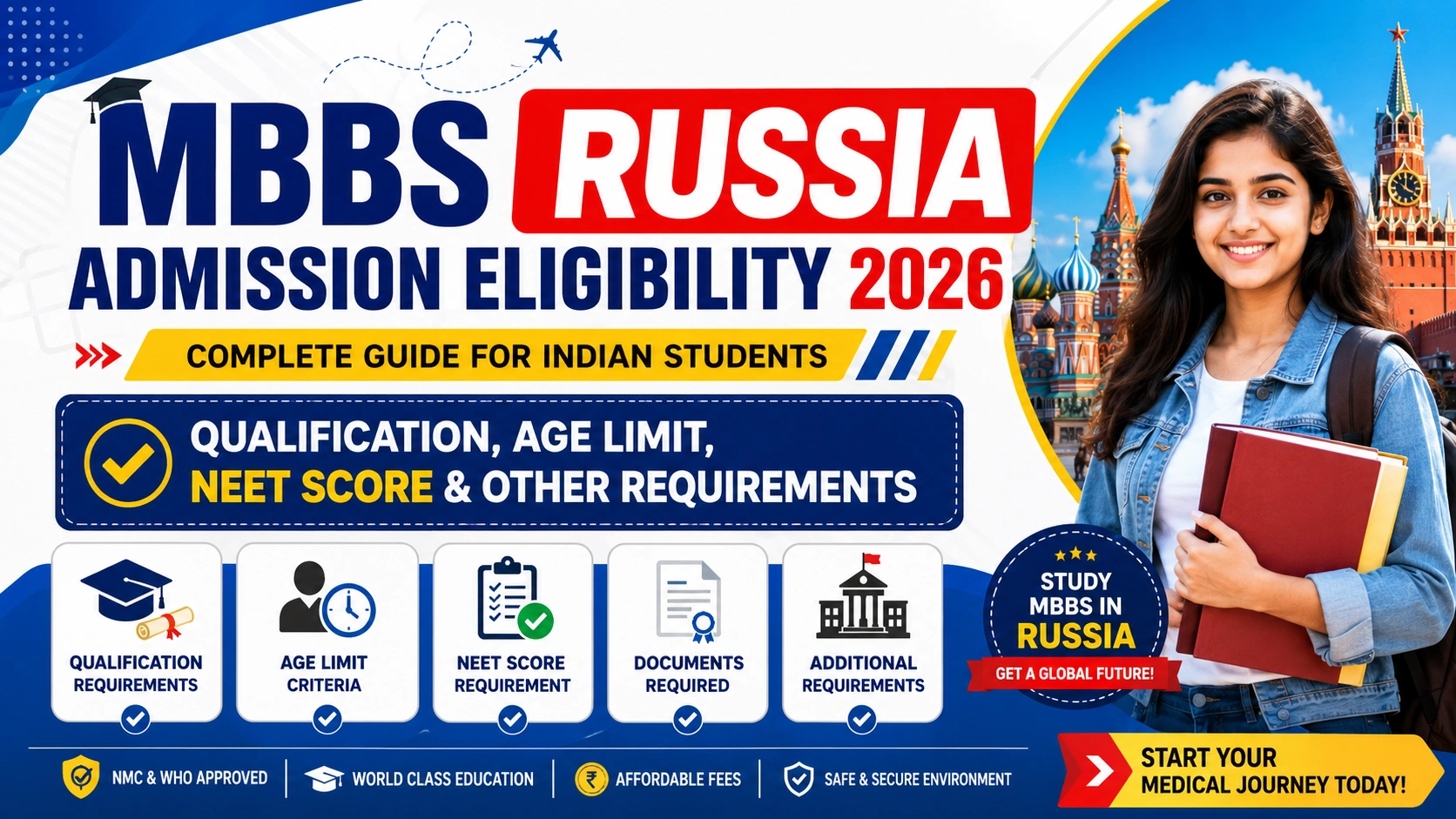
What is the eligibility for MBBS in Russia in 2026?
The general eligibility criteria for Indian students seeking admission to MBBS In Russia in 2026, are:
- Complete 10+2 with Physics, Chemistry, Biology and English
- Have a minimum of 50% in PCB (40% for the reservation category)
- Qualify NEET-UG
- Have completed 17 years of age as on 31 December of the admission year.
- Have a valid passport and the required documents for admission
MBBS Russia Admission Eligibility 2026
Why Choose mbbs in russia?
For a multitude of reasons, Russia has become an appealing medical education hub. These reasons include:
- Affordable education
- NMC accredited
- WHO listed medical schools
- Courses offered in English
- Up to date labs
- Great education and infrastructure for international students
- Great clinical exposure
The Admission Process in Russia is simple and, thus, appealing, especially to Indian students.
Eligibility Criteria for MBBS in Russia 2026
To pursue MBBS In Russia, you must meet the following criteria.
Educational Qualification
You must have completed your 12th standard with:
- Physics, Chemistry and Biology as core subjects
- English as a core subject
Minimum Marks Required
|
Category |
Minimum PCB Percentage |
|
General |
50% |
|
SC/ST/OBC |
40% |
|
PwD |
As per current regulations |
Many universities also accept students who are awaiting their final Class 12 results.
Age Limit
You must be at least 17 years old on or by 31 December 2026. Most universities will not enforce an upper age limit; however, applicants must comply with any related Indian eligibility criteria.
Is NEET Mandatory?
Yes.
As per the current guidelines, the qualifying criteria for practicing medicine in India post graduation are that Indian students must clear the NEET-UG examination.
Official Information
Documents Required
Students should keep the following documents ready:
- Class 10 Marksheet
- Class 12 Marksheet
- NEET Scorecard
- Passport
- Passport-size photographs
- Birth Certificate (if required)
- Medical Certificate
- HIV Test Report (if required)
- Invitation Letter
- Admission Letter
- Student Visa
MBBS Admission Process in Russia 2026
Students interested in mbbs admission in russia can follow these simple steps.
Step 1
Choose an NMC-recognized university.
Step 2
Fill out the university application.
Step 3
Submit academic documents.
Step 4
Receive Admission Letter.
Step 5
Obtain an Invitation Letter.
Step 6
Apply for Student Visa.
Step 7
Book your flight and begin your medical journey.
MBBS In Russia Fees 2026
One of the biggest advantages of studying medicine in Russia is affordability.
Estimated Cost Table
|
Expense |
Approximate Cost (USD/Year) |
|
Tuition Fees |
$3,000–$7,000 |
|
Hostel |
$300–$1,000 |
|
Food |
$800–$1,200 |
|
Insurance |
$150–$300 |
|
Miscellaneous |
$500–$1,000 |
Students can explore detailed information about mbbs in russia for indian students before selecting a university.
Top Medical Universities in Russia
Popular Universities
|
University |
Approx. Annual Tuition (₹) |
Hostel Fees (₹/year) |
Medium |
FMGE Passing rate |
|---|---|---|---|---|
|
₹3.4–4.2 lakh |
₹40,000 |
English |
20% - 25% |
|
|
₹3.8–4.8 lakh |
₹45,000 |
English |
25% - 30% |
|
|
₹3.0–4.0 lakh |
₹35,000 |
English |
30% - 35% |
|
|
₹2.8–3.8 lakh |
₹40,000 |
English |
25% - 30% |
|
|
₹4.0–5.0 lakh |
₹50,000 |
English |
25% - 30% |
|
|
₹5.0–6.0 lakh |
₹55,000 |
English |
20% - 25% |
|
|
₹4.2–5.3 lakh |
₹45,000 |
English |
10% - 15% |
Students looking for a reputed russian mbbs university should verify recognition before applying.
Benefits of MBBS In Russia
There are many benefits to choosing mbbs in russia 2026, some of which include:
- Affordable fees
- Globally acknowledged MBBS degree
- Modern teaching hospitals
- Well trained faculty
- English as the medium of teaching
- No donation or capitation fee
- International exposure
- Modern infrastructure
- Access to advanced research
- Good FMGE/NExT test prep support in many universities
Students who study mbbs in russia generally get exposure to a multicultural environment along with good clinical training.
Disadvantages of MBBS In Russia
Although there are many benefits to pursuing this degree, there are some challenges which should be kept in mind.
- Severe climate
- Need to learn basic Russian for hospital work
- Adaptability to different culture
- Dietary changes
- Self-discipline
- Licensing exams after degree
Despite all these factors, there are many students who approach mbbs abroad in russia and have a successful medical career.
Recognition of Russian Medical Universities
Before applying to any university, check if these universities are recognized by:
- National Medical Commission (NMC)
- World Directory of Medical Schools (WDOMS)
- World Health Organization (WHO)
Recognition is very important while considering future licensing and opportunities for post-graduation.
Career Scope After MBBS From Russia
Students who earn their mbbs from russia have plenty of options to choose from.
In India
- Can work in government hospitals
- Can work in private hospitals
- Can work in clinical practice
- Can work in medical research
Abroad
- USMLE (USA)
- PLAB/UKMLA (UK, as applicable)
- Licensing exams of other countries
- Postgraduation
- Hospital Management
- Public Health
Students who finish their mbbs course in russia also have the option of pursuing their postgraduation in specializations from Russia and other countries.
There are so many reasons why Indians choose to study MBBS in Russia.
Such reasons are,
- Safe campuses
- Low living costs
- Curriculum accepted worldwide
- Modern facilities in hospitals
- Professors with high levels of experience
- Easy contact with international students
- Better student teacher ratios.
Some students consider mbbs russia, russia for mbbs, mbbs at russia, russia mbbs, mbbs abroad russia, mbbs for russia, and study mbbs in russia 2026 when looking for universities and admission options.
Questions and Answers
Is NEET mandatory to pursue MBBS in Russia?
Yes, the passing of NEET is mandatory in order for students to be eligible to register for medical practice in India after completing their MBBS degree abroad.
What is the eligibility percentage?
The minimum percentage required is 50% in PCB, with a 40% for the specified reserved categories.
What is the minimum age requirement?
The minimum age of the applicant is 17 years old by 31 December of the application year.
Is IELTS mandatory?
No, most Russian universities do not require IELTS or TOEFL to pursue MBBS.
What is the length of the MBBS course in Russia?
The length of the MBBS course in Russia is typically 6 years.
Is a medical degree from Russia recognized in other countries?
This depends from university to university, however, many are recognized by NMC, WHO, and are listed in WDOMS.
Conclusion
Becoming eligible for admission to MBBS in Russia in 2026 starts with meeting the requirements. It is vital to ensure you possess the required education, are the appropriate age, qualify the NEET, and are prepared to submit the necessary documentation. With budget-friendly tuition and universities with international recognition, quality education, and great career opportunities, Russia remains the optimal choice for Indian medical students. You must check university recognition with the NMC, WHO, WDOMS, and the related university to make the best final admission choice.