
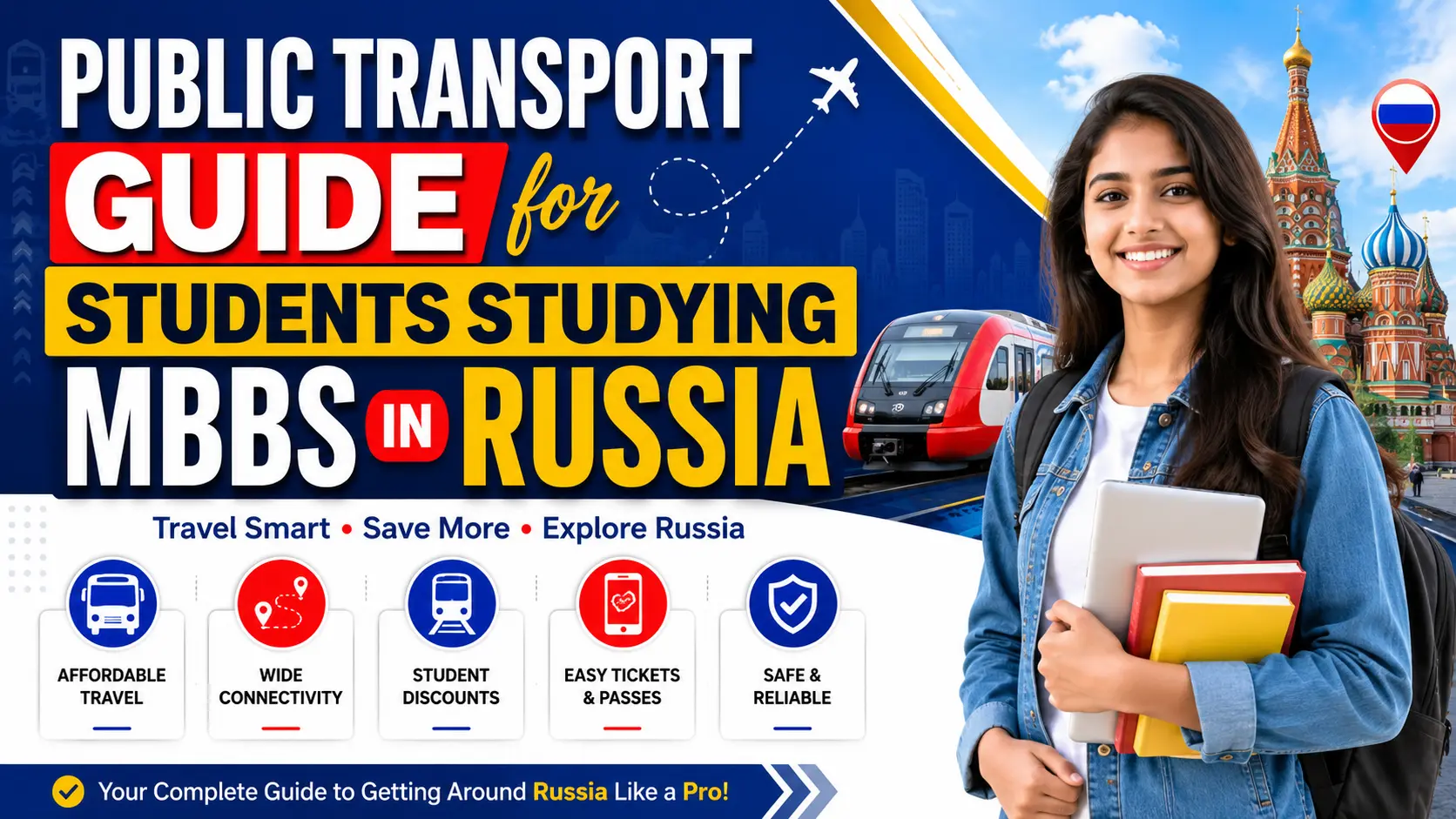
Every year, thousands of Indian international students regard pursuing an MBBS in Russia degree in Russia as a critical life choice. Beyond Russia’s core study-abroad strengths, including its world-class high-quality medical education, low tuition fees, and globally accredited medical universities, the country’s fully developed public transport system is another major tangible benefit these students can directly access.
Mastering the usage rules of public transport helps students cut expenses, travel safely, and integrate more smoothly into daily life in Russia. This guide covers all core travel scenarios, including commuting between dormitories and campus, shopping trips, sightseeing tours, and attending clinical training.
The multi-modal transport network that caters to all types of needs includes subways, buses, trams, trolleybuses, and suburban trains.
In addition to instructions for using public transport, this guide also explains in detail all core concerns of international students, such as admission requirements, application eligibility, study-abroad costs, pros and cons of studying in Russia, Russia’s top medical universities, career development opportunities, and frequently asked questions.
Public Transport Benefits for Students
The five types of public transport commonly used by international students all share the core strengths of being affordable, reliable, safe, and connected through an integrated road and rail network. They cover all major cities that host large groups of international students, including Moscow, Saint Petersburg, Kazan, and Novosibirsk. Most Russian medical universities issue student identification cards to enrolled students, who can use these cards to purchase discounted transport passes to lower their monthly living costs.
Public transport offers six core benefits for international students pursuing an MBBS in Russia for Indian Students.
Moscow Metro
First, the Moscow Metro is one of the most efficient underground railway systems in the world, with fast service, low fares, clean stations, and English signage at key stops.
Buses
Buses operate in most cities across Russia, featuring low fares, extensive route coverage, support for digital payment, and frequent service.
Trams
Trams are highly cost-effective, suited for short local trips and commutes within residential areas.
Trolleybuses
Trolleybuses are eco-friendly, affordable, and comfortable.
Suburban Trains
Suburban trains meet the long-distance commuting needs of students who live outside central city areas.
Monthly Transport Costs
If you are an Indian student planning to pursue an MBBS degree in Russia, this text outlines all core practical information for the full process of studying abroad.
All costs are listed in Indian Rupees (₹), so you do not need to convert exchange rates on your own.
First, we start with the essential costs of daily commuting:
- We have compiled categorized average monthly transportation expenses.
- Clarified the application benefits and optimal application window for student transit cards.
Eligibility Criteria
Next, we cover the eligibility thresholds for Study MBBS in Russia applications:
- Applicants in the general and reserved categories must meet the corresponding PCB score requirements.
- Be at least 17 years old.
- All Indian applicants are mandatorily required to pass the NEET exam.
Admission Process
The admission process is divided into 6 clear steps, completed in the following order:
- Select a university accredited by WDOMS (World Directory of Medical Schools) and NMC (National Medical Commission of India).
- Submit academic documents.
- Receive an admission letter.
- Apply for a student visa.
- Pay the first tuition installment.
- Travel to Russia to complete university enrollment.
Study Costs
We have also compiled the total cost range for all categories of studying abroad.
Top Medical Universities in Russia
|
University |
Approx. Annual Tuition (₹) |
Hostel Fees (₹/year) |
Medium |
FMGE Passing rate |
|---|---|---|---|---|
|
₹3.4–4.2 lakh |
₹40,000 |
English |
20% - 25% |
|
|
₹3.8–4.8 lakh |
₹45,000 |
English |
25% - 30% |
|
|
₹3.0–4.0 lakh |
₹35,000 |
English |
30% - 35% |
|
|
₹2.8–3.8 lakh |
₹40,000 |
English |
25% - 30% |
|
|
₹4.0–5.0 lakh |
₹50,000 |
English |
25% - 30% |
|
|
₹5.0–6.0 lakh |
₹55,000 |
English |
20% - 25% |
|
|
₹4.2–5.3 lakh |
₹45,000 |
English |
10% - 15% |
Benefits of Studying MBBS in Russia
There are 5 core advantages of pursuing an MBBS Admission in Russia:
- Far higher cost-effectiveness than similar study abroad programs in Europe.
- Globally recognized university accreditation.
- Full English-medium instruction.
- Sufficient clinical practice resources.
- Advanced university infrastructure.
We also offer supporting funding solutions via education loans to eliminate any financial concerns during your fund preparation process.
Challenges of Studying MBBS in Russia
If you are an Indian student planning to pursue a Bachelor of Medicine and Bachelor of Surgery (MBBS), the undergraduate medical degree, in Russia, you must clarify one key point before evaluating this choice:
While studying for an MBBS in Russia offers many benefits, it also presents a number of potential challenges that require advance preparation.
These core challenges, which must be integrated into your decision-making process early, include:
- Russia’s extreme harsh winters.
- Russian language barriers outside of campus.
- Difficulties with cultural adaptation.
- A relatively long program duration.
- The mandatory requirement to pass the Foreign Medical Graduate Examination (FMGE) or the National Exit Test (NExT) to practice medicine after returning to India.
MBBS Course Duration
First, the core program structure is clearly defined: The MBBS in Russia is a 6-year course that includes full clinical training, covering theoretical coursework, laboratory practice, hospital rotations and internships. This duration exactly matches the core program duration-related keywords that Indian students commonly search for.
Career Scope After MBBS in Russia
The full range of career pathways after graduation is clear:
- After passing the NExT or FMGE, you can return to India to practice medicine.
- You may also pursue a master’s degree abroad.
- I work at a research institution.
- Join the public healthcare system.
- Take a position at a private hospital to build expertise in a specialized field.
- Stay in Russia to pursue postgraduate studies.
Why Choose Russia for Medical Studies?
The core advantages of studying medicine in Russia include:
- Internationally recognized degrees.
- Low tuition fees.
- Experienced faculty.
- Advanced research facilities.
- A diverse student body.
- Well-developed public transport.
All public Russian medical schools open to Indian students boast high-quality infrastructure, hold full WHO certification, are listed in the World Directory of Medical Schools (WDOMS), and meet the requirements of India’s National Medical Commission (NMC).
Choosing the Right Medical University
When selecting a school, you can filter options based on three core dimensions:
- Budget.
- Geographical location.
- Academic goals.
Frequently Asked Questions
We have compiled and answered the most frequent questions raised by Indian students, covering:
- Public transport safety.
- Eligibility for transport discounts.
- The ability to travel without Russian language proficiency.
- The program’s cost-effectiveness.
- The authority of institutional qualifications.
Conclusion
Monthly transport expenses range from approximately 1500 to 3000 Indian rupees. Overall, pursuing an Russian MBBS is a high-value study abroad option that aligns with the needs of most Indian medical students. International students pursuing medical studies in Russia may travel using the country’s modern local subways, buses, or trams, and are also eligible to use discounted student transit passes. Familiarizing themselves with local transportation in advance can help these students adapt quickly to their new life and manage their expenses properly. In addition to its high-quality medical education, Russia also provides a friendly study environment for international students.