
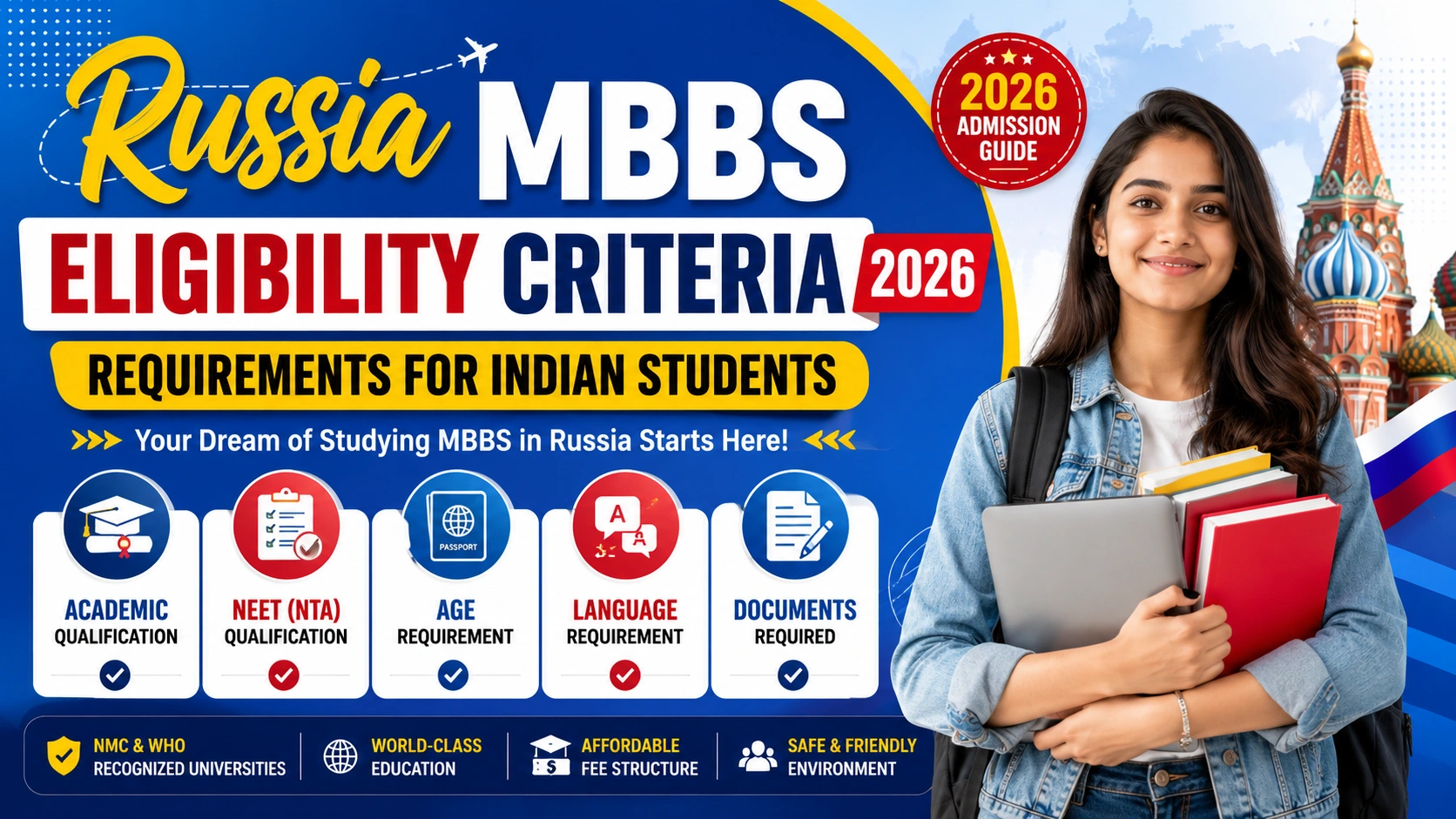
Selecting a country for medical education is crucial for Indian students after completing Class 12. Many Indian students prefer to study MBBS in Russia due to several factors such as a complete system of medical universities, affordable costs, relatively easy admission process, and various options with an English medium system. Though several factors are important while choosing a medical university, students should also check for eligibility criteria as well before applying to any medical university. Indian students should meet the academic requirements as per the rules of Indian medical education, clear the NEET examination, and select a university of their choice. There can be several variations among medical universities in terms of the course structure, medium of instruction, costs, clinical exposure, and even the regulations for post-graduate licensing.
The National Medical Commission (NMC) of India is responsible for all the regulations pertaining to Indian students studying medicine abroad, including the latest Foreign Medical Graduate Licentiate Regulations 2021. This guide discusses Russia MBBS eligibility criteria 2026 including fees, leading universities, advantages, disadvantages, and career opportunities.
Russell MBBS Eligibility Criteria 2026
The following are some of the common Russia MBBS eligibility criteria for Indian students:
- Completion of Class 12 or equivalent with PCB.
- Minimum PCB percentage as per the requirements of Indian medical aspirants.
- Appearance in NEET-UG, where it is mandatory as per the regulations of India.
- Age as per the requirements for medical admission.
- Valid passport and academic documents.
- Satisfying the admission and entrance requirements of the individual Russian medical university.
1. Academic Qualification
In general, Indian applicants must have passed Class 12 or its equivalent to be eligible for medicine programs. Physics, Chemistry, and Biology/Biotechnology are the main subjects.
Students must have their Class 10, Class 12 certificates, and all other relevant supporting documents ready. Different universities may have other requirements.
In light of the current situation, the route of study mbbs in russia is not advisable until both the university's admission conditions and India's regulations are confirmed.
2. NEET Qualification
NEET-UG is a necessary qualification for Indian students who intend to study medicine abroad and want to practice medicine in India. Information on this can be found on the website of the NEET exam.
A student should not assume that studying medicine abroad will fulfill the requirements for practicing medicine in India.
3. Age Requirement
The applicants must be of the required age to be eligible for medical admission. Since the requirements may change, applicants should cross-check the latest NEET notification published on the university's website and not rely on the old counseling information.
4. Passport and Documentation
A valid passport is necessary to process your admission and visa. Some universities may require additional translations, legalizations, attestations, or verification of documents.
Typical documents include:
- Passport
- Class 10 certificate
- Class 12 certificate and marksheet
- NEET scorecard
- Passport size photographs
- Medical Fitness documents
- University application forms
- Birth certificate (if needed)
- Other university requested documents
For example, Sechenov University states international applicants may require a passport, legalized education documents, and Russian translations, and certain medical documents.
Russia MBBS Eligibility at a Glance
|
Requirement |
What Indian Students May Check |
|
Education |
Class 12/equivalent |
|
Core subjects |
Physics, Chemistry and Biology/Biotechnology |
|
NEET |
Satisfy India-specific requirements |
|
Age |
Follow the current applicable requirements |
|
Passport |
Valid passport needed |
|
Medical documents |
As specified by the university |
|
Entrance test |
May depend on the university |
|
Language |
English and/or Russian, depending on the program |
|
Course duration |
Generally, 6 years for General Medicine |
|
Recognition |
Be cautious while checking the university and the program |
Admission Process for MBBS in Russia for 2026
Step 1: Verify the Eligibility
Ensure that your Class 12 subjects and marks, NEET scores and age fulfill the eligibility criteria.
Step 2: Select Universities
Consider the tuition fees, duration of the course, language of instruction, clinical facilities, university accommodation, location, and admission requirements.
Students should first go to study mbbs in russia to initiate their research, and then go to each university's website to check important claims.
Step 3: Verify the Medical School
Search for the university in the World Directory of Medical Schools (WDOMS) and review the current program information. WDOMS itself states that a listing does not imply recognition, accreditation or endorsement.
This is a significant element to consider when selecting MBBS In Russia.
Step 4: Submit the Application
Fill out the university application and send the required academic documents.
Some universities have their own admission exams. For example, Sechenov University's 2026/27 General Medicine program has internal admission exams.
Step 5: Admission and Visa Documentation
After admission, students complete the contract, payment and immigration requirements to travel to Russia and commence their program.
Step 6: Travel to Russia and Study
After the required visa is obtained and university requirements are completed, students travel to Russia to begin their medical studies.
MBBS In Russia Fees 2026
There is a big difference between the tuition fees of universities and cities. Therefore, prospective students should not take one "Russia MBBS fee" as definitive.
To demonstrate official university fees data for the current year, Sechenov University indicates that the General Medicine tuition for the 2026/2027 academic year is 1,300,000 Russian rubles.
Tuition fees are only one of many costs that students need to plan for, including accommodation, food, insurance, transport, visa fees, and costs associated with preparation and studying.
Best Medical Universities In Russia For MBBS
Along with high rankings, students must also consider the curriculum, clinical practice, language, and support services offered to international students. Assess the regulatory framework of each program to determine if it meets your requirements.
|
University |
Approx. Annual Tuition (₹) |
Hostel Fees (₹/year) |
Medium |
FMGE Passing rate |
|---|---|---|---|---|
|
₹3.4–4.2 lakh |
₹40,000 |
English |
20% - 25% |
|
|
₹3.8–4.8 lakh |
₹45,000 |
English |
25% - 30% |
|
|
₹3.0–4.0 lakh |
₹35,000 |
English |
30% - 35% |
|
|
₹2.8–3.8 lakh |
₹40,000 |
English |
25% - 30% |
|
|
₹4.0–5.0 lakh |
₹50,000 |
English |
25% - 30% |
|
|
₹5.0–6.0 lakh |
₹55,000 |
English |
20% - 25% |
|
|
₹4.2–5.3 lakh |
₹45,000 |
English |
10% - 15% |
Why Do Indian Students Choose Russia for Medicine?
There are many benefits associated with studying MBBS in Russia.
Benefits
- Many universities offer accredited MBBS programs in Russia.
- Some universities offer MBBS programs in Russia in English.
- Most universities offer MBBS programs in Russia for 6-years.
- Learning in a new, diverse country will create new social groups for you.
- Some universities offer the students immense infrastructure for clinical and research activities.
- The cost of Russian Universities is much lower compared to other private medical universities.
- Students gain international education.
Students are advised to understand in detail each university separately and not assume all the medical universities are the same.
Disadvantages of MBBS In Russia
There are many challenges associated with studying medicine abroad.
Language Barrier
Even if the classroom instructions are provided in English, students may need to communicate with Russian healthcare workers and patients during clinical training. Thus basic Russian may come handy.
Weather and Cultural Adjustment
Russia has a humongous change in climate when compared to India. The cold climate and extreme winters can be an even bigger adjustment to Indians.
Distance From Home
Studying in Russia may seem to be the best choice but the distance may at times matter. Travelling back home from Russia may become even more challenging during emergencies or when the students need a break from studies.
Regulatory Requirements
As much as clearing degree exams of a university outside India does not provide the right to practice medicine in India, Indian students are bound to comply with the licensing and registrations norms in India.
In case of choice of Universities, one can refer to the Foreign Medical Graduate regulations of NMC.
How to Choose the Right University
Students should make a practical checklist when assessing the options for an mbbs degree in russia:
- Verify the university is active.
- Check the medical programme in WDOMS.
- Choose the teaching language.
- Review the curriculum.
- Inquire about clinical training.
- Know the latest tuition costs and hostel fees.
- Know what services the university has for international students.
- Confirm the university follows the NMC guidelines.
- Avoid selecting a university because a middleman said it would be affordable.
- Confirm the University's admissions personnel send the admissions documents.
The WHO (World Health Organization) and the WDOM (World Directory of Medical Schools) also have relevant resources.
Career Scope After MBBS In Russia
Russians have multiple career paths, pursuant to country specific laws, after completing their medical studies.
Graduates who aspire to practice in India must follow the NMC protocols. Students are also required to follow the NMC changes that happen during the course of their studies, as the nature of NMC regulations and examination requirements can change.
Other options are:
- Practice medicine locally, after meeting the license requirements.
- Postgraduate medical education
- Pursue a residency
- Engage in medical research
- Pursue public health
- Healthcare administration
- Pursue a career in academia
- Pursue medical and healthcare related opportunities internationally
The WHO health workforce resources provide additional information about medical education and the healthcare workforce.
Before paying the Admission Fees, students and parents should obtain the following confirmations from the University:
- Current Tuition Fee
- Hostel Charges
- Medium of Instruction
- Duration of the Program
- Arrangements for Clinical Training
- Structure of Internship
- Admission Requirements
- Refund Policy
- Support for Applying for Visa
- Insurance Required
- Recognition and Accreditation
- Current Requirements applicable to Indian Graduates
Confirmations/requirements made verbally by education consultants should not be the only basis for admissions in any university.
FAQs About Russia MBBS Eligibility 2026
Is NEET Compulsory For Studying MBBS In Russia?
Indian students, applying for foreign medical admissions, will be required to clear the NEET exam, in order to retain their eligibility to practice medicine in India upon their return. The latest notifications of the NTA and NMC will help understand this requirement in detail.
Can Students Apply For MBBS In Russia After 12th?
Eligible Indian students who satisfy the minimum qualification, NEET, age and university-specific requirements can apply to medical universities in Russia.
Is Russian Medical Admission For Six Years?
Most Russian General Medicine programs are of six years duration. As an example, the General Medicine program at Sechenov University is of six years of full time study.
Does Russia have English- medium MBBS?
Russian universities offer multiple routes for students to study medicine. Some Russian universities offer English-medium General Medicine programs, while some may offer Russian-medium or mixed-language programs. You should confirm the language of instruction before you apply.
Is Indian registration guaranteed by WDOMS listing?
No. WDOMS states that listing should not be interpreted as recognition, accreditation or endorsement. Thus, Indian students should cross check the NMC instructions.
What do I need to apply for MBBS in Russia?
Generally speaking, applicants submit a passport, Class 10 and Class 12 certificates, mark sheets, NEET documents and medical records. Universities can have their own additional requirements which may consist of other documents, translations and legalizations.
Is studying MBBS in Russia worth it for Indians?
Considering the total costs involved, the Russian education system may be a good choice for Indian students who select a University carefully and plan to satisfy the requirements of getting a license to practice medicine in India after graduation.
Where do I get all the information I need for mbbs admission in russia?
To further assist you, you can check each University's website to view their eligibility criteria, fees and the process for admission. However, you must confirm any information you find with the University, NMC, NTA and other relevant government agencies.
Conclusion
Applying for a seat in a top university in Russia is easy, but students should focus on the finer details. Applying after senior secondary, fulfilling the NEET requirements, meeting the age criteria, preparing all required documents and fulfilling the requirements of a university are vital.
Studying MBBS in Russia for Indian students requires more than just trusting an ad or low fee claim. Indian students should examine all the elements of a medical university including curriculum, clinical exposure, cost, and the language of instruction.
International medical education can be more manageable after well informed decisions by the students. However, as admission and medical licensing procedures can change at any time, students should always cross-check the latest and most updated information from NMC and NTA and the university they have decided to join.