Getting your MBBS in Russia is a thrilling opportunity. However, packing is extremely taxing. Most Indian students tend to pack without thought or forget what is easily accessible in Russia. The excess baggage is costly and makes traveling and settling into your new home much harder.
Packing all of your belongings is not the answer. Packing strategically can save you money and, most importantly, decrease the stress of starting your medical education.
Along with all the information about eligibility, the admission process, the fees, the best universities, and the career opportunities and FAQs, there is a guide that includes what you should not pack for your MBBS in Russia, the reason each item is unnecessary, and what you should pack.
Featured Snippet
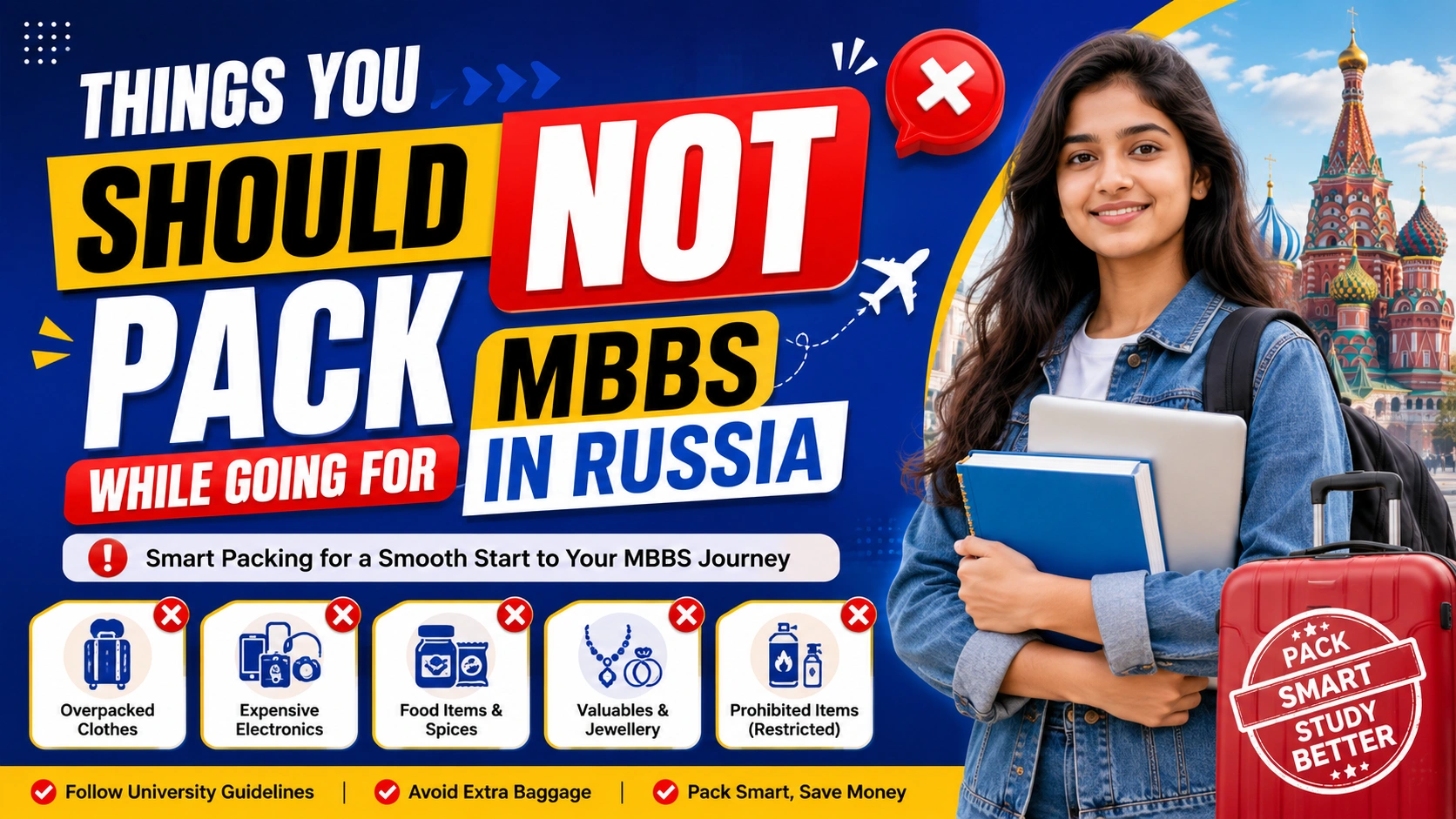
Things You Should NOT Pack While Going for MBBS in Russia
Avoid carrying the following items while traveling to Russia for MBBS:
- Heavy winter jackets (buy in Russia)
- Excess food items
- Large quantities of medicine without a prescription
- Electrical appliances that don't match Russian voltage
- Too many clothes
- Heavy books
- Expensive jewelry
- Large Cash Amounts
- Illegal or restricted items
- Too many utensils
Packing light helps your journey by avoiding excess baggage costs.
Why Smart Packing Matters for MBBS admission in Russia
Most students think that they will not be able to find products that they are familiar with in Russia. However, because of the pharmacies, malls, and markets in the major cities of Russia, you will be able to find everything you need.
Advantages of smart packing when preparing for MBBS admission in Russia include:
- Lower baggage fees.
- Easier transfers at the airport.
- More room in your hostel.
- Less stress when traveling.
- More organized luggage.
Things You Should NOT Pack
1. Bulky Winter Jackets
One mistake students commonly make is packing heavy winter jackets from India.
Why you should leave them behind
- Winter jackets in India are not built for Russian winters.
- Jackets bought in Russia are built to be more insulated.
- Bulky jackets take up most of your luggage space.
- Pack one smaller winter jacket for your arrival.
2. Excess Clothing
Students often think they need clothing for every occasion.
Instead, pack clothing that consists of:
- Everyday clothing
- One pair of formal clothing
- Basic winter clothing
- Athletic clothing
Everything else can be bought.
Students going to MBBS in Russia 2026 should know that the clothing in Russian shopping malls is inexpensive.
3. Large Amounts of Instant Food
Packing your suitcase with food is not a good idea, even if Indian snacks are your comfort food.
Do not pack:
- A lot of Maggi
- Rice
- Flour
- Cooking oil
- Big bags of spices
Indian grocery stores can be found in Russian cities.
4. Bulky Medical Books
Medical books are also bulky and expensive to transport.
Instead, buy your books in Russia, use the libraries at your university, and rely on digital books.
Students going to Russia for MBBS also prefer digital learning.
5. Too Many Shoes
Pack a
- Pair of sporty shoes
- Pair of formal shoes
- Some slippers
And nothing else.
6. Valuable Jewelry
Packing gold, diamond, or luxury items should be avoided.
7. Electronics
Russia has different electrical standards.
Avoid bringing the following:
- Electric kettles
- Rice cookers
- Hair dryers
- Induction cookers
Buy matching appliances when you get there.
8. Excess Medicines
Bring only what is prescribed.
Always travel with:
- The doctor’s prescription
- The original packaging
- Medical reports
Pharmacies are available in Russia.
9. Too Much Cash
Don’t bring a lot of cash.
Instead:
- Bring a small amount of Russian Rubles
- International debit cards
- Preloaded foreign exchange cards
10. Unnecessary Kitchen Utensils
Hostels have a shared kitchen.
Avoid bringing:
- Pressure cookers
- A lot of kitchen utensils
- Large cooking pots and pans
Buying these later is a good idea.
Students going to Russia for their MBBS studies usually find a nearby affordable option for kitchen items.
Things to Bring Instead
|
Essential item |
Why it is important |
|
Passport |
Must have for international travel and identity verification. |
|
Admission letter |
Proof required by authorities and university to allow entry and complete registration. |
|
Visa |
Official permission to stay/study in Russia; checked at immigration. |
|
Academic documents |
Transcripts, mark sheets, certificates for university verification and enrollment. |
|
Prescription medicines |
Ensure continuity of treatment and avoid health risks; carry prescriptions. |
|
Laptop |
Needed for online classes, assignments, study resources, and communication. |
|
Universal adapter |
Allows use of electronics with different plug types and voltages. |
|
Warm innerwear |
Helpful on first arrival before buying local winter clothing. |
Common Packing Mistakes
|
Common packing mistake |
Better alternative |
|
Heavy jackets |
Buy in Russia |
|
8–10 pairs of shoes |
2–3 pairs |
|
Heavy books |
E-books / digital copies |
|
Too much food |
Buy locally |
|
Too much cash |
Forex card / international debit card |
|
Packing appliances (non-compatible) |
Buy compatible ones locally |
Eligibility for Study MBBS in Russia
The following requirements are needed to study MBBS in a Russian university:
Academic Qualification
- 10+2 with the subjects Physics, Chemistry, Biology
- Minimum 50% marks (General category)
- Mark relaxation for the reserved category as per applicable rules
NEET Qualification
NEET must be passed by Indian students to practice medicine in India after MBBS studies from abroad.
Age
- Minimum 17 years
For the sake of their own verification, students are encouraged to look up the universities through the NMC and the WDOMS.
MBBS Admission Process
The following steps are to be taken by students wishing to pursue mbbs abroad in russia:
Step 1
Select an NMC-recognized University.
Step 2
Send the following documents:
- Passport
- 10th marksheet
- 12th marksheet
- NEET scorecard
Step 3
Receive admission letter.
Step 4
Apply for a student visa.
Step 5
Book flight tickets.
Step 6
Travel to Russia.
MBBS In Russia Fees
Students looking up MBBS in Russia usually check tuition and living expenses to compare costs.
|
Expense category |
Range (INR) |
|
Tuition |
₹2,50,000 – ₹6,00,000 per year |
|
Hostel |
₹40,000 – ₹90,000 per year |
|
Food |
₹96,000 – ₹1,80,000 per year |
|
Insurance |
₹10,000 – ₹20,000 per year |
|
Miscellaneous |
₹30,000 – ₹60,000 per year |
Check MBBS in Russia fees 2026 for Indian students for a close estimate before budgeting.
Benefits of Studying MBBS In Russia
Study mbbs in russia has many benefits such as:
- Low tuition fees
- Degrees recognition worldwide
- Study in English
- Modern labs
- More than one exposure to clinics
- International students
- Faculty with experience
- No donation in most universities
For confirmation, students can check the WHO and WDOMS listings.
Disadvantages
Pursuing mbbs in Russia has its fair share of challenges like other destinations.
- Cold winters
- Training in the local language in hospitals
- Cultural differences
- Homesickness
- Long distance from india
Most students adjust comfortably to the weather in the first few months.
Top Universities
|
University |
Approx. Annual Tuition (₹) |
Hostel Fees (₹/year) |
Medium |
Passing rate |
|---|---|---|---|---|
|
₹3.4–4.2 lakh |
₹40,000 |
English |
20% - 25% |
|
|
₹3.8–4.8 lakh |
₹45,000 |
English |
25% - 30% |
|
|
₹3.0–4.0 lakh |
₹35,000 |
English |
30% - 35% |
|
|
₹2.8–3.8 lakh |
₹40,000 |
English |
25% - 30% |
|
|
₹4.0–5.0 lakh |
₹50,000 |
English |
25% - 30% |
|
|
₹5.0–6.0 lakh |
₹55,000 |
English |
20% - 25% |
|
|
₹4.2–5.3 lakh |
₹45,000 |
English |
10% - 15% |
Remember to check for recognition on the official NMC and WDOMS sites before applying to any of these schools.
Career Scope After MBBS
There are many opportunities after completing MBBS in Russia. Graduates can:
- Take licensing examinations in India
- Continue their education
- Work in other countries
- Work in hospitals
- Engage in medical research
- Work in community health
- Teach
- Work in the medical sciences
Packing Tips for MBBS in Russia Students
2026 MBBS in Russia students should:
- Keep luggage within weight limits
- Keep important documents in carry-on bags
- Label All suitcases
- Digitally scan all documents
- Keep contacts
- Keep medicines in a separate bag
- Pack nothing that is not allowed
Why does all of this packing matter?
Those doing MBBS in Russia for Indian students focus only on getting admission. This is not a good idea. When the packing is done well, money is saved and students do not end up with luggage issues at the airport. Students can then settle into the new location.
Should Students Bring Winter Clothes?
No. It is better to buy winter clothes in Russia. They are designed for the climate there.
What about Indian Food?
Russsa Indian Grocery Stores carry most common Indian items so students should only bring limited Indian foods.
Should I carry medical textbooks?
No. Universities have libraries, and most students rely on online resources.
Is NEET compulsory for MBBS in Russia?
Yes. Indian students must pass NEET to be eligible to practice medicine in India after studying MBBS in Russia.
Can I carry electronic appliances?
You may want to avoid large appliances. Electrical standards are different so it is better to buy appliances that are compatible once you arrive.
Is MBBS in Russia affordable?
Yes. Russia has lower tuition and cost of living than many other countries, and their medical education is recognized internationally.
Conclusion
Packing wisely is just as important as choosing the right medical university. Unnecessary items cause excess baggage fees, and increase difficulty for you and those around you. Instead of heavy bulky clothes, books, appliances, and food, carry important documents, clothes and shoes, personal medication and health supplies, and some needed study supplies. A packing strategy also shows students that your start to the MBBS in Russia journey is confident and comfortable. Combine this with selecting an NMC approved university, and following official admission processes to check the university's recognition from trusted sources NMC, WDOMS, WHO and the NEET portal, and you will be safe and well prepared and your academic journey in Russia will be successful.